UTM: an uncertainty-guided thermal and mmWave detector, from a 2023 arXiv paper
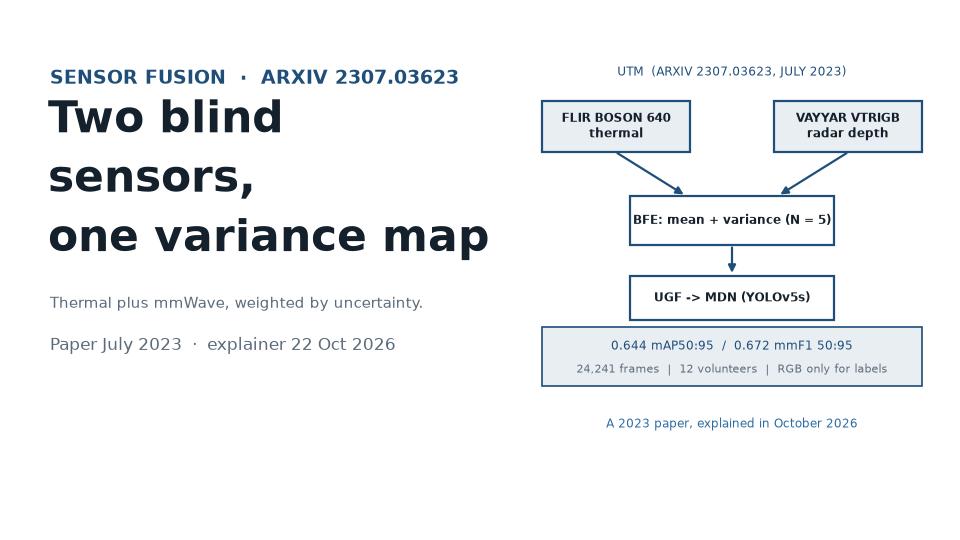
An RGB camera needs visible light. In a smoke-filled plant room or an unlit corridor, the image itself stops carrying reliable information, and no amount of downstream detection tuning puts it back. A Chinese-language explainer published on 22 October 2026 uses that problem to introduce UTM, a human-detection system that combines a thermal camera with a millimetre-wave radar and lets the model estimate how uncertain its own features are.
The first thing to fix is the date. The paper behind the explainer is arXiv:2307.03623, submitted on 7 July 2023, more than three years before the article about it. Its authors are Kaiwen Cai, Qiyue Xia, Peize Li, John Stankovic and Chris Xiaoxuan Lu, from the University of Liverpool, the University of Edinburgh and the University of Virginia. The arXiv comments field says the work was to appear at the 2023 International Conference on Embedded Wireless Systems and Networks. Nothing in the record supports reading it as a 2026 result.
Why two sensors, and why alignment comes first
Thermal and mmWave sensing both work without visible light, but they fail differently. A thermal image loses contrast when a person and the background sit at similar temperatures, or when a hot object in the scene flattens the display. A radar point cloud is robust to darkness and dust but suffers multipath reflections in corridors and rooms, where a single return bounces off walls and furniture and stretches or duplicates a person.
The paper's first step is geometric, not learned. Radar points are projected into the thermal camera's image plane using the camera intrinsics and the radar-to-camera extrinsics, producing a depth image with the same field of view and dimensions as the thermal frame. Only after that alignment can a warm region and a cluster of radar returns be treated as the same subject.
Three modules
The authors call the framework UTM, short for an uncertainty-guided thermal and mmWave radar fusion framework, and split it into three modules.
| Module | Name | Function |
|---|---|---|
| BFE | Bayesian Feature Extractor | Extract features from the thermal frame and the radar depth image in parallel, and produce a variance map alongside the mean features |
| UGF | Uncertainty-Guided Feature Fusion | Use that variance to weight the fusion so that uncertain regions are not simply ignored |
| MDN | Multiscale Detection Net | Predict person boxes at 1/8, 1/16 and 1/32 scales to cover near and far targets |
The Bayesian part is an approximation. Dropout is kept active in both training and inference, but only in the last two convolutional blocks of each feature extractor, because enabling it in every convolutional layer reduced representational capacity. The implementation sets the dropout rate to 0.2 and the number of forward passes to 5. The mean of those passes is treated as the feature, and the variance as the model's uncertainty about it. The fusion module then uses the variance map to give weight to regions where the model is least sure, such as overlapping people, low-contrast thermal areas and radar returns polluted by multipath noise.
The detection backbone uses the convolution blocks of YOLOv5s, chosen for a small footprint and established object-detection performance. The paper also reports a dedicated ablation on where dropout is placed and on the IoU threshold used for non-maximum suppression.
The hardware behind the dataset
Because no public dataset paired thermal images with mmWave radar for human detection at the time, the team built its own rig on a 3D-printed carrier board.
| Device | Role | Quoted characteristics |
|---|---|---|
| Vayyar vTrigB | 4D mmWave radar | 62 to 69 GHz, 20 transmit and 20 receive antennas, roughly 6 to 13 Hz capture |
| FLIR Boson 640 | Thermal camera | 640 by 512 pixels, 9 Hz, 95 degree horizontal field of view |
| Intel RealSense D455 | RGB camera | Used to speed up annotation, not used at inference |
That last row matters. The deployed detector does not consume RGB frames; the visible-light camera is part of the labelling setup. Data was collected in offices, corridors, an atrium and a kitchen under varied lighting, layout and temperature conditions. The final set contains 24,241 frames with one to four people per frame and 12 volunteers, split into 15,641 training frames, 4,300 validation frames and 4,300 test frames.
The result table, separated from the summary
The comparison covers single-modality baselines and several fusion strategies. The paper's Table 1 reports both a mean average precision across IoU thresholds and a mean F1-style metric across the same thresholds.
| Method | Input | mAP50:95 | mmF1 50:95 |
|---|---|---|---|
| TOD | Thermal only | 0.527 | 0.583 |
| TOD-Radar | Radar depth only | 0.194 | 0.277 |
| SOD | Input-level fusion | 0.588 | 0.635 |
| AM | Attention fusion | 0.584 | 0.629 |
| VA | Feature addition | 0.594 | 0.635 |
| MilliEye | Late fusion | 0.343 | 0.375 |
| UTM | Uncertainty-guided fusion | 0.644 | 0.672 |
The explainer quotes relative gains of about 9.5, 10.2 and 8.4 percent over SOD, AM and VA respectively; those are relative improvements computed from the mAP column, not absolute percentage points. The paper argues the advantage grows at stricter IoU thresholds, which is the relevant claim for people counting and safety monitoring, where a box in roughly the right area is not enough.
On embedded hardware the model is reported at 7.24M parameters and 61.4G FLOPs, running at 4.94 frames per second on a Jetson Xavier NX and 7.21 frames per second on a Jetson AGX Xavier. The paper lists these figures next to two other fusion methods with almost identical parameter and FLOP counts, so the comparison is about fusion strategy at roughly equal cost rather than about a smaller network.
What has not been established
The dataset is self-collected and indoor. Multipath behaviour depends strongly on the geometry of a specific room, so a system tuned in one corridor may face a different noise profile in another. Thermal and radar calibration plus time synchronisation are prerequisites, not details that can be skipped in deployment. The explainer's closing observations about fire grounds, mines and construction sites are editorial extrapolation; the paper evaluates offices, corridors, an atrium and a kitchen.
The durable idea is the one in the title: a fusion module that asks where each sensor's features are unreliable, rather than assuming the stronger modality should always win. That idea is from a 2023 paper, and it should be cited as such.
How this was checked
The arXiv abstract page, the full HTML rendering of version 1 and an independent ar5iv rendering were all read directly. Author affiliations, the submission date, the comments field, the BFE and UGF implementation details, the hardware list, the frame counts, Table 1 and the embedded timings come from those pages. The relative-improvement percentages were recomputed from the mAP column. No sensor rig was assembled, no dataset was downloaded and no detection result was reproduced for this article.
Source: Embedded Home, WeChat, 22 October 2026.
This article is part of the mmWave Radar channel.