Chengtech's CTO argues the radar pipeline itself is the problem: model-defined radar, three developer tiers, and raw signal access as the top rung
Zhou Ke is co-founder and CTO of Shenzhen Chengtech Technology, and he has spent a decade in radar. In this interview with the SuperRadar community he makes a structural argument rather than a performance one: the thing wrong with conventional radar is not its accuracy, it is that its function is frozen on the day the firmware ships.
That framing matters for anyone integrating radar into a product, because it converts an argument about algorithms into an argument about who is allowed to change the behaviour of a sensor after purchase.
The claim: function should be defined by a model, not by firmware
His definition is deliberately narrow. An AI radar, in his phrasing, is a radar that supports deploying AI models and whose function is defined by those models — not a radar with a neural network bolted onto the end of an existing chain.
The distinction he draws is between two architectures. A conventional radar runs a fixed cascade: ADC sampling, 2D-FFT, CFAR detection, DOA angle estimation, clustering, tracking, classification, each stage handing results to the next. Each of those stages encodes an assumption about the physical world — that targets are point scatterers, that noise is Gaussian, that multipath can be filtered out. In the real world those assumptions fail, and because the stages are cascaded, the errors accumulate.
A model-based radar, in his account, takes the raw signal and learns a representation directly, on the argument that nothing is discarded on the way in. He calls the result model-defined radar, MDR, by analogy with software-defined networking and software-defined vehicles, and reduces the difference to a slogan borrowed from Tesla's framing of vision: photons in, control out becomes "electromagnetic waves in, semantics out."
4D imaging radar is not the same thing, and he is careful about it
The obvious objection is that 4D imaging radar already claims to change the game. Zhou separates the two cleanly: 4D imaging improves what the sensor can see, which is a hardware problem; AI radar changes how the sensor is developed, which is a paradigm problem. They are complementary rather than competing — high-resolution data feeds the model, and the model is what turns high-resolution data into value. His image is that 4D imaging widens the road and AI radar puts traffic on it.
Why now: one demand pull and three inflection points
His answer to "why did this not happen five years ago" is specific.
The demand pull is physical AI. Embodied systems, robots and autonomous driving need perception that goes beyond seeing to understanding, and mmWave radar is being pulled forward because it works in rain, fog, dust, glare and against transparent obstacles where cameras struggle.
The three inflection points are data, compute and algorithms:
- Data. Radar point clouds have moved from a handful of points to thousands or tens of thousands per frame, with single-frame data volume now in lidar territory. That is what makes raw-data learning possible at all.
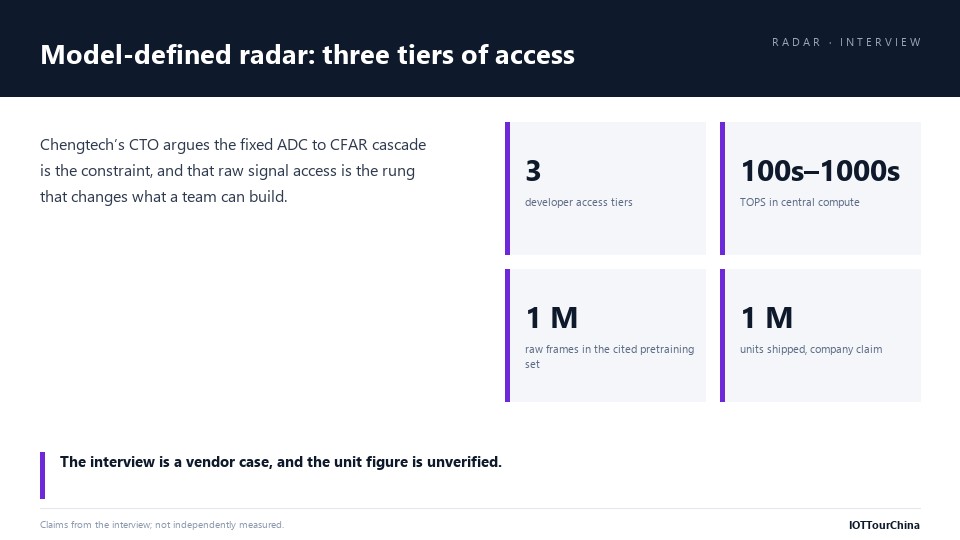
- Compute. Two ends moved at once. On the sensor, memory and compute improved by orders of magnitude, enough to host a model. In the vehicle architecture, distributed ECUs are giving way to central compute plus zone control, with hundreds to thousands of TOPS available centrally, and raw radar data can be sent over the in-vehicle network to be processed there. Multiple radar nodes can then be fused coherently, which he describes as virtual aperture extension that a standalone "smart radar" could never achieve.
- Algorithms. PyTorch and ONNX made training accessible, and architectures proven on vision — GPT, ViT, occupancy networks — provide a migration path into the radar data domain.
He cites the supporting evidence from research: a Carnegie Mellon team pretraining what he calls the first mmWave radar foundation model on one million raw radar frames and fine-tuning it across detection and segmentation; Google's Soli putting mmWave into a phone for gesture input; work measuring cardiac signals without contact; and robotics work in which natural language commands a 4D radar directly.
Three tiers of participation, and where a developer starts
The part of the interview most useful to integrators is the tiering, because it tells you what to ask a vendor for.
- Point cloud processed off-board. The radar emits a point cloud over a standard interface; the developer runs models on an external processor. Lowest barrier, and where most developers start.
- Model deployed on the radar itself. The developer deploys to the radar's own compute unit and reads point clouds through an API. Better integration, lower cost, better latency — this is the form Chengtech says it is pushing now.
- Raw signal access. The developer takes raw radar returns over a high-speed interface and works on micro-motion features, non-line-of-sight sensing and other frontier problems. Aimed at research groups and teams with deep development capability.
The tiering is a useful litmus test. A vendor that only offers tier one is selling a sensor; a vendor that offers tier three is selling a platform, and the price of the platform is that you have to do the signal processing yourself.
Sensing separated from computing
Zhou draws a second split alongside the software/hardware one: sensing separated from computing. In a conventional radar the front end and the compute are in the same box. In what the automotive industry calls satellite radar, the front end sends raw ADC samples to a central domain controller, which fuses radar and camera data in one place.
He argues this is the right architecture for embodied systems for a first-principles reason: a person's eyes and ears are sensors, and the brain does the unified processing. An embodied system has a high-compute central unit; the radar should be a sensor feeding it, not a self-contained device producing a verdict.
Chengtech claims to be the first supplier to mass-produce satellite radar, with deliveries in the million-unit range. That is a company claim, not an independently verified figure, but it is consistent with the product line described: an "AI super radar" platform that splits the front end further into antenna module, RF module and compute module, with the three independently replaceable, compute options quoted at 47 and 157 TOPS with 4 GB or 8 GB of memory, point cloud density from thousands to tens of thousands of points per frame, and an SDK covering everything from point cloud readout to model deployment.
The bottleneck he is most worried about is data
The most concrete admission in the interview concerns datasets. He cites a 2026 review by a South China University of Technology team in IEEE IoT Journal arguing that the next bottleneck for mmWave sensing is not model architecture but high-quality datasets and standardised evaluation. He agrees, and says it plainly: without annotated radar data, no model gets off the ground.
Chengtech's response has two parts. On hardware, a radar-vision fusion unit feeds radar and image signals into one compute module so that vision models can assist radar annotation — using the stronger modality to label the weaker one. On software, an in-house annotation model aimed at automating radar labelling, plus a plan to run an open annotation platform with standardised point cloud formats and model interfaces. The stated goal is a shared, standardised dataset for the field, and he is explicit that standardisation is what makes "open" credible rather than a marketing word.
What to take from it
Strip out the advocacy and three things remain that are checkable against a product datasheet rather than taken on faith:
- Where does the vendor's interface stop? Point cloud, on-device model deployment, or raw ADC. Everything about what you can build follows from that answer.
- Is the compute separable from the antenna? If the three modules can be swapped independently, an integrator can follow a compute roadmap without redesigning the RF front end.
- Is there a dataset and an evaluation protocol? Without one, any accuracy claim about a model-based radar is untestable.
The interview is a vendor making a case for its own platform, and the performance claims — resolution beyond the physical aperture, semantic output, free-space reasoning, radar SLAM that remembers a scene — are presented as direction rather than measured results. What is not advocacy is the architecture argument, and that one is falsifiable: either the sensor lets you at the data or it does not.
This article is part of the mmWave Radar channel.