Forlinx FCU3101: a fanless 3 TOPS edge AI box on Rockchip's RV1126B
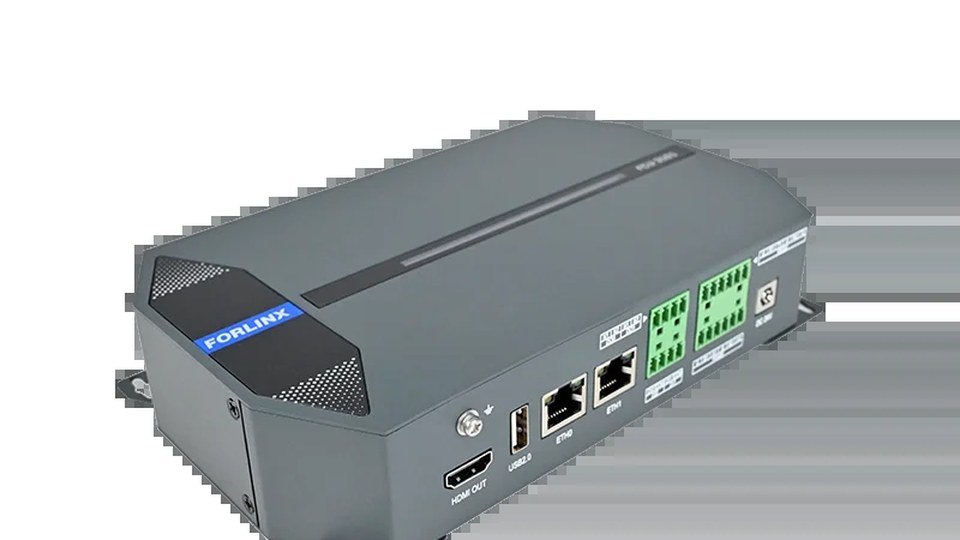
Forlinx's FCU line of edge computers spans a wide range, and the FCU3502 sits at the top of the Rockchip branch: an RK3588 paired with an RK1828 accelerator to drive analytics across up to 36 camera streams. The FCU3101 is the other end of that range, a smaller fanless box built on Rockchip's RV1126B with a 3 TOPS neural accelerator and a specification list aimed at a handful of cameras rather than a control room.
It was announced in August 2026 and it uses the same family chassis language as the larger model, which is rather the point. Forlinx is selling a tiered product line rather than a single board, and the FCU3101 is the tier for projects that need inference at the edge of a production line or a car park rather than across a site.
What the RV1126B brings
The processor is Rockchip's RV1126B, also offered as the RV1126BJ. It carries four Cortex-A53 cores at 1.6 GHz and no big cores at all, which tells you what class of workload it is intended for. The neural accelerator is rated at 3 TOPS at INT8. Forlinx describes the arrangement as heterogeneous, meaning the inference work is offloaded to the dedicated accelerator rather than sharing time on the application cores, so image capture, inference and the data handling around it can proceed at the same time.
The operating system is Linux on a 6.1.141 kernel. Forlinx ships a QT 5.15.11 library, a Python runtime and sample code for the serial ports, the buzzer, the watchdog and the Bluetooth stack, and it lists TCP, UDP, DHCP, TFTP, FTP, SSH, Nginx, iptables and SQLite as part of the image. The networking stack is configured for static or dynamic addressing and the MAC address can be changed.

The box
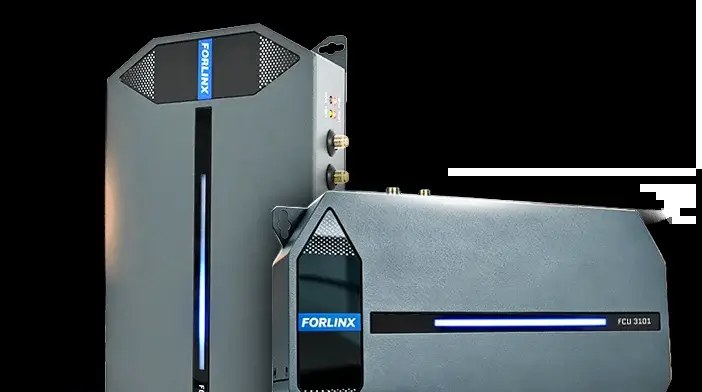
The chassis measures 202 mm by 123 mm by 42 mm and weighs 0.8 kg. Cooling is passive, with no fan, which is the practical reason this class of device can be sealed and put in a cabinet. It can sit on a desk or hang from an M3 bracket.
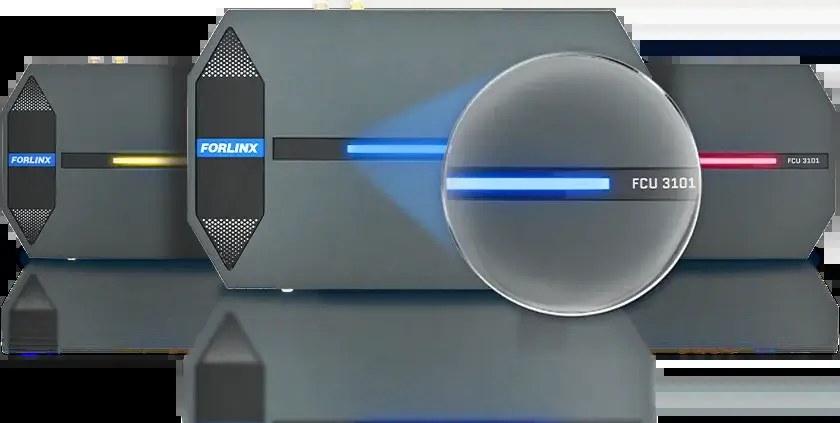
The front carries a programmable light bar. Out of the box it runs a blue flowing pattern, and the colour and the flashing logic can be programmed by the application, so a deployment can signal normal running, an alert or a fault without anyone opening a browser. It is a small thing, but on an installation where the box is inside a cabinet it is the only status indication anyone will actually see.
The interface list
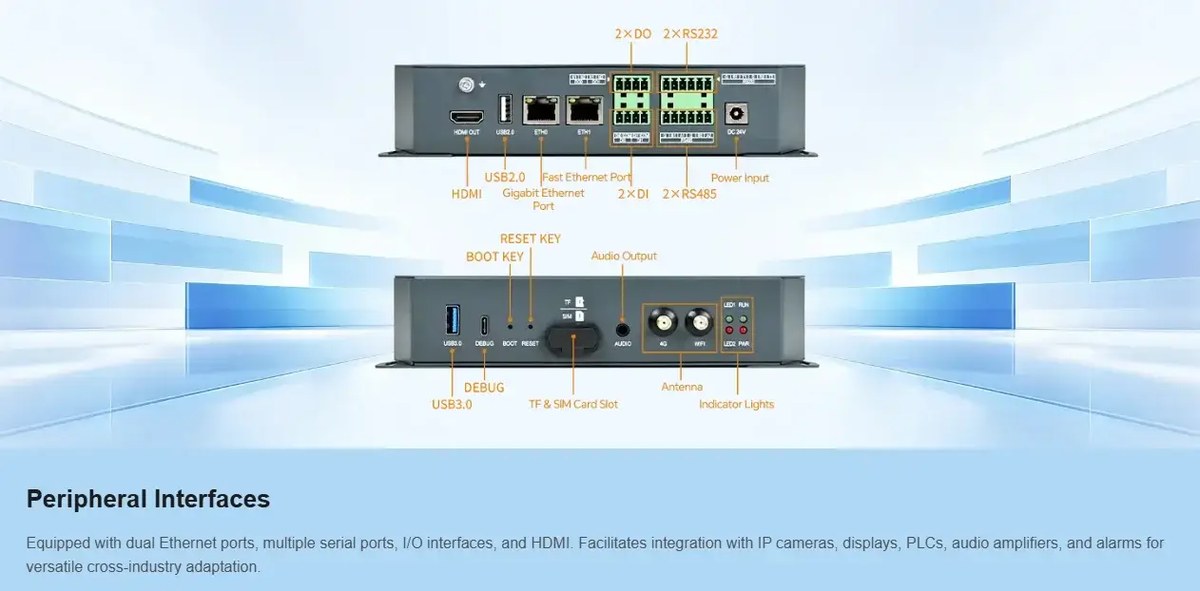
This is where an edge box is judged, because the cost of a deployment often sits in the adapters and converters needed to talk to what is already on site.
| Item | Specification |
|---|---|
| Processor | Rockchip RV1126B or RV1126BJ, 4 x Cortex-A53 at 1.6 GHz |
| Neural accelerator | 3 TOPS at INT8 |
| Memory | 2 GB or 4 GB |
| Storage | 16 GB or 64 GB eMMC, plus a TF card slot supporting up to 128 GB |
| Operating system | Linux, kernel 6.1.141 |
| Ethernet | Two ports, one 10/100/1000 Mbps and one 10/100 Mbps |
| Serial | Two RS485 and two RS232, all at 115200 bps |
| Digital input | Two channels, dry contact |
| Relay output | Two channels, 5 A at 30 VDC, normally open |
| USB | One USB 3.0 host and one USB 2.0 host |
| HDMI | One output, up to 1920 x 1080 |
| Debug | USB Type-C |
| Cellular | One optional 4G Cat 1 module |
| SIM | One push-push Nano SIM slot |
| Wireless | Wi-Fi 4 and Bluetooth 4.2, station and access point modes |
| Audio | One 3.5 mm AUX analogue output |
| Power | DC 24 V nominal, 9 V to 36 V wide input, reverse polarity and overcurrent protection |
| Other | Battery-backed real-time clock, hardware watchdog, buzzer, reset key |
| Dimensions | 202 x 123 x 42 mm, 0.8 kg |
| Cooling | Passive, fanless |
| Mounting | Desktop or M3 wall bracket |
The serial arrangement is worth reading closely. Two RS485 and two RS232 ports at 115200 bps cover most industrial equipment without an external converter, and the RS485 termination resistor is selectable with an internal DIP switch rather than by soldering. The two relay outputs switch 5 A at 30 VDC, which is enough to drive an alarm beacon or a door strike directly.
Algorithms, and what arrives with the hardware
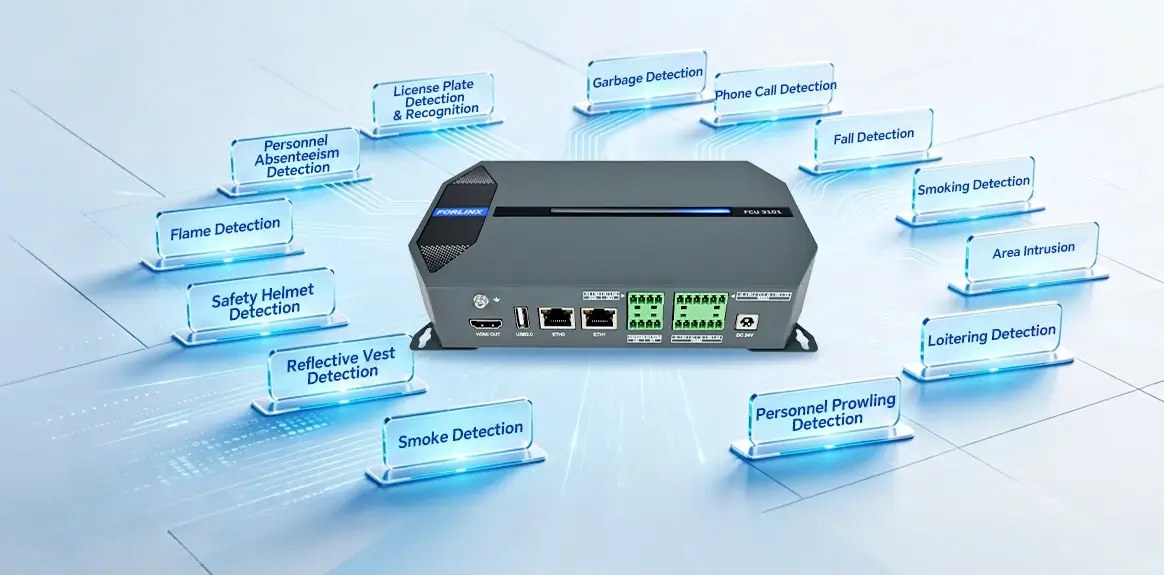
Edge vision projects tend to stall on the software rather than the board. Forlinx addresses that by shipping an algorithm suite alongside the hardware, covering more than ten common tasks: safety helmet detection, reflective vest detection, phone use detection, absence from post, area intrusion, loitering, prowling, smoke detection, flame detection, smoking detection, fall detection, garbage detection and licence plate recognition.
The commercial significance is the schedule rather than the algorithms. A team that would otherwise spend weeks assembling and tuning detectors can install the box and move on to integration, and Forlinx will develop custom models where the standard set does not fit. The suite is licensed separately and details are kept behind a sales conversation rather than published as a price list, which is the main thing to establish before committing to the platform.
Two temperature grades
Hardware is offered in two environmental specifications. The industrial grade runs from minus 40 to plus 85 degrees Celsius for production lines, metallurgical workshops and mining sites. The extended commercial grade runs from minus 20 to plus 85 degrees Celsius for access control, car parks, retail and campus security.
Forlinx also publishes its own test reports for high and low temperature, thermal shock and electromagnetic compatibility, and states that the enclosure carries level three EMC protection. That matters for tender work, because a buyer can point at a document rather than at a claim.
Certifications, and one caveat
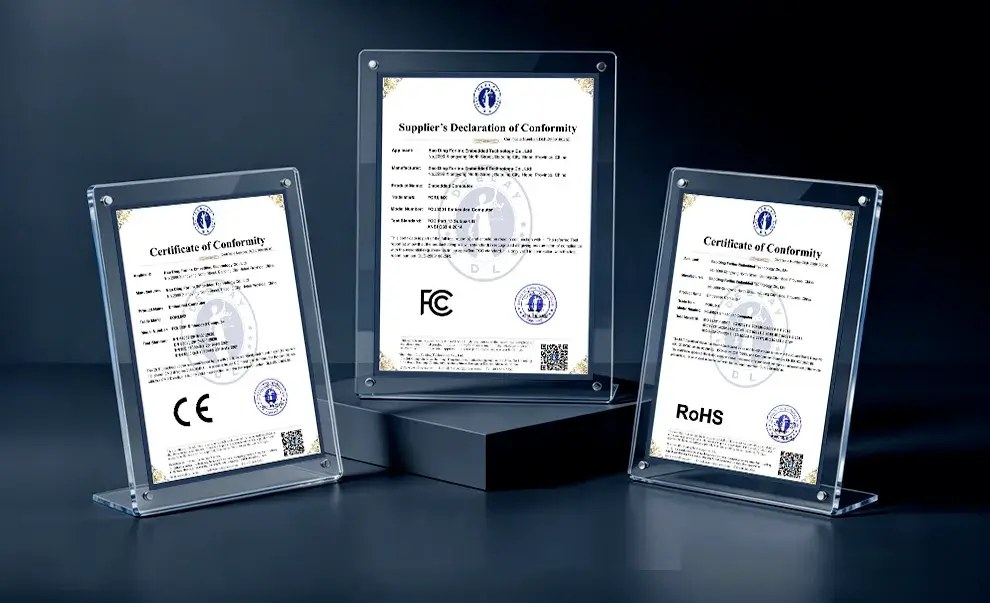
The device is described as compliant with CE, FCC and RoHS, and the certification artwork is on the product page. The qualification is worth attaching to that sentence: Forlinx states that the third-party certification reports are expected in the fourth quarter of 2026. Compliance and the paper that proves compliance are not the same thing, and a project that needs the report in a bid package should confirm the date rather than assume it.
Where it is aimed
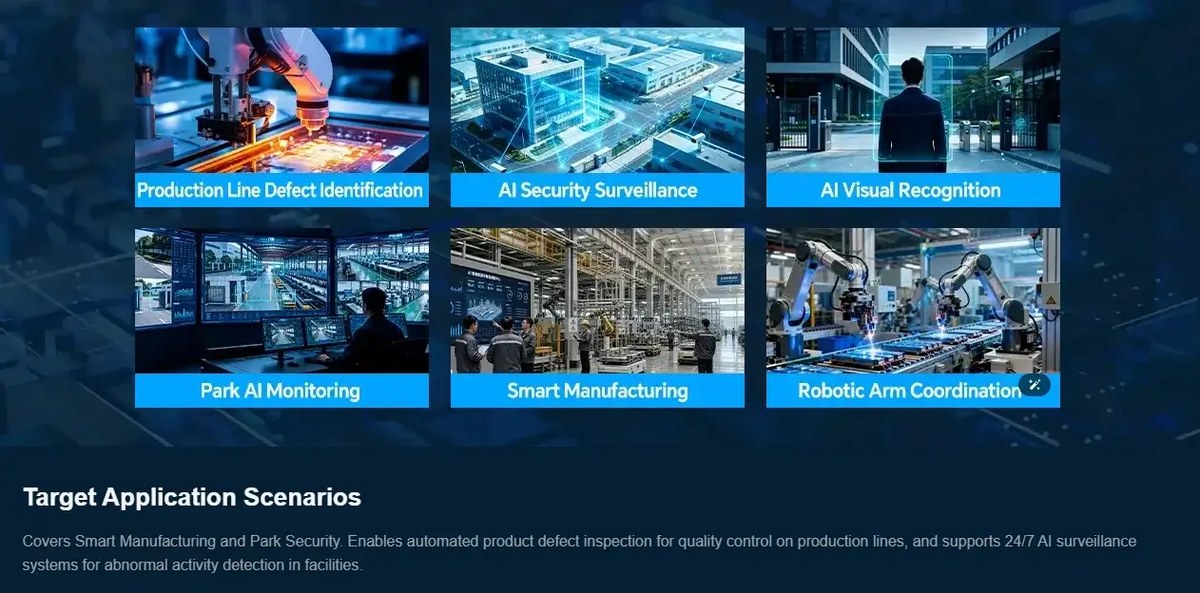
Forlinx names three deployment families for the box. The first is surveillance, across factory grounds, residential communities and industrial parks, where the work is identifying people, vehicles and abnormal events in real time. The second is manufacturing, covering defect detection on a line, material counting and checks that operators are working to procedure. The third is coordination with industrial robot arms, where the box supplies visual positioning and workpiece recognition rather than motion control.
The pattern across all three is that the inference runs on a handful of local streams and the output is an alert or a coordinate rather than a recording to be reviewed later. That is where a 3 TOPS accelerator is comfortable and a cloud round trip is not.
Price and availability
Forlinx lists three starting configurations in China. An industrial grade unit with 2 GB of memory and 16 GB of storage starts at CNY 1,799. A commercial grade unit with 4 GB and 64 GB starts at the same figure. A second commercial grade 4 GB and 64 GB unit, described in the listing as a compute version, starts at CNY 2,199.
The second and third listings describe the same memory and the same storage, so the gap between them is not a capacity difference. Forlinx has not published a specification table that separates the two, and the sensible step before ordering is to ask what changes.
Treat all three figures as China market references. Export pricing runs through distributors with their own margins.
Practical notes
- The 3 TOPS figure is the right size for four or so video streams, not for a site. Forlinx's own material puts the multi-camera tier at the FCU3502 instead. Decide on stream count before deciding on the model, because the two boxes are not interchangeable.
- Four Cortex-A53 cores at 1.6 GHz is a modest application processor. Anything beyond inference and the plumbing around it, for example a local database or a web dashboard, is drawing on the same four cores.
- Forlinx says the accelerated algorithms share models, so running several detectors on one camera costs less than running several separate models. That is why the number of algorithms pointed at a single stream is a poor measure of the load, and why the stream count is the figure to size against.
- RS485 termination is off by default and enabled with an internal DIP switch, so a long bus that behaves badly is a configuration problem before it is a hardware problem.
- Two Ethernet ports but only one is gigabit. If the camera traffic and the uplink both need full rate, check which port is which before laying the cable.
- The 4G module is an option and is not fitted at the factory, so a deployment that depends on cellular needs it ordered with the unit rather than added later.
- The third-party certification reports are due in the fourth quarter of 2026. Plan procurement around that date if the paperwork is a prerequisite.
- The temperature grades are quoted inconsistently across Forlinx's own English material, where the product page and its artwork state 0 to 70 degrees Celsius for the commercial grade while the specification tables state minus 20 to plus 85. Confirm the grade and the band in writing on the order.
IOTTourChina covers China-made IoT and edge hardware as part of its developer resource. This is editorial coverage, not an endorsement or an advertisement; specifications, availability and pricing should be confirmed with the vendor or a distributor before you buy.