Aerial–ground smart inspection: how China's power grid runs unmanned substations with robot dogs, drones, and video AI
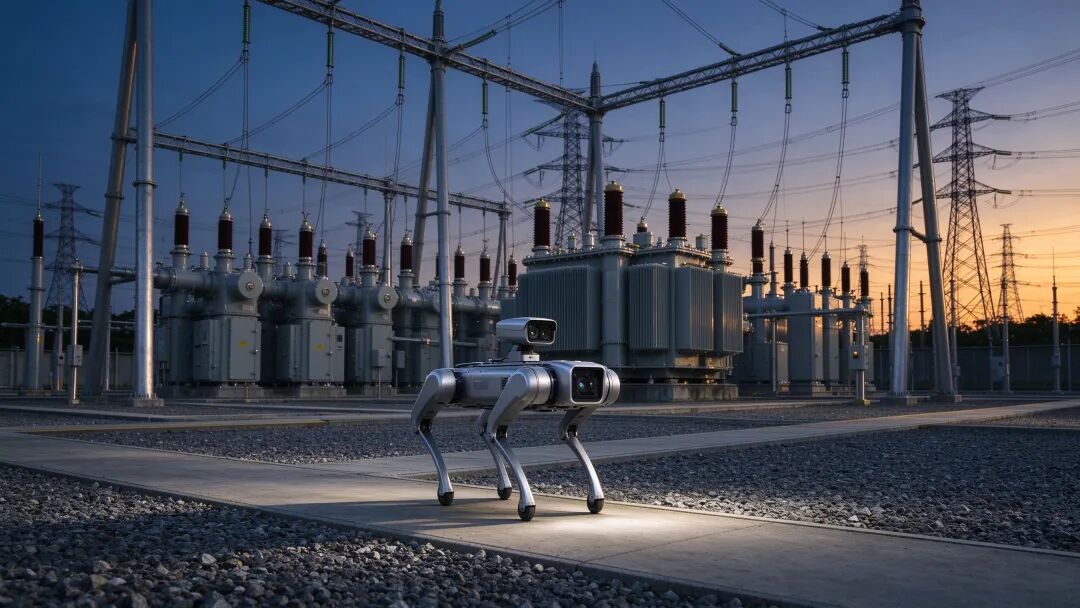
A substation is the hub of a power system — stepping voltage up or down, receiving and distributing energy. Its equipment health directly determines supply reliability. As the "dual-carbon" goals and the new power system push grids from rigid supply toward flexible dispatch, and from scattered control toward regional centralized control, unmanned substations are becoming the norm. Their sensing layer is built on robot dogs, rail robots, wheeled robots, drones, and video AI, fused with equipment monitoring, environmental sensing, security, and one-touch coordination into a closed loop of perceive → judge → warn → act.
Why manual inspection hits a wall
As device counts grow, the traditional human patrol runs into hard limits:
- Heavy reliance on people. Over 95% of patrol information comes from visual observation; quality depends on individual experience and condition.
- Low frequency, low coverage. Many devices, dense points — a single routine sweep takes too long to repeat at high frequency.
- Blind spots and high risk. Equipment undersides, frame gaps, and GIS rooms are hard to reach; working inside live zones is dangerous.
- Fragmented data. Video, fire, environment, and robot systems run independently with no unified platform or cross-system linkage.
One platform, many subsystems
Smart inspection consolidates dozens of previously siloed subsystems into a single inspection platform covering equipment monitoring, environmental monitoring, security, and intelligent patrol — with unified data access and cross-system linkage.
Equipment monitoring reads health from temperature + image + partial-discharge signals: infrared thermometry, automatic meter/oil-level/oil-pressure reading, acoustic and UHF online partial-discharge sensing, and appearance-defect recognition for leaks, cracks, and foreign-object bridging. Infrared imaging combined with load current can qualify heating defects, catching many hidden faults before planned outages.
Environmental monitoring guards the invisible risks — gas, temperature, humidity, water level. Limit alarms for temperature, smoke, and gas concentration; real-time water-logging monitoring in cable trenches and sumps; automatic linkage of ventilation, air-conditioning, lighting, and drainage; pressure anomalies that trigger safeguards for personnel safety.
Security, fire, and linkage unify perimeter, access control, video, and fire-fighting: preset-position video patrol, perimeter alarms, electronic fences, access records; AI behavior recognition for personnel; fire-alarm linkage; automatic pop-up of the relevant bay video on equipment trip; and image double-confirmation for one-touch sequential control.
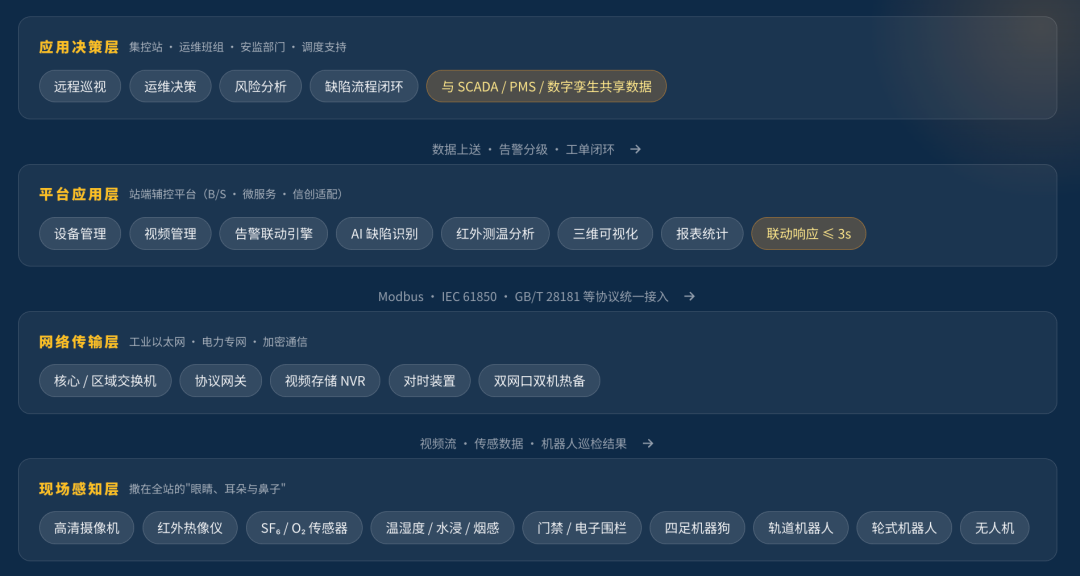
Aerial–ground inspection: drones, robot dogs, robots
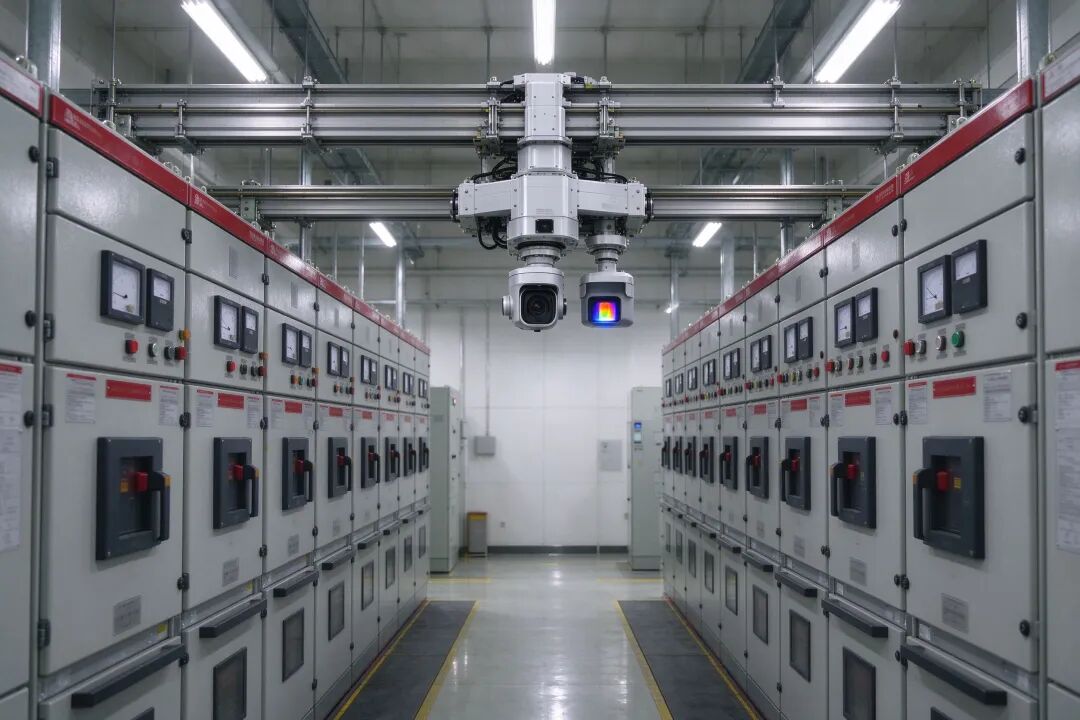
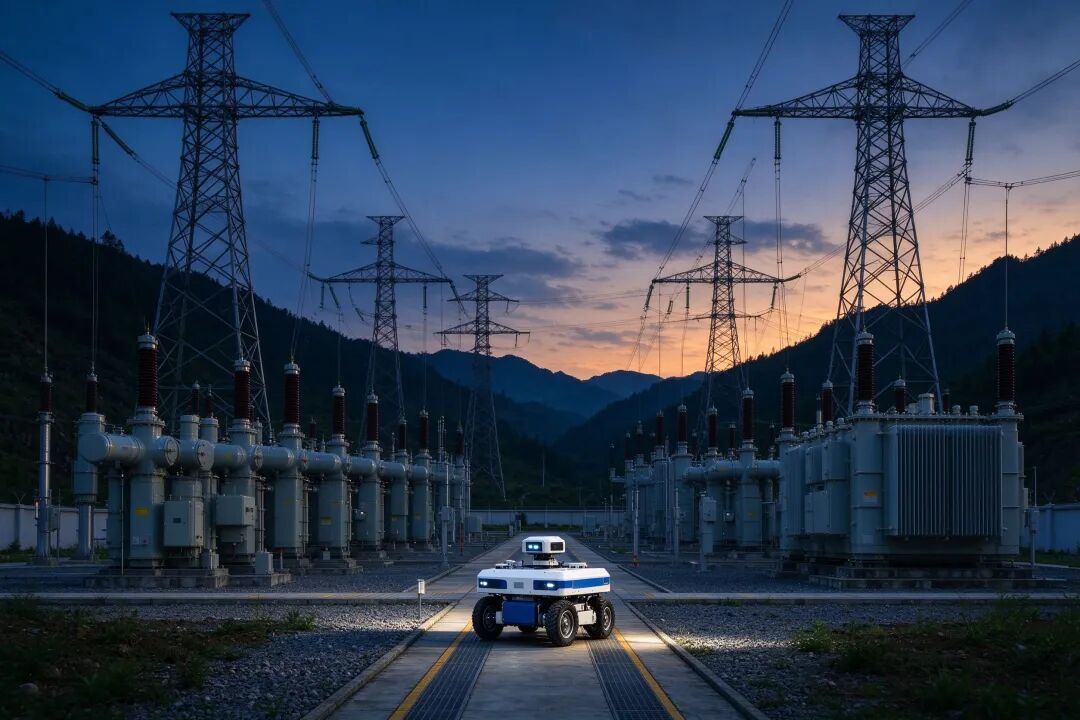
Multiple form factors divide the work to build a three-dimensional network spanning rail – ground – complex terrain – high altitude:
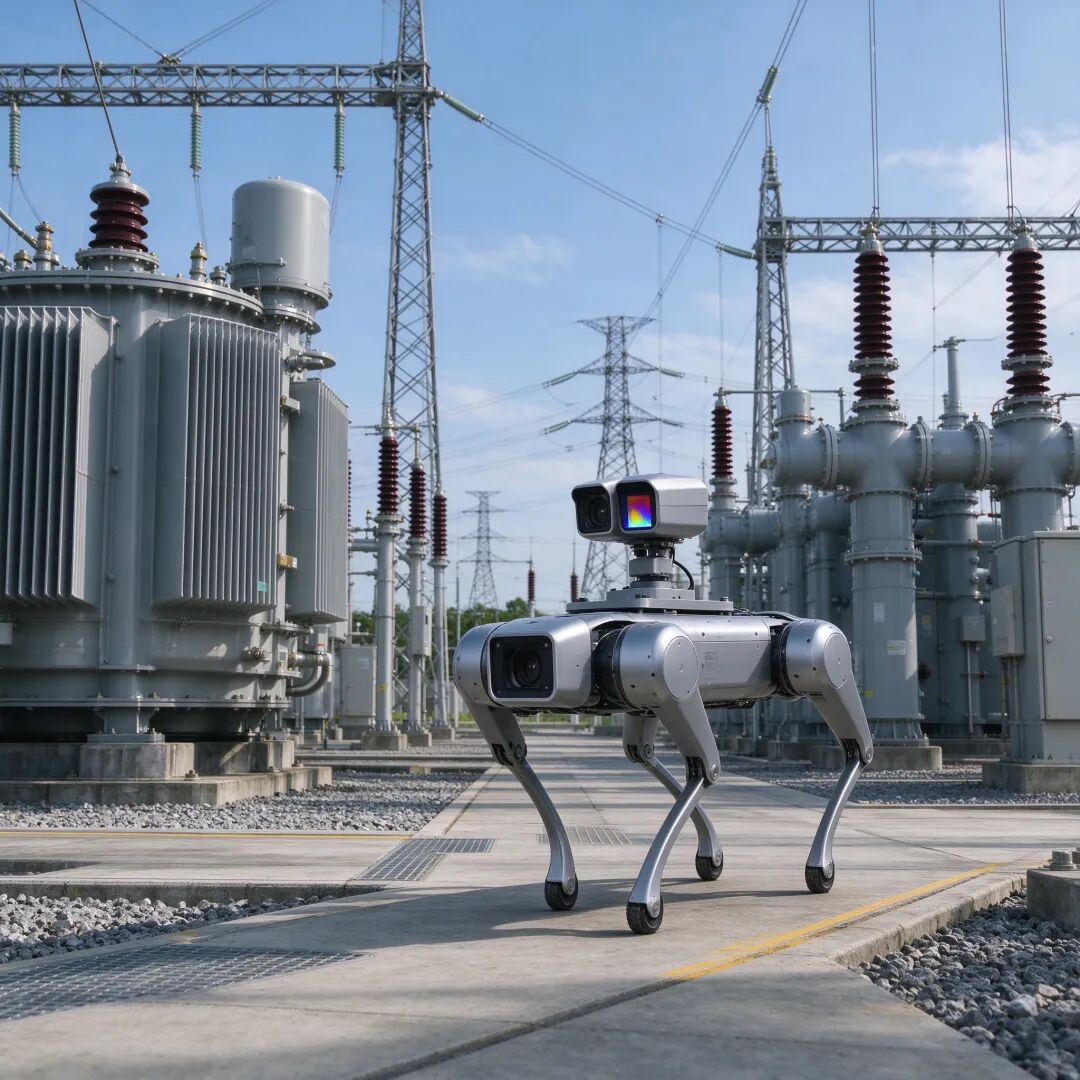
- Quadruped robot dog — tackles complex terrain and blind spots.
- Rail robot — millimeter-precision fine inspection indoors.
- Wheeled robot — large-area, high-frequency routine patrol.
- Drone — inspects high-altitude targets such as fittings and insulators.
Technical architecture
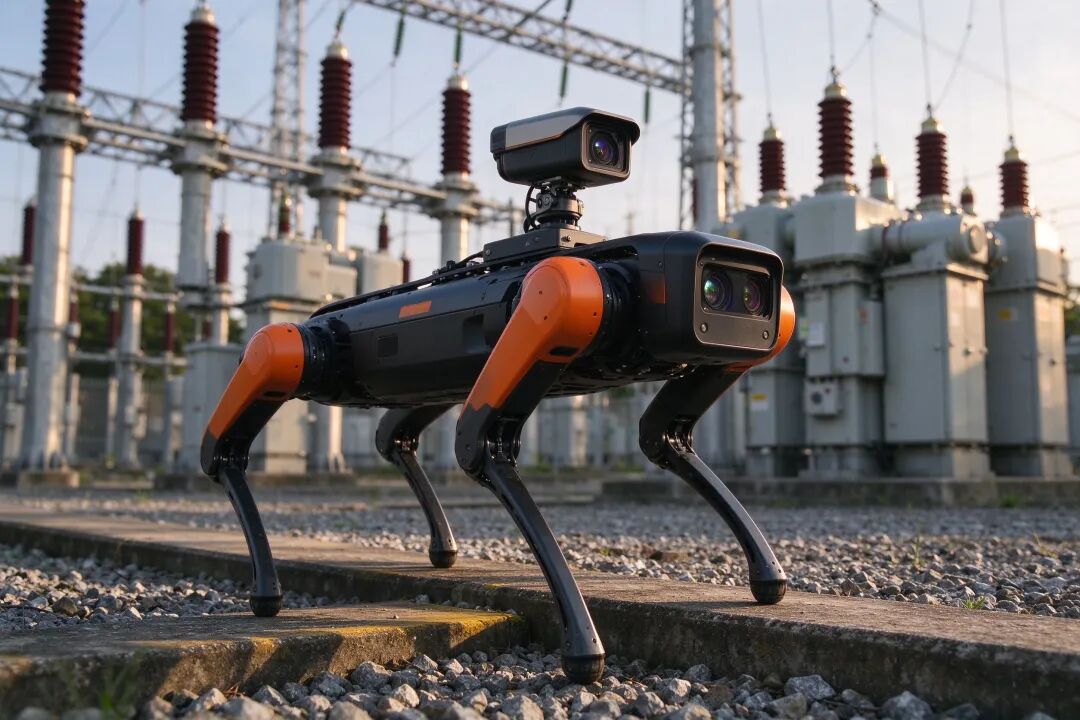
Security-zone deployment. The auxiliary-control platform sits in the production-control zone (Security Zone II) with a "monitor-only, no-control" posture. Large-capacity services like video storage and intelligent patrol sit in Security Zone IV, exchanging with Zone II through a forward-isolation device to meet regulatory protection requirements.
Three operating flows. Data flow: device → station → centralized-control platform → decision system. Control flow: dispatch → centralized control → sequential-control engine → station execution. Security flow: boundary protection → intrusion detection → host protection → audit and traceability.
Main–auxiliary coordination. The auxiliary system receives SCADA trip information to trigger video linkage, but never controls primary equipment in return — a core principle of production-control-network security and the boundary of "main–auxiliary fusion."
Core advantages
- Inspection efficiency up ~4×. A UHV station compressed its full-site patrol to 30 minutes; one provincial operator sweeps 160 substations in just 2 hours.
- Far fewer site operations. Robots enter live equipment zones in place of people — hundreds of thousands of field-person entries avoided, sharply lowering time spent in high-voltage areas.
- More accurate, steadier defect detection. Cloud AI iterated over four rounds; appearance-defect detection rate rose 36% over station-side models while false alarms fell 49%.
- 95% point coverage. Multi-form robots cover over 95% of patrol points, including undersides and frame gaps unreachable by eye, completing thermometry and appearance capture there too.
- 100% traceable data. Inspection data is retained end to end; anomalies auto-route into the defect workflow; similar defects can be compared and trended, turning experience into data assets.
- 7×24 unmanned operation. Routine patrol is robot-led with human spot-checking, providing the "double confirmation" behind unmanned operation and one-touch sequential control — shifting O&M from manual duty to intelligent O&M.
Application cases
Quadruped dog fills GIS blind spots + cloud AI patrol. One provincial utility standardized cloud AI substation inspection across 100+ stations, feeding 16,900 samples back into the platform and completing four algorithm iterations. A quadruped inspector captured, for the first time, infrared thermometry of 500 kV GIS basin-type insulators; across Suzhou, Zhenjiang, and a cable tunnel it completed 150+ patrols over 35.79 km, fully traceable.
Drone + wheeled + quadruped as a standing AI patrol team. In filter fields and GIS rooms, drones, wheeled patrol vehicles, and quadruped dogs form a three-dimensional inspection system covering 95%+ of points — infrared thermometry, meter reading, and appearance-defect capture even in undersides and frame gaps, with the whole flow compressed to 30 minutes.
Three robot types team up. A wind-farm step-up station deployed 2 rail robots, 1 wheeled robot, and 1 quadruped dog for a "rail – ground – complex terrain" three-dimensional layout: rail robots at millimeter position accuracy monitor indoor equipment around the clock; the dog carries a thermal dual-spectrum pan-tilt and industrial acoustic imager for thermal, visible-light, and acoustic identification deep in narrow, high-risk areas.
Smart retrofit drives ~4× O&M efficiency. One southern utility's system auto-plans patrol paths, back-hauls infrared and visible-light feeds, and flags anomalies with warning reports. Across 160 substations, full-domain patrol takes 2 hours, hundreds of thousands of field entries are avoided, and overall efficiency is up 400% — a leap from human-led to intelligence-led O&M.
Takeaway
Quadruped motion control, pan-tilt self-stabilization, and payload vibration damping keep improving; arm coordination and fine manipulation are the next frontier — machines will not only find problems but act on them, closing the perceive → decide → execute loop. Heterogeneous fusion of large AI models with specialist small models can already distinguish oil stains, shadows, and real leaks, moving from pixel-level comparison to semantic understanding; operator experience becomes reusable through agent platforms.
Looking ahead, fusing drone patrol, satellite remote sensing, and ground smart sensing with video monitoring breaks down monitoring silos and pushes UHV operation and maintenance from passive response toward active prevention — an aerial–ground coordinated intelligent inspection system.
IOTTourChina covers IoT robotics and edge-AI deployment in China's critical infrastructure as part of its device and integration resource. Details should be confirmed against the project's official documentation.