Espressif open-sources MiniHub, a local-first smart-home hub on one ESP32
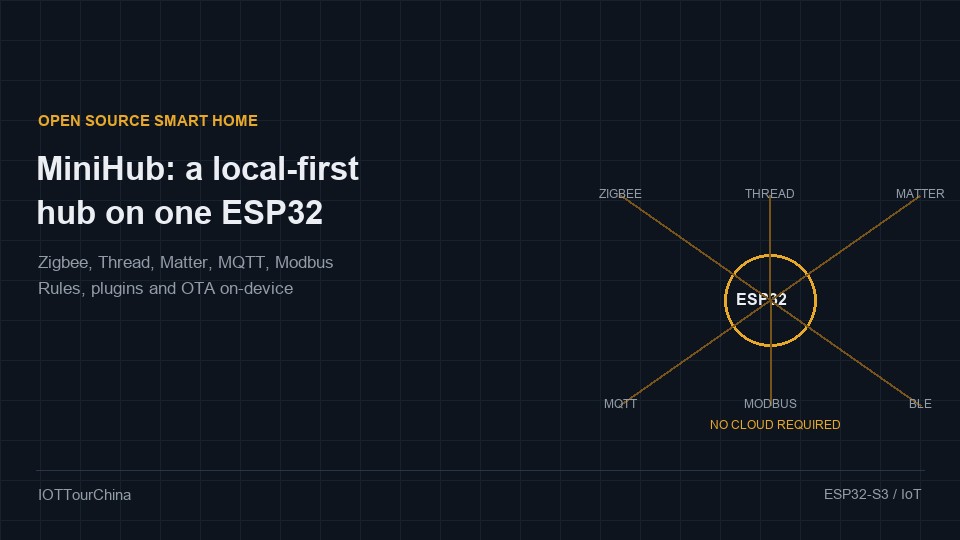
A smart-home hub that keeps working when the internet drops has to move automation off the cloud and onto local hardware. Espressif's MiniHub is an open-source attempt to put that whole stack on a single ESP32-S3. It was published on GitHub in early November 2026 under Apache-2.0, with no formal release yet. The facts below come from the official repository and documentation; the firmware was not built or tested by us.
One chip, six protocol stacks
MiniHub runs Zigbee, BLE Mesh, Matter, Thread, MQTT and Modbus on the same controller, and adds a rule engine, a web console, REST endpoints and a WebSocket event stream. The reference hardware is an ESP32-S3 Function-Coreboard-1 with a YT8531 Ethernet PHY. Plug in a cable, open the device IP in a browser, set an admin password and the hub is usable without a computer or NAS left running.
The repository was created on 5 November 2026 and is still on the master branch with no tagged release. Commit history indicates development began around early October. The project is very new, and both the chip support and the firmware should be treated as early-stage.
A point model instead of device structs
The central design choice is that every device, regardless of protocol, becomes a point in the hub. A point carries an ID, a type, a current value, a parameter table, the owning adapter and an online state. There are no device-specific C structs for lights or switches; a CSV catalogue defines the types, parameters and controls, currently 14 device types, 33 parameters and six controls. Adding a device type is a catalogue row rather than a firmware change.
That matters for rules. Automation is written against points, not protocols, so replacing a Zigbee lamp with a Matter lamp leaves the rule intact as long as the point ID stays the same. The project describes this as turning device shape into data rather than code.
Rules run on the device
Automations are stored and evaluated on the hub in a when-if-then form. A when clause fires on a point change or a time; up to four if conditions must all hold; then steps run in order with up to four actions each and an optional delay. The documented example turns on a light when a door sensor changes over MQTT and switches it off 30 seconds later, with the delay delivered by a hardware timer so other control is not blocked. Scenes are a separate configuration triggered through REST.
Plugins fill the gaps
Protocols or vendor clouds that are not in the firmware are added as store plugins with an .mhub suffix, in three levels. L1 is a JSON mapping, L2 a JavaScript script on an on-chip QuickJS engine, and L3 a compiled native C or C++ module. Plugins can be installed and upgraded in the field without reflashing, and a reload endpoint applies configuration changes without a full restart. Three examples ship with the repository: a BLE Mesh device pack, a JavaScript colour bulb and a JavaScript metering socket.
There is a clean boundary here. Anything that needs a vendor account or vendor server stays out of the main firmware, so the generic build contains no vendor keys and the public preinstalled-plugin list is empty. Vendor ecosystems arrive as plugins instead.
Updates, limits and the AI hook
The 16 MB flash holds two 5 MB firmware partitions. An update is written to the inactive partition, verified, then switched, with automatic rollback if the new image fails to boot. Firmware, web console and device icon resources update independently and each download is checked with SHA-256.
An optional MCP server, off by default, exposes twelve tools so an AI assistant can query points, send commands and manage plugins through the same operations the browser uses. The repository also carries an AGENTS.md and task-split skill files for AI coding assistants.
The published limits are explicit: 64 points across all protocols, 16 rules and eight scenes per configuration, and a 1 MB cap per plugin. Only two of the three 2.4 GHz radios can be active at once, Zigbee and Thread cannot run together, and the display version and Ethernet are mutually exclusive. The web console is plain local HTTP with no TLS server in the firmware, secure boot and flash encryption are off in the generic build, and all JavaScript plugins share one QuickJS task, so a stuck callback blocks the others.
Where this fits
MiniHub is not positioned against Home Assistant for hobbyists; the documentation frames it as a local-first base for gateway manufacturers. For an integrator the value is that a chip vendor has published a reference architecture for device abstraction, on-device rules, plugin isolation and safe OTA, all in one repository. The constraints are as much a part of that reference as the features, and anyone sizing a deployment should start with the point and radio limits rather than the protocol list.