Songyan Power sells a care robot's face in three tiers, and eye contact starts at tier two
Songyan Power and Yiling Group announced a strategic partnership on 22 October 2026, and the concrete part of it is a deployment: the X-Head1 anthropomorphic head, sold in China as Xiaoyue, becomes a service terminal inside Yiling's care business. The announcement describes eye contact, multimodal interaction and intent recognition, and stops there.
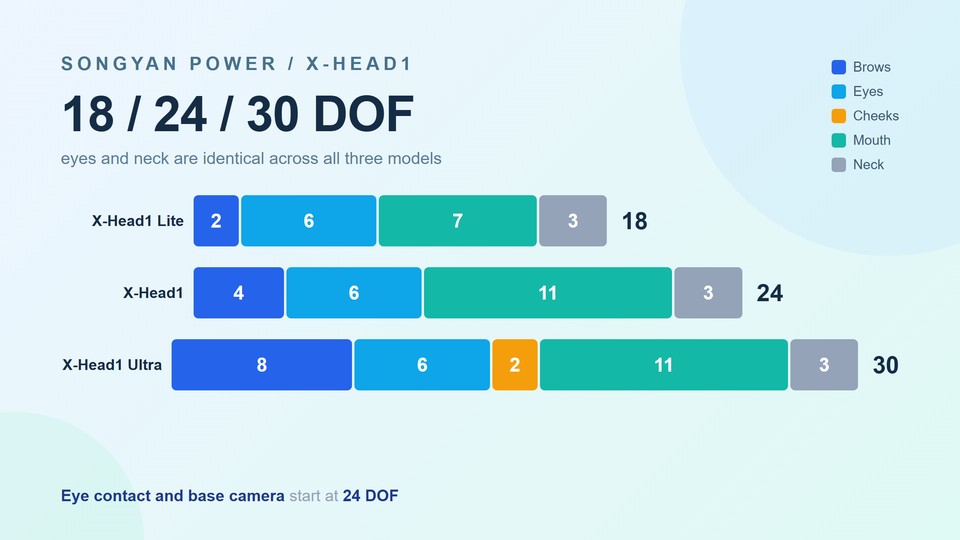
The product's own specification page is the more useful document, because it splits the X-Head1 into three models and marks every capability as standard, optional or absent for each one. Read that matrix and the announcement acquires a floor: eye contact, and the base camera that feeds it, are not on the entry model. The 18-DOF head is a talking face. The 24-DOF head is the first one that can look at you.
Three models, twelve degrees of freedom apart
| Region | X-Head1 Lite | X-Head1 | X-Head1 Ultra |
|---|---|---|---|
| Total active DOF | 18 | 24 | 30 |
| Brows | 2 | 4 | 8 |
| Eyes | 6 | 6 | 6 |
| Cheeks | 0 | 0 | 2 |
| Mouth | 7 | 11 | 11 |
| Neck | 3 | 3 | 3 |
The distribution is the interesting part, not the total. Eyes sit at six degrees on all three models and the neck at three on all three. Every extra degree is spent on the face, and the increments are not spread evenly. The step from 18 to 24 buys two more brow joints and four more mouth joints. The step from 24 to 30 buys four more brow joints and, for the first time, two cheek joints.
The cheeks are the tell. Two cheek degrees are what produce a raised-cheek smile, a puff, a grimace that reads as discomfort rather than as a shape. They exist only on the Ultra. A care deployment that wants the face to carry emotion beyond open-and-close needs the top model, not the middle one.
The second thing the table says is that gaze is not a degree-of-freedom problem. Eyes and neck are identical across the range, so the mechanism that moves the eyes is the same hardware on an 18-DOF head as on a 30-DOF one. What the entry model lacks is not the ability to move its eyes. It is the camera, and the software layer that would tell them where to look.
The capability matrix shows where the tier cuts
| Capability | Lite | X-Head1 | Ultra |
|---|---|---|---|
| Voice, mirroring, intent, mini-program | Standard | Standard | Standard |
| Eye contact and base camera | Not offered | Standard | Standard |
| Bespoke makeup and styling | Not offered | Not offered | Standard |
Voice interaction, expression mirroring, intent recognition and mini-program control are standard across all three models. Eye contact and the base camera appear together at the 24-DOF model, which is consistent with the argument above: the feature is a sensing plus software package, not a mechanism. Bespoke makeup and styling is the one line reserved for the Ultra, and that is a finish rather than a function.
For a care operator the practical reading is narrow. The entry model can greet, speak and mirror an expression, and cannot establish eye contact, which in a lobby or a corridor is the difference between a terminal that acknowledges a person and one that merely faces them.
Xiaonuo 3.0 puts its numbers on latency
The other head in the line, Xiaonuo 3.0, is documented far more tightly. It ships as a bust rather than a bare head, and the page gives the numbers an integrator needs before quoting anything.
| Parameter | Xiaonuo 3.0 |
|---|---|
| Form factor | 400 x 300 x 600 mm |
| Weight | 10.5 kg, head alone 2.8 kg |
| Skin | Platinum-cure silicone, face shell on magnets plus clips, removable without damage |
| Active DOF | 32 |
| Passive DOF | 8 |
| Actuation | Tendon and linkage, mixed |
| Perception | Two RGB cameras in the eyes, one RGB camera and a touchscreen in the chest, linear microphone array, stereo speakers |
| Controller | Android or Ubuntu |
| Power and comms | DC 48 V, serial port, Wi-Fi |
| Conversation latency | Under 1200 ms |
| Expression imitation latency | Under 150 ms |
| Neck range | Pitch 27 degrees each way, roll 25 each way, yaw 35 each way |
Two latency figures, an order of magnitude apart, and the gap is the point. Expression imitation closes in under 150 ms and determines whether the face feels alive. A conversational turn closes in under 1200 ms and determines whether the exchange feels responsive. It is the sum of recognition, language model and synthesis, and a vendor quoting one of those numbers without the other is quoting half of the user experience.
Both figures carry the same qualifier, that they depend on actual network conditions. For the conversational figure that is expected. For the 150 ms expression figure it is a question worth asking, because a face tracking loop on a head-mounted camera has no reason to touch the network unless inference sits somewhere else. The page does not say where imitation runs.
Two mechanical details are worth keeping. Face degrees are driven by a mix of tendon and linkage rather than one servo per joint, which is how 32 active and 8 passive degrees fit into a bust that weighs 10.5 kg. And the neck range is quoted per axis rather than as a cone, which is the right way to quote it for anyone mounting a head on a third-party torso: pitch, roll and yaw are independent limits, and a host neck that duplicates them wastes both.
Open source stops before the head
The company publishes code, but not for the faces. The Noetix-Robotics organisation on GitHub carries seven code repositories: C++ SDKs for Bumi, N2 and E1, three Python reinforcement learning frameworks for the same bodies, and a Docker image for the build environment. There is no X-Head repository and no Xiaonuo repository.
The documentation portal is the same shape. It lists Bumi, N2 and E1 with delivery documents, product manuals and SDK development guides, an anthropomorphic section holding the Hobbs W1 and Hobbs 3 manuals and product introductions, and two general entries for the voice module and for Bumi frequently asked questions. Neither head has an entry.
Both product pages promise an SDK anyway. The X-Head1 page offers an Android platform SDK, demo samples and developer documentation. The Xiaonuo page offers a cross-platform SDK with open motor control, face generation and audio-to-mouth-shape interfaces. Neither points at a download, a repository or a documentation URL. So the integration path for the biped and wheeled line is a git clone, and the integration path for the anthropomorphic line is a request. A project that needs a proof of concept before a purchase order has to resolve that asymmetry first, and the answer determines the schedule more than any specification does.
What the care deployment actually covers
Yiling Group describes itself as an international medical service organisation with an architecture spanning preventive medicine, chronic disease management, rehabilitation, elderly care and precision medicine. The head enters at the shallow end: user identification and daily health reminders, then a vertical medical knowledge base for health education and service coordination.
The announcement is careful about the role. The robot is a terminal in the service system, not a substitute for staff: it takes baseline tasks so that time is released, and the stated goal is collaboration rather than replacement. Three axes of iteration are named. Appearance and expression covers face, persona, voice, pace and expression. Knowledge and interaction covers collecting frequent questions into a knowledge base and scripting the answers. Service flow covers reminders, companionship, wayfinding and handoff to a person.
The third axis is the only one that produces something reusable, and it is also the only one that cannot be bought with hardware. That is the honest frame for the whole announcement: a head with 18 to 30 degrees of freedom is a component, and a care service is an operating procedure that has to be written around it.
The policy context behind the timing
In July 2026, fourteen departments led by the Ministry of Civil Affairs issued the three-year action plan for the rehabilitation assistive device industry covering 2026 to 2028. It names brain-computer interfaces, care robots, prosthetics and orthotics, and hearing aids among six to eight priority sub-sectors, targets breakthroughs in 50 key technologies and at least 80 products aimed at health, ageing and elderly care, and sets a goal of more than 500 enterprises above designated size by 2028 with at least 60 standards published.
That is a demand-side document, not a procurement one. It does not say which robot a facility should buy. It does explain why Chinese care operators are running pilots now rather than in three years, and why a vendor is willing to put an anthropomorphic head into a live service flow while the public SDK is still a promise on a web page.
Four things to confirm in writing
The gap between a launch announcement and an integration is four answers.
- Whether the entry model's missing base camera can be substituted externally, since eye contact depends on it and the page does not say the camera is optional rather than absent.
- Whether the 150 ms expression figure holds with the network unplugged, or whether imitation inference runs off the head.
- The Android SDK version, whether a ROS or ROS 2 bridge exists, and whether the stack runs fully offline. The Xiaonuo page lists serial and Wi-Fi as its only communications, which is thin for a head meant to sit on a mobile base.
- Who maintains the vertical medical knowledge base, and whether it can be hosted on site. For a care deployment outside China that is the question that decides feasibility, and it is not a hardware question at all.
The announcement says the two companies will explore. The specification page says what each tier can do today. Budget from the specification page.