Q8botOne: a 250 g quadruped on ESP32-C3 and eight DYNAMIXEL servos, fully open
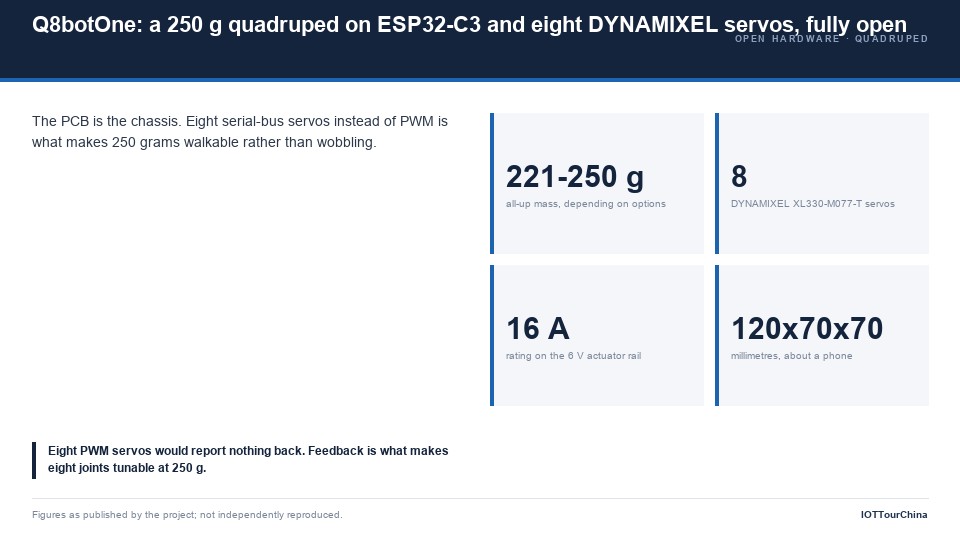
A quadruped that fits in a hand is a mass problem before it is a control problem. Q8botOne is 120 × 70 × 70 mm and 221 to 250 g depending on options, and the reason it looks tidy is that the main PCB is also the chassis: there is no separate frame to bolt the board onto, and almost no wiring is visible from outside.
The design is fully open — firmware, a Python control stack, Altium schematics, Gerbers, BOM and 3D CAD — published by ZeroWire Robotics, with a Crowd Supply campaign that has a USD 10,000 goal.
The parts that decide whether it walks
| Item | Choice | Why it matters |
|---|---|---|
| MCU | ESP32-C3-MINI-1-N4: single-core RISC-V, 160 MHz, 4 MB flash, Wi-Fi + BLE 5.0 | one core, no second chip for radio |
| Actuators | 8 × ROBOTIS DYNAMIXEL XL330-M077-T | serial bus, individually addressed, position/speed/PID plus feedback |
| Battery | 2 × 14500 Li-ion | BQ25887 charger with balancing, S-82C2A protection |
| Actuator rail | TPS543A26 to 6 V, 16 A rated | eight servos stalling at once is a current problem, not a voltage problem |
| Logic rail | MPM3632C, 5 V at 3 A | MCU, LEDs, expansion |
| Frame | MJF-printed PA12 nylon | leg joints run on ball bearings |
The actuator choice is the one that separates this from the pile of small quadrupeds built on hobby PWM servos. A PWM servo takes a pulse width and reports nothing back. A DYNAMIXEL on a shared half-duplex UART bus is addressed individually, accepts position, speed and PID targets, and returns present position, load and temperature. That feedback is what makes a 250 g machine with eight joints tunable at all: you can see a knee fighting the ground before the body starts to buck.
The cost of that decision is visible in the campaign tiers. The USD 199 kit contains the main PCB, the printed frame and legs, the controller board, the battery and the assembly hardware, but not the actuators. The USD 599 tier is assembled and includes them. The gap — USD 400 for eight units, about USD 50 each — is roughly the list price of an XL330-M077-T, so the tier difference is essentially the parts bill for the servos rather than a margin step. If you source your own actuators, the kit price is the number that matters.
Power, and the parts that are easy to skip
Two 14500 cells in series give the 6 V rail some headroom through a buck converter rated at 16 A. The BQ25887 handles charging and cell balancing; the S-82C2A is the protection IC that stops a pack from being discharged into a stalled servo until one cell inverts. A MOSFET with a mechanical jumper controls whether the rails are live, which is a deliberate choice: a software-only power switch cannot recover from firmware that hangs early in boot.
Expansion is where the board is more generous than the enclosure suggests. There is a Qwiic/STEMMA QT four-pin I²C connector, a four-pin powered UART, and SK6812 RGB LEDs. Three sensors are listed as optional: an MPU-6050 six-axis IMU for motion tracking, an INA228 for power monitoring, and an ESP32 camera module for vision. None of them is required to walk, which is the right order of priorities — an IMU is a nice-to-have on a machine this small, because the servos already report enough state to close a loop.
Control, and the trick with the second board
The kit ships with a separate ESP32-C3 controller board and an Adafruit Mini I²C gamepad. Plugged into USB-C power it talks to the robot over ESP-NOW; plugged into a computer it works as a wireless adapter, so the same board serves as handset and dongle. From the desktop there is a GUI, Xbox controller support and an API for writing your own behaviours.
That dual role is worth copying. Two radios that must talk to each other are two things to debug; one board that can be either end of the link is one firmware target and one set of failure modes.
What to check before believing the numbers
The vendor-facing claims are a jump, a trot and a payload of about twice its own weight. Only the first two are demonstrated in the material; the payload figure is the one to reproduce first, because a 250 g quadruped carrying 500 g is a statement about the 6 V rail, the printed leg geometry and the servo torque all at once.
Shipping is quoted as late March 2027 with worldwide free delivery, and the campaign is a goal, not a pre-order guarantee. Everything needed to build one without the campaign is in the repositories, which is the actual value here: the actuators are off-the-shelf, the frame is printable, and the board files are open.