Laifen put a 24 GHz radar in a RMB 499 makeup mirror — and the module vendors are still waiting for the beauty brands
In May 2026 Laifen — a beauty-appliance brand built on the twin labels of "technology for the masses" and "premium substitute" — released the M8 smart makeup mirror. It carries a 24 GHz millimetre-wave radar, sells for RMB 499, and reached the top three in its category on Tmall at launch.
That is a first for the company in two directions: its first smart mirror, and its first use of millimetre-wave radar in a mass-market beauty product. In September the M9 followed, and the radar became a fixed part of the series rather than a one-off.
What the radar actually does
The interaction model is deliberately minimal. The M8's stated design ideas are "forget the controls" and "interaction you do not notice".
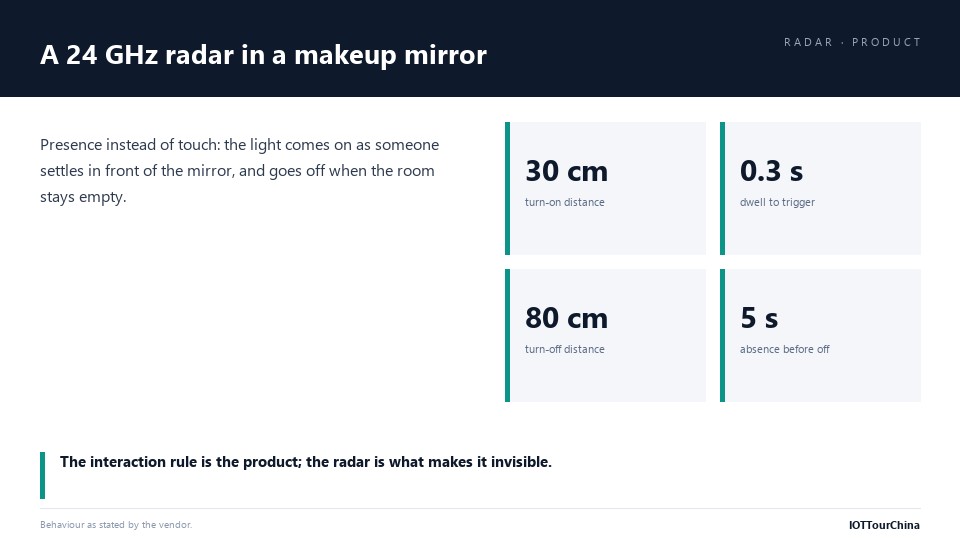
The radar implementation is a presence gate, not a gesture sensor:
- Approach within about 30 cm and dwell roughly 0.3 s → light on.
- Leave to beyond about 80 cm and stay away roughly 5 s → light off.
No touching the mirror, no waving, no app. The rest of the product is conventional but competent: 64 LEDs at Ra98 and 1450 lux, daylight / morning / ambient colour presets, six brightness levels, and non-volatile storage so the last setting survives power cycles.
It is worth being precise about what this sensor is not doing. There is no respiration or heart-rate sensing, no gesture recognition, no skin analysis. It answers one binary question with two thresholds and two time constants — and the time constants are the design work: 0.3 s of dwell suppresses someone walking past, 5 s of absence suppresses someone reaching for a drawer mid-routine.
Why the integration detail matters more than the feature
Laifen built its reputation on cost, and its stated method is self-developed production lines plus technology reuse — aluminium structures, temperature control, motor technology migrating between categories. Hair dryers, curling irons and electric toothbrushes share components, materials and lines to amortise cost.
A radar module fits that logic only if the brand controls the integration. Which is why one line in the reporting is more consequential than the feature list: the M8's radio compliance certifications in the US, Japan and Korea were all filed under Laifen's own name. That means the module integration and the RF compliance work sit inside the company, not with a third-party module vendor. If the sensor moves into other product lines, the cost and the schedule are controllable.
That is the difference between buying a pre-certified module and owning a platform. The first is faster for one product. The second is what makes the second and third product cheap.
The module market is crowded and the brands are not buying
The supply side is not the bottleneck. The article's survey of modules aimed at beauty scenarios is dense:
| Announced | Vendor | Part | Capability | Beauty use |
|---|---|---|---|---|
| 2025-07 | 唯创知音 | WT4102A-C01 | presence, micro-motion, low power | mirror screen on/off |
| 2025-04 | Seeed Studio | MR60BHA2 | respiration/heart rate, presence | physiological state input |
| 2024-10 | 云帆瑞达 | R60ABD1-S | respiration/heart rate, sleep assessment | sleep-skin correlation |
| 2024-04 | 正和微芯 | RS6130 | ultra-low-power presence, integrated radio | battery-powered wake |
| 2023-07 | 英飞麦 | BGT60UTR11AIP | sub-millimetre micro-motion, vital signs | high-end mirror front end |
| 2023-02 | TI | IWRL6432 | presence/count, vital signs | stress-related physiological input |
| 2021-10 | 加特兰 | Rhine-Mini | vital signs, tracking | domestic-sourced option |
Seven families of silicon, all capable of the job Laifen needed. And yet the article's characterisation of the market is "module vendors pushing, big beauty brands standing still".
The explanation offered is about incentives rather than technology. Beauty is an anxiety business: what drives purchase is the discovery of imperfection. So the intelligent layer that big brands actually invested in over 2025–26 was AI and AR diagnosis — L'Oréal, Shiseido and Estée Lauder all shipping skin-analysis and shade-selection tools, deployed first in stores, used to quantify a customer's problems and steer them toward a product. Shu Uemura's Real-Glass AI mirror, released in July, was launched as a tool for in-store artists and a permanent fixture of the store, not as something a customer takes home.
Anything that makes makeup easier or more convenient — lowering the skill floor, improving the result — is off the main line. Where it exists, it needs a special-needs frame around it: Lancôme's HAPTA lipstick applicator for people with limited hand mobility, or the HaloBraid automatic braider.
A mirror that turns its own light on is, in that logic, a convenience feature rather than a diagnostic one, which is exactly why an appliance brand known for cost engineering got there before the beauty majors.
What to take from it
For anyone building radar products, the M8 is a useful case because the technology is unremarkable and the commercial structure is not:
- The sensor is a two-threshold presence gate. The engineering is in dwell time and hysteresis, not in the spectral processing.
- Certification ownership is the moat. Filing radio compliance under your own name converts a purchased module into an internal platform, and that is what makes reuse across categories viable.
- The demand gap is in the buyer, not the supplier. Silicon capable of the function has existed since at least 2021. The reason it is not in every mirror is that the category's economics reward diagnosis, not convenience.
Whether Laifen's radar moves into its other beauty products depends on how the M8 and M9 sell. The compliance structure has already been built to allow it.
This article is part of the mmWave Radar channel.