RISE: one static mmWave radar rebuilds a room from its multipath ghosts
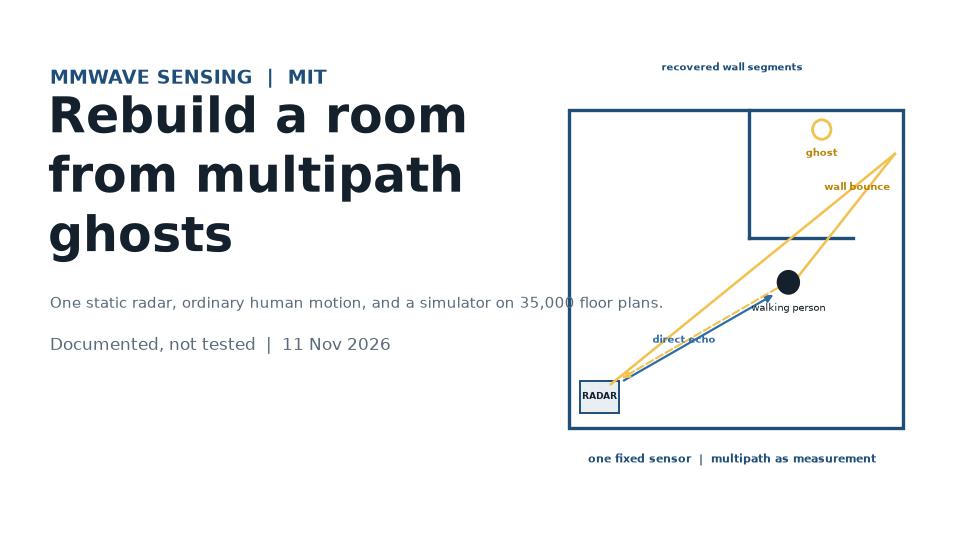
A radar bolted to a wall sees very little of a room directly. Millimetre-wave signals hit a smooth wall much as light hits a mirror, so most of the energy leaves along a narrow direction instead of scattering back to the receiver. RISE, built by researchers at MIT and Cartesian Systems, starts from the opposite assumption: the reflections that do come back indirectly, and the ghost targets that ordinary processing tries to delete, are where the missing geometry is hidden.
The work is documented as an arXiv preprint, with a project page and a public six-stage code repository. That matters for an integrator, because the signal chain can be read end to end instead of being inferred from a results table.
Why a fixed radar sees so little
The usual answer is spatial resolution. Indoor millimetre-wave sensing has a more awkward problem: specular reflection. A transmitted pulse only produces a strong return when some surface happens to send it back toward the sensor. Cameras and LiDAR give far richer spatial detail, but they are blocked by ordinary occlusion and raise privacy questions in bedrooms, offices and care facilities. Radar penetrates some obstacles and does not produce a recognisable image of a person.
One common workaround is to put the radar on a moving robot and scan the space. That adds hardware, a power budget and a motion planner. RISE occupies the gap between the two: keep the sensor still, let people walk normally, and use the reflection paths created by that movement as a kind of mobile probe.
Ghosts are geometry, not noise
When someone walks through a room, the received signal is not only the direct echo from the body. A path may go from radar to wall, then to the person, then back; or from radar to person, then wall, then radar. Each of these longer paths creates an extra target in the radar map that moves together with the real person. Tracking systems discard these as ghosts or clutter.
Their positions are not random. A ghost is tied to the geometry between the radar, the person and the reflecting surface, and it shifts as the person moves. Accumulated over a trajectory, those positions say something about walls and furniture edges that were never in the direct field of view. The paper's core observation is that the ghost is useless as an object, while the ghost's position is useful as a measurement.
BAME separates the two angles
Ghost visibility is the first practical obstacle. The authors report that the same ghost can be strong in one frame and vanish in the next, and they trace much of this to standard MIMO angle processing.
A conventional pipeline folds transmit and receive elements into one virtual array, which effectively assumes the angle of arrival and the angle of departure are approximately the same. Direct returns mostly satisfy that. Oblique multipath does not: it arrives and leaves at different angles, so it falls off the main diagonal of the range-angle response and is suppressed by the detector.
Bi-Angular Multipath Enhancement, or BAME, computes the range, angle-of-arrival and angle-of-departure response as a three-dimensional cube, runs a 3D CFAR detector over it, and reintegrates off-diagonal clusters into the range-angle map as valid ghost reflections. The result is not a prettier heatmap; it is a sufficiently steady supply of observations for the geometric inversion that follows.
From sparse points to a floor plan
Multipath inversion estimates reflector points from first-bounce and second-bounce ghost geometry. What comes out is a sparse, noisy set of two-dimensional samples. A Gaussian mixture model groups spatially coherent points, then RANSAC fits a dominant line to each cluster and rejects outliers. This yields a rough layout of wall segments and furniture edges, still broken and incomplete.
Sim2Real Hierarchical Diffusion, or SRHD, fills the gaps in two stages. The first predicts a furniture segmentation map to provide semantic cues; the second generates the wall layout from the raw radar observation, the object result and noise, with channel attention aligning the geometric and semantic channels. A final reverse-optimisation step uses an overlap loss to adjust the latent noise so that generated walls and objects do not cut across the recorded human trajectory. A wall crossing a path that someone actually walked is physically impossible, so the model is pushed away from it.
Where the training data comes from
A single static radar had no large labelled dataset to learn from. The team built a simulator from a corpus of 35,000 real indoor floor plans; the repository identifies the source as HouseExpo. A virtual radar is placed at a random position and orientation, obstacles are added, and each ray keeps only its first intersection so that the nearest reflecting surface dominates, as it does in millimetre-wave propagation. Random missing segments, rotations and scaling emulate occlusion, mounting error and range error. The repository documents a 100,000-scene simulated training run for the paper.
The public data release is smaller than the benchmark: four scenes with furniture in the ground truth, packed as a 1.6 GB archive hosted on Hugging Face. The remaining annotated cases are not part of that release.
The real benchmark itself contains over 100 trajectories of roughly 30 seconds each, about 50,000 radar frames at 20 Hz, across 11 indoor environments including offices, corridors, laboratories and furnished living rooms. Five volunteers walked random routes. A TI MMWCAS-RF-EVM Cascade mmWave sensor at a fixed height of 1.2 m was synchronised with an Intel RealSense depth camera for ground truth, with walls, room boundaries and furniture annotated in two dimensions.
Results, and one internal discrepancy
| Metric | RISE | Prior baseline |
|---|---|---|
| Wall Chamfer distance | 16.03 cm | 39.06 cm |
| Boundary F1 at 15 cm tolerance | 83.63 % | 63.43 % |
| Object IoU | 57.78 % | 7.70 % |
| Object Dice | 69.34 % | 12.66 % |
For layout reconstruction the comparison baseline is EMT, the multi-frame radar layout method. Because EMT does not detect objects, the object-detection baseline is EMT augmented with the same post-processing used by RISE, labelled EMT plus SRHD in the paper's table; a learning-based single-radar detector, BRL, is also reported and scores far lower. The paper describes RISE as the first system to tackle layout reconstruction and object detection together from one static radar.
| Ablation configuration | F1 | Chamfer |
|---|---|---|
| Baseline | 63.43 % | 39.06 cm |
| Plus ghost enhancement | 73.37 % | 32.31 cm |
| Plus diffusion | 78.84 % | 19.82 cm |
| Plus reverse optimisation | 83.63 % | 16.32 cm |
Each module addresses a different failure: ghosts that are not visible, segments that are broken, and generated layouts that are geometrically implausible. With only 40 percent of a full trajectory, RISE still beats the baseline's full-trajectory Chamfer distance, although its F1 drops more sharply because the generative output becomes less consistent.
Two numbers are worth reading carefully. The main comparison reports 16.03 cm for the complete system, while the ablation table reports 16.32 cm for its complete configuration. The paper does not explain the 0.29 cm difference, and the abstract rounds both to 16 cm. Neither figure should be quoted as a reproduced result.
What it cannot do yet
The discussion section is explicit. RISE depends on human motion to excite enough diverse multipath, so an entirely static room remains difficult. Blind regions caused by fixed sensor placement cannot be removed completely, only reduced by the dual-angle step. The output is two-dimensional top-down geometry, not a 3D mesh or a semantic 3D object model: it can say where a wall is and roughly how much floor an object occupies, but not what the object is made of.
Fall detection and elder monitoring are listed as application areas that could benefit from camera-free top-down geometry. The paper does not report a fall-detection evaluation, so that is a motivation rather than a measured capability.
How this was checked
The arXiv abstract page, the full HTML rendering of version 3 from 5 June 2026, the project page, the repository README and the dataset notes were read directly. The title, authors and affiliations, the hardware and capture setup, the 20 Hz frame rate, the 11 environments, five volunteers, 35,000 floor plans, all four headline metrics and all four ablation rows were checked against the paper. The repository's six-stage pipeline, the 100,000-scene simulated run and the four-scene data release were checked against its README. Note that the arXiv listing now shows a fifth version dated 3 August 2026; the figures quoted here come from version 3, which is the version the source article cites. No radar was operated, no model was trained and no result was independently reproduced for this article.
Source: Embedded Home, WeChat, 11 November 2026.
This article is part of the mmWave Radar channel.