IROS 2026 best paper turns a suction cup into an underwater GPS substitute
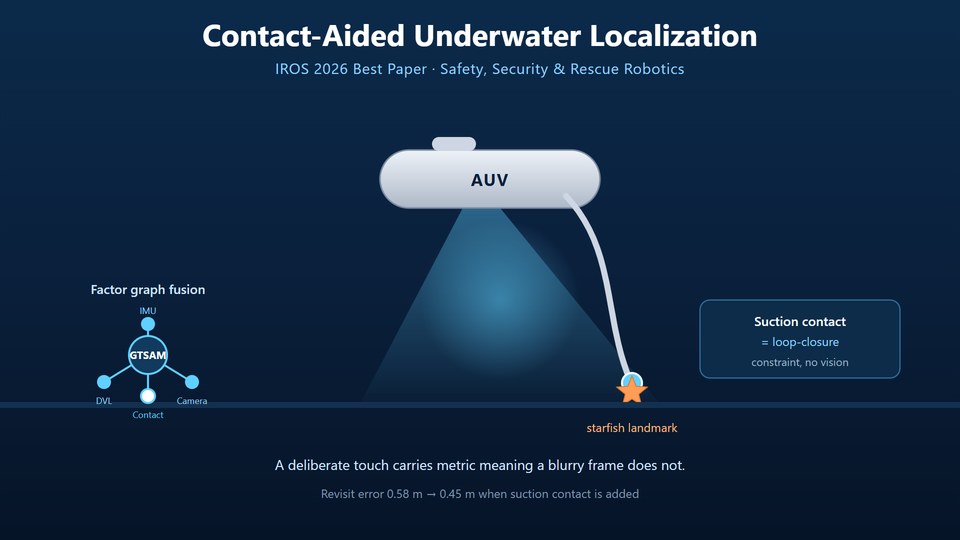
A paper that won the Safety, Security, and Rescue Robotics best-paper award at IROS 2026 starts from a blunt observation: underwater, a robot often does not know where it is. Autonomous underwater vehicles sampling the seafloor fly low over flat, featureless sand where down-looking cameras struggle, and there is no GPS to fall back on.
The team behind the work comes from Heriot-Watt University in the United Kingdom and the Japan Agency for Marine-Earth Science and Technology, known as JAMSTEC. Their answer is to let the vehicle feel its position. Each time a suction manipulator touches the seabed, that contact becomes a geometric constraint in a factor graph, acting like a loop closure the robot never has to see.
Why a camera alone loses the seafloor
Low-altitude sampling keeps the camera pointed straight down at plain sand. In that view, motion parallel to the seabed is hard to observe, scale is uncertain without reliable height, and feature tracks are unstable. Starfish and other bottom-dwelling animals are small, sparse, and visible for only a moment, so monocular distance estimates are noisy and re-identification is unreliable.
The paper quantifies how bad the view gets. In the harbor sequence the detector found on average 418 keypoints per frame, with a low of 90 in one frame, and only 42 percent of features survived from one frame to the next. In the first pool the average was 781.8 keypoints per frame but inter-frame retention was still only 47 percent. Across 4078 frames in the second pool, the median optical flow was just 1.24 pixels, too little parallax to triangulate depth reliably.
| Condition | Value |
|---|---|
| Harbor, mean keypoints per frame | 418 (minimum 90) |
| Harbor, inter-frame retention | 42 percent |
| Pool one, mean keypoints per frame | 781.8 |
| Pool one, inter-frame retention | 47 percent |
| Pool two, frames analysed | 4078 |
| Pool two, median optical flow | 1.24 pixels |
Under those conditions the classical toolchain collapses. COLMAP cannot finish sparse reconstruction initialization, and ORB-SLAM3, VINS-Mono, and ROVIO repeatedly lose track or diverge. The authors argue that standard monocular structure-from-motion and visual SLAM are ill-posed in this setting, not merely poorly tuned.
A suction touch as a loop closure
The alternative is to stop relying on sight and start relying on touch. When the suction cup grips a seafloor object, the end-effector position is known precisely from the manipulator's forward kinematics. That position carries real metric meaning and does not change with viewing angle, so the team models the contact as a high-confidence factor in the graph.
If a previously built landmark sits nearby, such as a starfish detected by vision, the system adds a bearing-range factor between the current pose and that landmark. If no landmark exists, the contact point itself becomes a new landmark. Both cases use a tight noise model to keep geometry consistent. When the cup later touches an object it has recorded before, the result is an implicit loop closure that needs no appearance-based place recognition.
The whole framework runs on GTSAM with an iSAM2 incremental solver behind it. It fuses inertial measurement unit data, Doppler velocity log readings, a pressure and temperature sensor, a magnetometer, the down-looking monocular camera, learned object detections, and the manipulator contact events.
Two design choices keep the estimator stable. The visual odometry factor is weighted by its own reliability: the inlier rate is passed through an exponential moving average and then clamped, so frames with weak visuals cannot pull the estimate off course. Object detection uses YOLOv8 trained on a public starfish dataset; distance comes from the detection box height under a pinhole model, and low confidence or a small box inflates the measurement uncertainty. A mixed sliding-window local bundle adjustment optimizes landmarks together with poses when they are present and poses alone when they are not, and the system can initialize online while moving instead of having to stop first.
What the vehicle carried, and where it was tested
The experimental platform paired a JIMS-80 MEMS inertial unit with a Wayfinder Doppler velocity log, a Paroscientific pressure and temperature sensor, a magnetometer, and a down-looking monocular camera. Trials ran in two pools of 100 by 7.8 by 4.35 metres and 40 by 4 by 2 metres, a roughly 10 by 10 by 5 metre harbor area, and the Stonefish simulation environment.
| Environment | Dimensions |
|---|---|
| Pool one | 100 by 7.8 by 4.35 metres |
| Pool two | 40 by 4 by 2 metres |
| Harbor area | about 10 by 10 by 5 metres |
| Stonefish simulation | synthetic, with ground truth |
The numbers: drift, ablation, and return accuracy
In the first pool the straight-line trajectory reached an absolute trajectory error of 0.0990 metres. Adding two 180 degree turns pushed error to 0.2917 metres, confirming that planar rotation is the worst case. Adding depth variation brought it back to 0.1954 metres, and when depth change coincided with starfish landmarks the yaw error reached its lowest point at 0.0412 radians.
The ablation makes the contribution concrete. On the straight path, using only the Doppler log, inertial unit, and pressure sensor gave an absolute trajectory error of 0.6780 metres with a yaw error of 2.2396 radians. The full system cut that to 0.0990 metres and 0.0524 radians. Removing the camera raised error to 0.2798 metres, and removing the local bundle adjustment raised it to 0.2270 metres.
| Configuration | ATE, metres | Yaw RMSE, radians |
|---|---|---|
| Doppler log plus inertial unit plus pressure only | 0.6780 | 2.2396 |
| Full system | 0.0990 | 0.0524 |
| Without camera | 0.2798 | not listed |
| Without local bundle adjustment | 0.2270 | not listed |
The point of the work is not the absolute trajectory but the ability to come back to the same spot. In the second pool, revisit error fell from 0.58 metres with no landmark, to 0.50 metres with a visual landmark, to 0.45 metres once the suction contact was added. In the harbor, where water is murkier and light changes, the same progression ran from 1.23 metres down to 1.12 and then 0.90 metres. Simulation told the same story with ground truth in hand: well-excited trajectories stayed under 0.1 metres, continuous planar rotation reached 0.998 metres in absolute error yet only 0.0032 metres in relative pose error, and a figure-eight path with two starfish dives, using landmarks and contact together, revisited to within 0.06 metres.
| Scenario | No landmark, metres | Visual landmark, metres | Suction contact, metres |
|---|---|---|---|
| Pool two | 0.58 | 0.50 | 0.45 |
| Harbor | 1.23 | 1.12 | 0.90 |
What the result says about underwater state estimation
The authors frame the core issue as observability rather than sensor quality. Planar rotation amplifies drift because it gives the estimator little to lock onto. Vertical motion improves the observability of scale and heading. Visual landmarks mainly steady the orientation. Contact constraints, added near the place where the robot is actually working, reliably shrink the error on return.
The next step the team names is to combine this contact-aided localization with high-frequency voxel mapping, aiming at dense maps of the benthic work area and manipulation planning on top of them.
What to take away
This is a research result, not a product, and the numbers come from tanks, a harbor, and simulation rather than offshore deployment. But the engineering idea transfers. When a robot works in a place where cameras and GPS both fail, a deliberate physical interaction can serve as a localization primitive: a touch carries metric meaning that a blurry frame does not.
For anyone building close-range manipulation on any platform where global positioning is unavailable, the lesson is to treat contact events as first-class measurements. Fuse them as constraints with known, tight uncertainty, weight the noisy visual cues by their own reliability, and let a smoothing-based graph hold the state. The hardware on this vehicle was off-the-shelf inertial, acoustic, pressure, magnetic, and optical sensing plus one suction arm, which is a stack most inspection and sampling robots can already carry.