At a shared intersection, priority starves slow vehicles but a token-ring reservation restores 94% throughput
The previous article on why two AGVs in one aisle fight each other covered interference and deadlock. The reader question that followed was sharper: at the intersection itself, who goes first? Is it "whoever is more urgent" (priority), or "whoever booked the slot" (reservation)? The answer is not one or the other. It is a switch you set by traffic.
Intersection control is the first gate of dual coordination. If the junction is chaos, the avoidance and interference work underneath is wasted.
One junction, two vehicles, no rule
Vehicle A crosses horizontally, vehicle B crosses vertically, and their paths overlap at the centre. With no rule, order is decided by the millisecond of arrival. On the measured line, the unmanaged junction ran an emergency-stop rate of 5.2 per shift, because every approach made both vehicles yield and stop, and the takt shattered.
The two routes: priority or reservation
Priority means "whoever is more urgent goes first," with equal-weight tasks taking turns. It is simple to implement, but at peak it starves the low-priority vehicle.
Reservation means booking a time slot before entering the junction and only releasing it once through. Throughput is high, but it needs the scheduling layer to participate.
Low-traffic periods get by on priority. Once crossings become frequent, reservation is mandatory, or priority starves the slow vehicle.
Priority is simple but starves
The biggest trap in priority is starvation. The high-priority vehicle (say blue) occupies the junction on every arrival, and the low-priority vehicle (orange) cannot enter during a 4.5 to 6.5 second window. Once a low-priority vehicle waits more than 30 seconds, the entire line behind it is dragged down. Simple is not the same as stable.
Reservation cuts the junction into time slots
The reservation idea splits junction time into slots: S1 to A, S2 to B, offset by 2 seconds, so the junction is no longer contested. A third slot, S3, is deliberately left empty as a buffer so a delayed front vehicle does not drag the rear one into a conflict. This turns "who goes first" from luck into a queue.
Reservation lands as a token ring
The most stable implementation is a token ring. A single token sits at the junction centre, and only the vehicle holding it may enter. When A leaves the junction it returns the token and only then can B take it. It behaves like a serial port: physically impossible for two vehicles to be inside at once.
This is steadier than a simple time limit, because the token expresses occupancy, not elapsed time. If the front vehicle is stuck, the rear one naturally cannot acquire the token, so the two never enter together.
Measured: what each scheme does to throughput
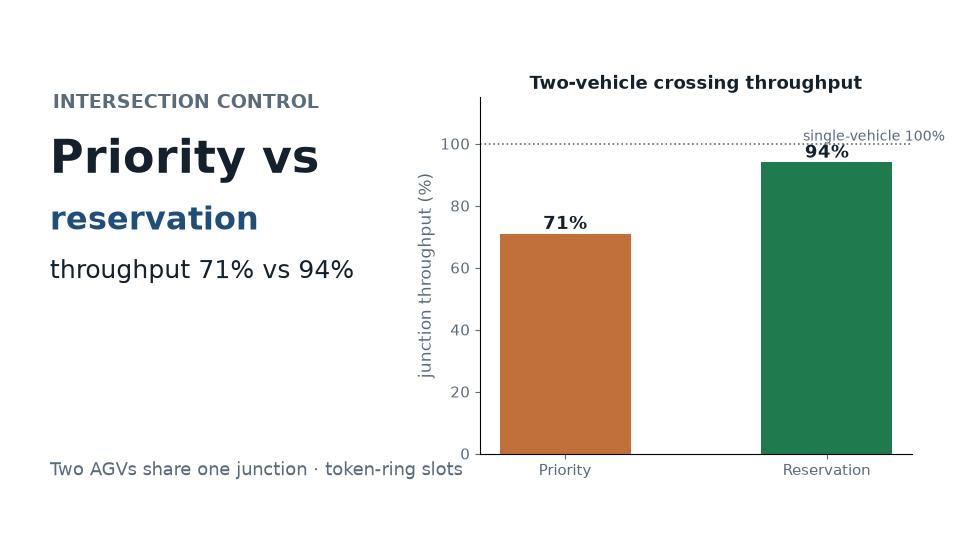
The same two-vehicle crossing was run for a day under both schemes, with single-vehicle throughput as the 100 percent baseline:
| Scheme | Junction throughput |
|---|---|
| Priority | 71 percent |
| Reservation (token ring) | 94 percent |
Priority drops junction throughput to 71 percent because starvation and mutual yielding eat a large share. Reservation pulls it back to 94 percent, close to the single-vehicle level.
Priority's three hard rules
If you choose priority for its simplicity, you must still set three asymmetric rules, or it fails:
Outbound outranks return. The loaded outbound vehicle always has priority; the empty return vehicle yields. This is the key to preventing symmetric deadlock.
Near outranks far. The vehicle closer to the junction goes first, to minimise empty travel.
Timeout preemption. If a vehicle waits more than 8 seconds, it unconditionally takes the junction, to prevent starvation.
Symmetric priority, the "neither retreats" rule, deadlocks every time. No preemption starves every time. You need both the asymmetry and the preemption, or the junction is not stable.
Reservation has a cost: the scheduler must be accurate
Reservation is not free. It demands that the scheduler compute two things correctly: how long a vehicle takes to clear the junction, and how many seconds until the next vehicle arrives. Get either wrong and the slots misalign, making congestion worse. And do not skip the buffer slot: when the front vehicle overruns, the buffer absorbs it; without it, the chain fills and everything blocks.
Mix them: priority at low traffic, reservation at peak
The most practical design is a hybrid. Run priority when the junction is quiet and reservation when it is busy, with preemption available in both. The switch threshold is an intersection wait above 5 seconds per shift: below that, priority; above it, reservation. Using one rule for every condition is the classic field mistake.
Which scheme does your junction need?
Peak crossings above 20 per shift. If yes, use reservation.
Junction emergency stops above 3 per shift. If yes, use reservation.
Any vehicle waiting above 20 seconds. If yes, add preemption.
Any one of those being true means priority alone is insufficient.
The summary
Traffic control is not about adding hardware. It is about stating clearly who goes first.
At low traffic, run priority with three asymmetric rules: outbound over return, near over far, and timeout preemption.
At high traffic, run reservation: split the junction into time slots, serialize them with a token ring, and recover throughput to 94 percent.
Switch by traffic instead of forcing one rule to fit every load. The next article takes up deadlock and livelock: two vehicles each waiting for the other, harder to see than a congested junction.
Source: RANKING IOT (Suzhou Yunqi Intelligent Technology), WeChat, 7 November 2026.