Two AGVs sharing one aisle fight each other: lidar reads the other as a pillar and symmetric priority deadlocks
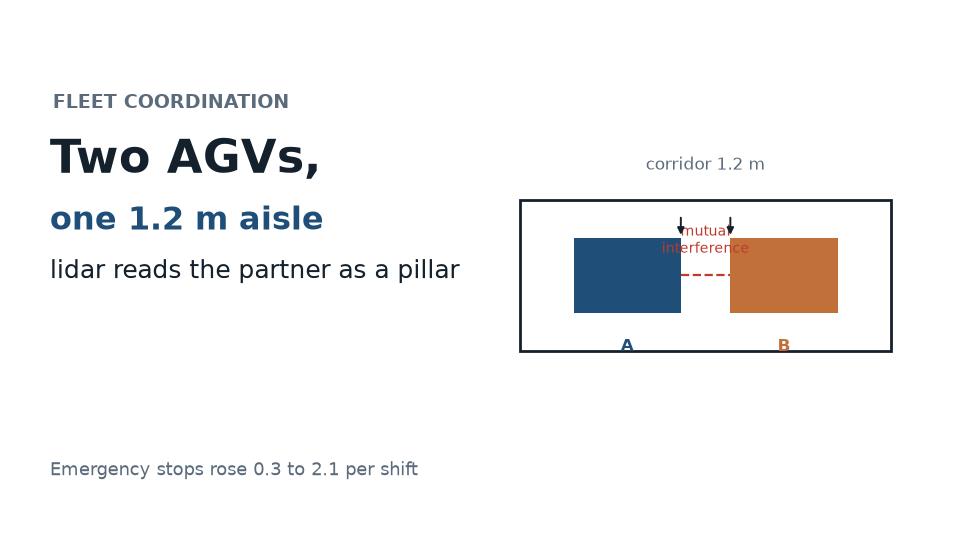
A parts factory added a second AGV to a line, expecting the extra vehicle to shorten the takt. One vehicle picked bins from the left and delivered them right; the other returned empty bins left. Instead of gaining speed, the line gained emergency stops, edge-scrape alarms and heartbeat timeouts. The vehicles were not faulty. They had been put into the same corridor without anyone telling them how to take turns.
Over two months of logs the conclusion was counterintuitive: most of the takt saved by running two vehicles was eaten by avoidance and mutual interference. Adding a robot did not double throughput. It doubled the ways to collide.
The symptom: takt did not improve, faults arrived first
The corridor is 12 metres long and 1.2 metres wide, wide enough for one vehicle only. Vehicle A carries loaded bins from the left to the right; vehicle B carries empty bins back. Their paths overlap across the middle 4.2 metres.
Two weeks of data tell the story:
| Metric | Single vehicle | Two vehicles |
|---|---|---|
| Emergency stops | 0.3 per shift | 2.1 per shift |
| Edge-scrape alarms | near 0 | 1.4 per shift |
| Enable drops (heartbeat timeout) | 0 | 0.2 per shift |
The extra vehicle did save some takt on long, straight runs, so the idea was not wrong. It was simply applied to the wrong layout.
The account: avoidance ate the savings
The same pick-deliver-return task was timed three ways:
| Configuration | Takt index |
|---|---|
| Single vehicle (baseline) | 100 percent |
| Two vehicles, ideal coordination | 65 percent (save 35) |
| Two vehicles, actual | 92 percent (save 8) |
The 27 percentage points between ideal and actual were spent on the two vehicles yielding to each other. Avoidance is not free. When one vehicle stops and waits for the other, that wait is added straight back into the takt. Worse is edge-scraping: instead of yielding or waiting, the vehicles squeeze past, both drift off trajectory, and the recovery time costs more than the wait would have.
The corridor is a single-log bridge
The corridor is 1.2 metres wide, the AGV body is 0.9 metres, leaving 15 centimetres of margin on each side. The vehicles cannot pass. Without a reservation mechanism, A and B each reach the entrance on their own takt, whoever arrives first enters, and the later one waits at the edge.
"Wait at edge" is the trap. The later vehicle stops at the entrance and blocks the upstream segment. If a third vehicle is upstream, it is blocked too, and the whole line's takt collapses in a chain reaction. A typical edge wait eats 3 to 8 seconds; across twenty trips a day that is one or two minutes simply lost.
The hidden fault: radar reads the partner as a pillar
This is the most overlooked failure source in dual coordination. Both underride AGVs carry a 2D lidar that spins and measures distance. In the same area, A's lidar hits B's body, and the echo strength resembles a reflector post, so the system treats B as a static pillar.
A emergency-stops and waits for the "pillar" to move. B, of course, does not move, because it is also waiting and its own lidar has tagged A as a pillar. Both stop; takt goes to zero. On the same corridor, the lidar false-alarm rate with two vehicles is 4 to 6 times higher than with one, and the alarm carries no error code. The log only shows "obstacle ahead, decelerating," which is almost impossible to trace after the fact.
Three signs identify mutual interference immediately:
The obstacle position is locked onto the other vehicle's coordinates. Both vehicles stop and recover at the same instant. Drive one vehicle away and the other returns to normal at once. Any one of these confirms the fault.
Three avoidance strategies, three costs
| Strategy | Extra time | Note |
|---|---|---|
| Yield and wait | 3 to 8 seconds | Also adds up to 15 m of detour travel |
| Detour | 0.5 to 2 seconds | Needs open space |
| Speed phasing | 0.5 to 2 seconds | Offset departure by 0.5 to 2 seconds |
A narrow corridor can only yield, because there is nowhere to detour, and yielding is exactly what wrecks the takt, so a narrow corridor is the wrong place for two vehicles. In open space, prefer detour or speed phasing over blind waiting. Speed phasing, where the two vehicles enter the same segment offset by half a second to two seconds, is the best value in dual coordination: almost no time lost. Blind yielding is the main reason dual-vehicle takt collapses.
The deadlock prototype: neither yields
Worse than mutual interference is mutual waiting. A reaches the entrance, sees B occupying the far side, and by rule "A does not retreat, A waits for B to go first." B reaches the other end, sees A occupying, and by the same rule "B does not retreat, B waits for A to go first." Neither retreats.
When the mutual wait exceeds the heartbeat threshold, generally 0.5 to 1 second, both vehicles drop enable, and the line stops for 30 seconds or more until a person or an auto-reset clears it. This is not occasional. Any time the two vehicles' priority rules are symmetric, they deadlock periodically at the intersection. The fix is to make priority asymmetric: on the same segment, the loaded outbound vehicle always has priority and the empty return vehicle always yields.
The scheduling layer: three gates
Whether dual coordination is stable depends on the scheduler, not the vehicles. This line got three gates:
Reservation. Apply for a time slot before entering the corridor. The corridor is like a single-occupant room; only when one vehicle leaves can the next enter. A holds slot 03, B waits for slot 04.
Priority. Task urgency sets the order; only equal-weight tasks poll, which avoids symmetric deadlock. Loaded outbound always outranks empty return.
Takt lock. Offset the two vehicles' departure times by the production takt so they never grab the same time window.
Remove any one gate and dual coordination degrades to two vehicles each running their own route plus the occasional fight. After all three were in place, the factory's emergency stops fell from 2.1 per shift back to 0.4 per shift.
Reservation lands as a token ring: split the corridor into four segments, each a token. A entering segment 2 holds segment 2's lock; B waits in segment 4 and may not cross segment 3. When A leaves segment 2 it releases the lock and B may enter segment 3. Occupying a segment is holding its lock; releasing it is the handover to the next vehicle. It is a traffic light, only finer.
The hidden cost: positioning jitter
Mutual interference does more than risk a collision. It inflates the positioning scatter. At one fixed point, twenty static frames gave a single vehicle a lateral standard deviation near 8 millimetres; under dual-vehicle interference that spikes to 42 millimetres. Docking precision fails first, and that is the most expensive sequel of running two vehicles together.
Three steps to decide whether to go dual
Average task trip under 15 metres. Short trips are the only ones where two vehicles pay off; on long trips a single vehicle is steadier.
Independent passing bay available. Without one, fix the layout before forcing two vehicles in.
Same-area false-alarm rate and positioning spread within spec. If not, isolate the lidars and stagger their frequencies first, then coordinate.
The lesson
Adding a second vehicle first adds a second thing to fight. Before running two AGVs, sort out the corridor, the lidar and the takt. No passing bay, do not run two. Lidars that illuminate each other, separate their frequencies or stagger their timing. Symmetric priority always deadlocks; make it asymmetric. And if any of the three scheduling gates is missing, the system collapses to two vehicles each doing their own thing.
For integrators: dual coordination saves takt and costs coordination. Coordinated badly, two vehicles stack the risk of two single vehicles while delivering less than double the throughput.
Source: RANKING IOT (Suzhou Yunqi Intelligent Technology), WeChat, 6 November 2026.