TICKEY: an ESP32-S3 color e-paper badge with interchangeable faceplates and open firmware

What it is
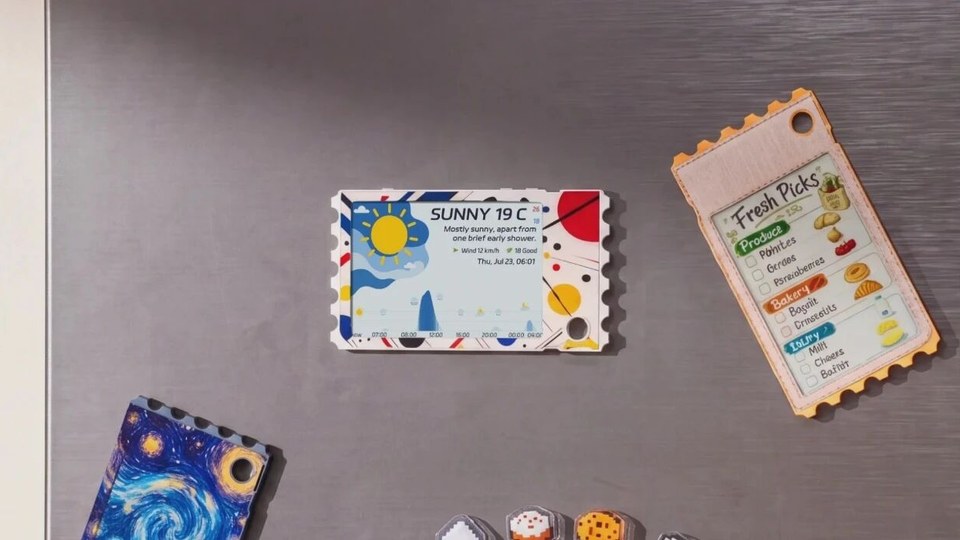
TICKEY is a pocket-size display that clips onto a bag, stands on a desk or sticks to a fridge, and keeps showing one image until you decide to change it. It is made by ENILINX, the brand of ENIAC TECHNOLOGY LIMITED, a Hong Kong, China company. The product was introduced during the campaign as TICKET and renamed to TICKEY before it closed; the hardware is the same.
The object itself is small: 111 x 62 x 3.8 mm and 45 g, in a CNC-machined aluminum unibody with a hole at the top for a clip ring. The panel is a 3.7-inch reflective display at 720 x 480 that reaches 48+ native colors using a driver developed with Modos, the open-source e-paper group behind the Modos Flow monitor.
What you actually get is a shell plus a set of ways to mount it: a clip ring for a bag, magnets and a recessed groove that hold interchangeable faceplates, and a desk stand.
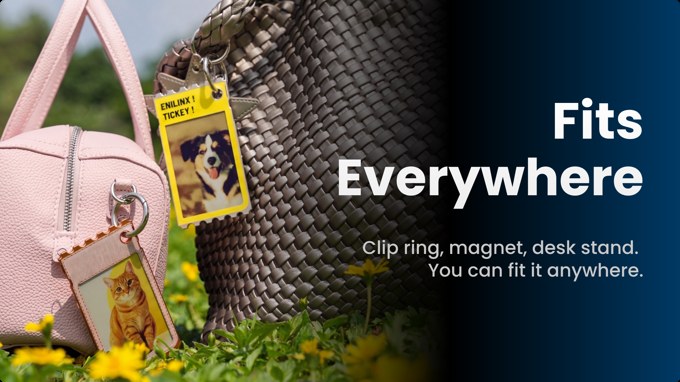
The zero-power part
E-paper only draws current while the picture changes. Once a refresh finishes, the panel holds the image with no power at all, so the battery can run flat and the picture stays where it is. The maker quotes over 1,000 refreshes per charge from the 360 mAh cell, and more than two months of use as a daily bag charm.
Because the display is reflective rather than backlit, it is readable in direct sunlight and does not glare. The trade-off is speed. A full refresh takes around 13 seconds, and the fast mode gets down to about 3 seconds. Video is out of the question, and the company says so rather than implying otherwise.
What is actually inside
The controller is an ESP32-S3, a dual-core Tensilica LX7 running at up to 240 MHz, which puts the device squarely in the ecosystem most readers here already work in. Around it:
- Wi-Fi 4 (2.4 GHz 802.11n) and Bluetooth 5.0 LE for getting images across from a phone.
- NFC (ISO 15693) for tap-to-share links. The company is explicit that this is for opening a page, profile or portfolio, not for access control, payment or door cards.
- USB-C for power, programming and recharging.
- Three physical side buttons, labelled up, down and back, plus 8 MB of on-board flash on the standard model.
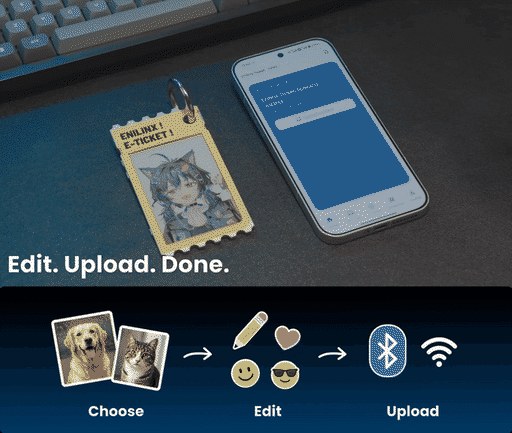
Content arrives through a companion app: pick a photo, a template or pixel art, edit it, then send it over Bluetooth or Wi-Fi.
Open firmware and the Developer Edition
The part that matters for a developer-facing catalogue is what sits underneath. TICKEY is open-source hardware, and ENILINX says it is building a firmware-sharing platform where third-party firmware can be found, downloaded and installed, with the option to restore the stock firmware afterwards.
There is a Developer Edition for people who intend to use that: the same base hardware, but 128 MB of storage instead of 8 MB, in a different color. The regular firmware still runs on it, and because the board is an ESP32-S3 the usual toolchains apply.
The crowdfunding result
TICKEY launched on Kickstarter with a goal of HK$10,000 and closed on 25 September 2026 having raised HK$7,018,414 from 8,214 backers, which is roughly US$900,000. Shipping is scheduled in two batches: the first 10,000 units in November and December 2026, and the remainder in the first quarter of 2027, with chip supply named as the main risk.
Why a small gadget like this sells
Nothing here is a new invention. E-paper is decades old, color e-paper is not new, and a badge that shows one static image cannot compete with a phone on a specification sheet. The campaign's own framing is the honest one: it is not selling capability, it is selling a small, quiet object that you can make your own.
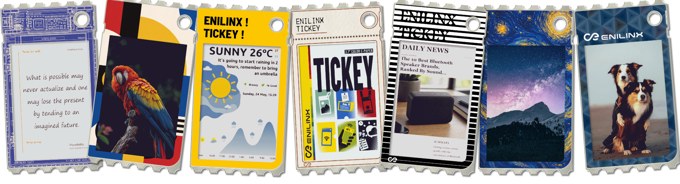
Two things do the work. The first is changeability. The picture and the faceplate both swap, so the same piece of hardware can play a different role from one week to the next. The second is the power behaviour. Because the panel holds an image without current, the object can sit on a bag for months without asking for attention, which is the opposite of every other screen in the room.
Where it fits in the IOTTourChina context
For readers here the interesting angle is not the charm but the pattern: a mature low-power display, an ESP32-S3, open firmware and a machined case that costs more than the electronics inside it. The pattern recurs across our E-paper Displays category, from Seeed's reTerminal E1002 to the Watchy smartwatch. The trade-offs involved are the same ones we set out in the e-paper display selection guide. And they apply here too.
TICKEY is a consumer product rather than an integration target, and it does not pretend to be anything else. It is still a useful marker of where China-made e-paper hardware currently sits: small teams, mature silicon, open firmware, and a willingness to sell a very simple idea very well.