Two routes to a tactile "RGB": LingBot-Touch unifies sensor signals into tokens, N0-Foundation converts them into a tri-axial force field first
Robot touch has a data problem that vision solved two decades ago and mostly forgot about. A camera produces RGB frames, and because every camera agrees on what those numbers mean, a model trained on one dataset transfers to another. Tactile sensors have no equivalent. A piezoresistive pad reports resistance, a magnetic sensor reports field change, a visuotactile sensor reports images of a deforming elastomer. The same press produces three unrelated signals.
Two Chinese teams are attacking that problem from opposite ends, and the difference in ordering is the interesting part.
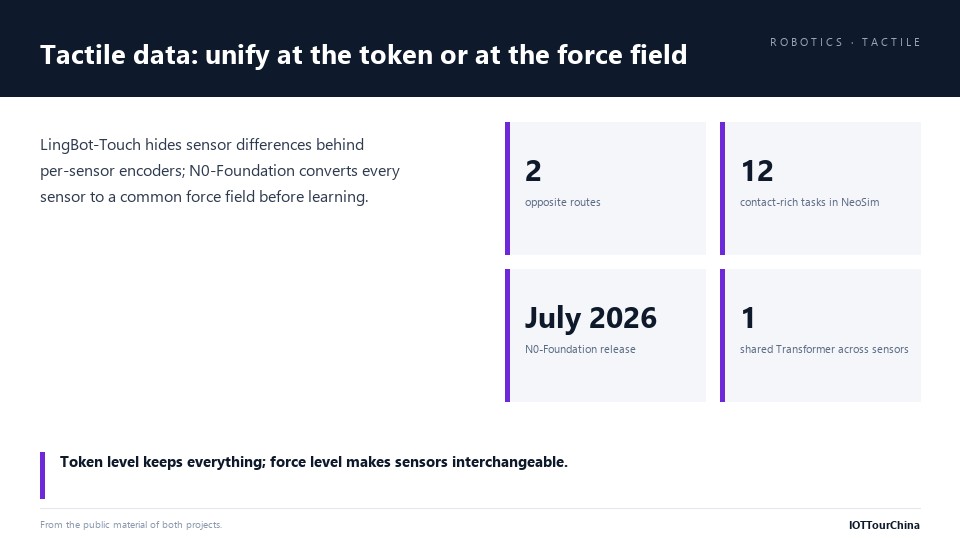
What LingBot-Touch does: unify at the token level
Ant Lingbo's LingBot-Touch, recently open-sourced, wraps heterogeneity behind an interface rather than trying to define a common physical quantity. The architecture described in public materials has three parts: a standardised geometric interface, sensor-specific encoders, and a shared Transformer. Each sensor type gets its own encoder; the outputs are projected into a common token space; downstream action models then consume tactile tokens regardless of which sensor produced them.
Training uses masked prediction, in the style of self-supervised work on images and video: hide part of the tactile observation and require the model to predict it from the visible portion and its context. That objective forces the representation to encode how contact state varies in space and time, rather than memorising a particular sensor's response curve.
The design choice is to let the model learn the correspondence between sensors. Nothing is asserted about what a pressure reading physically is; the encoder absorbs that, and the shared Transformer finds the common structure.
What N0-Foundation does: unify at the physical-quantity level
NeoteAI, working with Fudan University's Trustworthy Embodied Intelligence Institute, published N0-Foundation in July 2026 and takes the other order. Before any learning happens, each sensor is calibrated so that its raw reading maps to a standardised tri-axial force field — one normal component and two shear components. Only then does NeoForce, the representation model, learn from force fields combined with vision, with force-field reconstruction included among the training objectives.
Their pipeline is explicit: raw tactile signal, sensor calibration and conversion, unified force field, shared tactile representation, downstream manipulation task.
The RGB analogy they draw is precise, and it is about the interface rather than the channels. Different cameras have different sensors and different optics, but a common colour space plus calibration gives a consistent data representation. RGB's value is the convention, not the three numbers. A force field, in their argument, can play the same role for touch because contact force has a single physical definition even when the measurement principle differs — the work is in agreeing on units, coordinates and spatial sampling.
The trade, stated plainly
Unifying at the token level keeps every sensor's full information: nothing is thrown away by an intermediate conversion, and the model can in principle exploit idiosyncrasies of a particular sensor. The cost is that the mapping between sensors is learned implicitly, inside a network, and can only be trusted where training data covered it. A new sensor type needs data before it means anything.
Unifying at the force-field level produces an intermediate representation that is inspectable, comparable across hardware, and physically interpretable — a force is a force regardless of who measured it. The cost is that the calibration step becomes load-bearing. If the conversion to force is wrong, or if a sensor cannot be characterised this way (a visuotactile sensor's deformation field is not a direct force measurement), the common representation is either lossy or unavailable.
The two are not mutually exclusive, and the article is careful not to claim they are. But for anyone choosing a sensor stack, the difference matters: the force-field route decouples hardware adaptation from model learning, so sensor calibration, data collection and model training can each iterate independently. The token route couples them, which is more flexible and harder to debug.
What is actually available, and what it proves
The N0 stack ships as an ecosystem rather than a single model: NeoForce for the representation and its training and evaluation resources, NeoSim with 12 contact-rich simulation tasks, NeoReal with 10 real-world task definitions and evaluation protocols, and OpenNeoData, an open dataset of roughly 5,000 hours covering more than 250 tasks.
The project also reports a larger internal corpus — 30,000-plus hours across 450 tasks, about 1.4 million episodes, 8 billion RGB frames and 10 billion tactile frames across six embodiments — and states that OpenNeoData has passed one million cumulative downloads.
Those dataset numbers are the part worth scrutinising, because they are the actual bottleneck. A tactile foundation model is only as transferable as the diversity of contact conditions it has seen, and the field's limiting factor is not architecture. Earlier work on mmWave and radar datasets made the same point: standardised, annotated, comparable data is what turns a demo into a benchmark.
Downstream, NeoteAI has extended the representation into N0-VTLA, a vision-tactile-language-action model, and N0-TWAM, a tactile-native world-action model aimed at predicting future contact states. Both are attempts to move tactile information from perception into decision-making — which is the only place it can pay for itself.
Why this matters beyond robotics research
For integrators, the practical question is which tactile sensor to standardise on, and the honest answer today is that the choice is still tied to the model you intend to use. A unified representation is exactly what would break that tie: buy the sensor that fits the geometry and the budget, calibrate it into the common space, and let the model do the rest.
Neither team has demonstrated that across a genuinely open set of hardware. LingBot-Touch, being open-sourced, is the easier one to test. N0-Foundation's force-field route is the easier one to reason about. Until one of them is validated on sensors it was not trained on, both are arguments rather than infrastructure — but they are arguments pointed at the right problem, and the problem is not the network architecture.