Particle published its snowflake PCBA in full, down to the BOM and the wake word
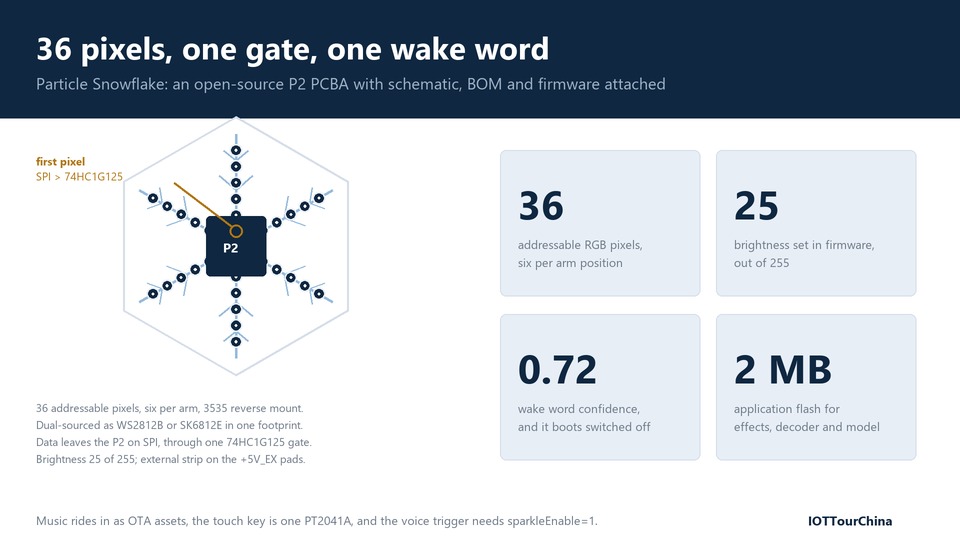
Most holiday LED projects are an ESP32 and a strip. Particle's is a snowflake-shaped four-layer board that the company designed, built in a limited run, and then published in full: schematic, board file, bill of materials, silkscreen artwork, component datasheets, firmware, and the audio files. The repository has been public since October 2023, carries an Apache-2.0 licence, and was last pushed to in February 2026.
What makes it worth reading is not the shape. It is that a module vendor shipped its own reference product and left the working files visible, so the level shifting, the power budget, the asset pipeline and the wake word model can all be checked against each other.
What is on the board
A P2 module sits in the middle, thirty-six addressable RGB LEDs run out along the arms, and a PDM microphone and a single capacitive touch key hang off the module. There is a speaker, a USB-C connector that both powers the board and flashes it, and no battery. No accelerometer, no light sensor, no radio beyond the module's own.
| Block | Part | Detail |
|---|---|---|
| Module | Particle P2, built by Wistron Neweb | Realtek RTL8721DM, Cortex-M33 at 200 MHz, 802.11a/b/g/n on 2.4 and 5 GHz, BLE 5, 2 MB application flash, 3 MB RAM |
| LEDs | 36 addressable RGB, 3535 reverse mount | Schematic labels every one WS2812B; the production BOM names the device WS2812B_SK6812E in a NEO3535_REVERSE footprint |
| Microphone | ST MP34DT05TR-A | PDM output, wired to the module's PDM pair |
| Touch | PinTeng PT2041AT6 | One key, SOT-23-6, electrode net CAP_SENSE_1 |
| Audio | TI TPA6211A1, Fu Sheng FS-1540 | Class-AB amplifier in MSOP-8 into an 8 ohm, 0.5 W, 87 dB speaker |
| Regulator | Torex XC6220B331PR-G | 3.3 volts at 1 amp, SOT-89-5, fed from USB 5 volts |
The board itself is 138.8 by 112.6 millimetres, 1.6 millimetres thick, four layers at 1/0.5/0.5/1 ounce copper, Tg150 material, white solder mask, black silkscreen, ENIG finish. Two supervisors sit on the reset line, an RT9818C on the 3.3 volt rail and an APX803L on the 5 volt rail, the second reaching the module through a zero ohm link, and a 10 second hardware watchdog is armed in firmware.
The LED chain is the part worth copying
Thirty-six pixels is not a lot, but the way they are wired is instructive.
The firmware defines the pixel pin as SPI. The strip object is constructed as a 36 pixel WS2812B chain bound to the SPI peripheral, not to a GPIO that the CPU toggles. Pushing the waveform through SPI keeps the timing off the application loop, which is why the render code can hold a 30 frame per second cap while the MP3 decoder and the classifier run on their own threads.
A buffer sits between the module and the first pixel, and the netlist says exactly where. The module's SPI data pin, labelled MOSI in the schematic, goes into the A input of IC1, a single-gate 74HC1G125 whose output drives a 200 ohm series resistor and then the data-in of LED2, the first pixel. The production BOM lists the Nexperia 74HC1G125GV; the schematic symbol is drawn as a 74AHC1G125, so the two documents disagree on the letter after 74, and the part that was actually bought is the HC one. The gate runs from the same 5 volt rail as the LEDs, which is what makes it a level shifter as well as a driver: the module emits 3.3 volt logic and every pixel on the board expects 5 volt logic.
Brightness is set to 25 out of 255 when the strip is initialised, and the reason is on the power side. The pixels do not hang off the 3.3 volt regulator; all thirty-six sit on the USB 5 volt rail with a ferrite bead and bulk capacitance. At full white a chain this size wants on the order of 2 amps, several times what a plain USB port is obliged to supply, so the cap is what keeps a 500 milliamp port from browning out mid-animation. That arithmetic is ours, not a comment in the code, but the two numbers line up too well to be a coincidence.
There is also a path for more pixels, and it is wired as a continuation rather than a second output. The last on-board pixel, LED37, sends its data-out through a 200 ohm resistor to a pad marked DATA, and the 5 volts for an external strip come through a P-channel MOSFET enabled by D4_NEOPIXEL_EXT_5V_EN, with a small NMOS between the module pin and the FET gate to lift the 3.3 volt enable up to the 5 volt rail. So an external strip is chain position 37 onward, not an independent bus.
Audio is decoded on the module and amplified on the board
Nothing exotic here, which is the point. The MP3 files are decoded in firmware by minimp3 and handed to the module's audio path through Particle's own audio HAL. The repository carries that HAL plus a driver for the Realtek RL6548 codec path, and there is no separate codec or DAC chip in the parts list. The module brings the audio out on a left and a right pin, each through a 1 kilo-ohm series resistor, straight into the TPA6211A1, whose shutdown pin is driven by D5 so the amplifier can be muted independently of the decoder. The speaker itself is an 8 ohm, 0.5 watt, 87 dB part in a 15 by 15 millimetre can.
Two 0 ohm jumpers on VO+ and VO- ship shorted and are there to be cut. Desolder or cut them and the speaker disconnects, which is what you want if the board becomes a line-level source instead of a decoration.
For voice the path is narrower: mono, 16 kHz, 16-bit. That is the format the classifier was trained on, and it probably explains why the holiday track in the assets folder is named frosty_short_16000.
One touch key, not three
The Particle logo on the front is the button. U7 is a PT2041A single-channel capacitive controller: the electrode net goes into its TCH pin, and its output reaches D10 of the module through a series resistor. Firmware reads D10 as an ordinary digital input through the clickButton library, with a 20 millisecond debounce, a 250 millisecond multi-click window and a 1 second long-press threshold.
The parts list contains exactly one touch device. There is no second controller on the board and no third one, and the module pin that receives the result is doing a plain digital read rather than acting as an electrode. Anyone describing this board as having several redundant touch schemes is reading pin names rather than the netlist.
The microphone is equally direct: its clock and data cross a pair of 0603 jumper footprints on the way to the module's PDM pins, its left-right select is tied to ground through a resistor, and that is the whole circuit.
The wake word is real and it ships switched off
The voice feature is a genuine Edge Impulse export compiled into the application. The model metadata says project Sparkle, deploy version 15, two classes, sparkle and unknown, one second of 16 kHz audio per inference window cut into four slices of 250 milliseconds, with an MFCC front end. A dedicated thread pulls slices, runs the continuous classifier, and fires the callback when the sparkle label clears 0.72.
That threshold is not a tuned number. The comment beside it calls it somewhat arbitrarily chosen from testing.
More important, the feature is disabled at boot. The stored setting sparkleEnable defaults to false, and the callback does nothing unless the setting has been written to 1. There are three ways to turn it on: call the settingsWrite cloud function with sparkleEnable=1 from the console, call the Mode function with the string sparkle, or change the default in the source and rebuild. When it fires, the strip jumps to a sparkle animation, plays super_star.mp3, and restores whatever mode was running when the track ends.
So the demo video where the board lights up on a spoken word is showing an opt-in path, not the out-of-box behaviour. The firmware is honest about it in a comment block that spells out both the console route and the one-line code change.
Music is attached as assets, not compiled in
The MP3s are not baked into the application binary. They sit in the asset directory declared in project.properties, are mounted as a file system at boot, and are enumerated with System.assetsAvailable. The playlist is every mp3 found there except voice_welcome.mp3 and super_star.mp3, which are reserved for the greeting and the sparkle animation.
In the published repository that leaves exactly one song, frosty_short_16000.mp3. The other two clips are voice_welcome.mp3, which the startup code comments out, and super_star.mp3, which belongs to the sparkle animation. Adding music therefore means adding an asset rather than editing the application, and it keeps audio out of the application flash partition.
What a finger does
One click advances the animation and fires a two-tone confirmation beep. The mode list is off, snowflake, hanukkah, rainbow, chase, circles, wave and sparkle, and the click handler deliberately skips off and sparkle so you cannot land on them by accident. A long press plays the next song. The chosen mode is written to settings and survives a power cycle.
There is also a Particle function named Mode that accepts sparkle, off, next, prev, previous, snowflake and hanukkah, which is how you drive the board from a script, a schedule or another device instead of a fingertip.
Files worth opening first
| File | Why |
|---|---|
| schematic PDF | The buffered LED net, the touch electrode, the external strip switch and both supervisors on one page |
| BOM spreadsheet | Manufacturer part numbers for every line, plus the lines marked not fitted that show what was considered and dropped |
| firmware application source | Click semantics, the sparkle gate, the asset enumeration and the watchdog in 365 lines |
| model parameters header | The classifier's window, slice count, class list and sample rate in a dozen defines |
The blueprint file at the repository root is the fifth thing to open, because it is what makes the project reproducible: it declares the web setup link that flashes a device from a browser, the two supported boards, and the Edge Impulse integration.
Where the design is thin
The P2 is the entire compute story. Two megabytes of application flash and three megabytes of RAM have to hold the LED effects, the MP3 decoder, the audio HAL and a neural network, and there is no alternate footprint for anything else. If the module goes away, the board does too.
That is not hypothetical. Particle announced on 27 January 2026 that it is being acquired by Digi, which is worth knowing before committing to a build that depends on a single module part number.
The USB-C port is a proper USB 2.0 device port, not a charging jack: the connector's D+ and D- run through ESD diodes into the module's USB pair, and both CC pins carry 5.1 kilo-ohm pulldowns, so the board enumerates and flashes over the connector it ships with. What is missing is power delivery. There is no CC controller and no negotiation, so the board takes what a plain 5 volt source gives and cannot ask for more when an external strip is attached.
The model is a fixed export. Retraining means going back to Edge Impulse, re-exporting, and rebuilding, and the confidence threshold would need to be re-checked against the new model rather than copied forward.
The amplifier is oversized for the speaker. The TPA6211A1 is a 3.1 watt part and the fitted speaker is rated at half a watt, so the software volume setting is the only thing between a loud track and a damaged cone. Playback is queued at volume 100 in the application code, which leaves no headroom in software for that mismatch.
And brightness stops at 25 out of 255. The snowflake is a decoration that sits on a tree or a desk; nobody is going to light a room with it.