Arm Cortex-M42 slots between M33 and M52: Helium vectors, custom instructions, and no cache — 10% less silicon, 15% less power at 22ULL
The problem Arm is addressing with the Cortex-M42 is not performance in the abstract. It is the specific situation of an MCU vendor with an existing product line, a mature firmware stack and a customer asking for keyword spotting, anomaly detection or a small vision model — on the same bill of materials, in the same package, with the same power budget.
On 18 November, Arm China held a briefing in Beijing on the new core and on an accompanying AIoT prototype platform called Xingchen 100e. The framing throughout was upgrade cost rather than peak throughput.
Three engines, one core
The Cortex-M42 is an Armv8.1-M design on a conventional AHB bus, and Arm describes it as combining three things:
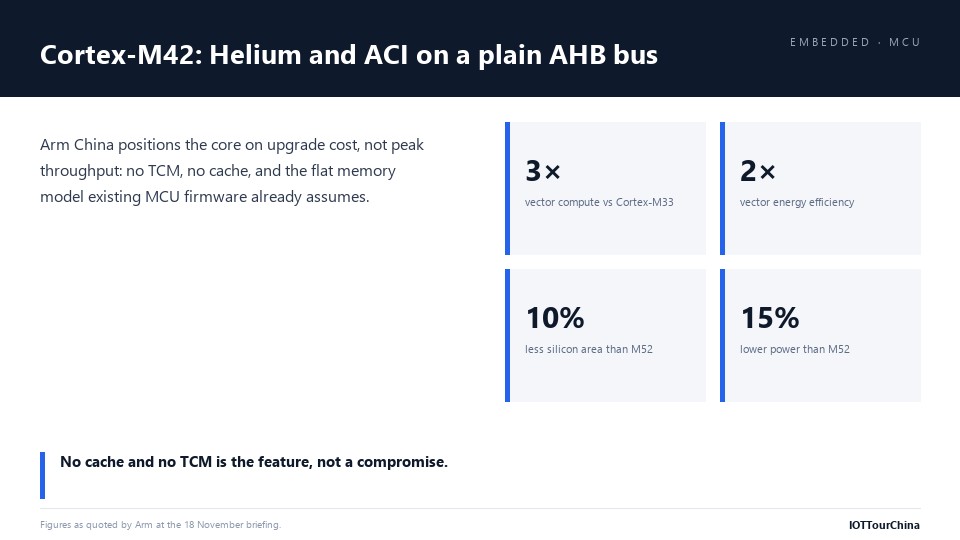
- Helium, Arm's M-profile vector extension, which carries the DSP and neural-network arithmetic. Against the Cortex-M33, Arm quotes three times the vector compute performance and twice the vector energy efficiency.
- ACI (Arm Custom Instructions), which lets a silicon partner add instructions for its own proprietary workloads — the differentiation space left to chip vendors rather than to Arm.
- AHB, the bus most MCU designs already use, which is the part that matters most commercially.
Arm says the 8-bit fixed-point workloads typical of quantised end-side inference gain more than twice what 32-bit floating-point workloads do. That is a deliberate alignment with where tinyML has settled: int8 models, small tensors, and a hard cap on how much SRAM the application can spare.
The omission is the argument
The Cortex-M42 has no TCM and no cache. There is no memory subsystem to re-architect around, which means the design keeps the memory model most MCU firmware is written against — a flat address space with deterministic access.
For a team already shipping on Cortex-M4 or Cortex-M33, that is the difference between a migration and a rewrite. Firmware, peripheral drivers and platform assets carry over. Arm's positioning material states the intent directly: simplified migration from M4 and M33.
It also bounds what the core can be used for. Anything that needs a large working set, a cache hierarchy or heavy external memory traffic is not what this part is for.
Where it sits, with numbers
Arm places the Cortex-M42 between the Cortex-M33 and the Cortex-M52, competing on area and power rather than on peak capability. At TSMC 22ULL and 150 MHz, Arm's comparison against the Cortex-M52 is:
- comparable scalar plus vector performance,
- 10 per cent less silicon area,
- 15 per cent lower power.
Those are vendor figures from a specific process and clock, and they describe the core rather than a finished SoC — a real part adds SRAM, flash, peripherals and analog, which can easily dominate both area and power. But the direction of the claim is the one that matters for endpoint products: the same class of vector work, in a smaller and cooler die.
Arm's suggested landing zones are wearables, low-power connected terminals, industrial sensor nodes and connected controllers, with workloads such as keyword recognition, sensor signal analysis, equipment condition monitoring, anomaly detection and predictive maintenance.
The platform, and the numbers that go with it
Xingchen 100e pairs the Cortex-M42 with an Ethos-U55 NPU in a heterogeneous arrangement — CPU for control and vector pre/post-processing, NPU for the tensor work. It follows the earlier Xingchen 300 design and has been validated on FPGA, running keyword detection, object recognition and automatic speech recognition.
The speedups Arm quotes, against the Cortex-M42 running the same work on its own, are dramatic: 95 times for keyword detection, more than 132 times for object recognition, more than 340 times for speech recognition.
Read those with the usual caution. The baseline is a microcontroller core doing inference in software, and the comparison is NPU-plus-CPU against CPU alone — the multiplier mostly measures how unsuitable a scalar-plus-vector core is for convolutional or transformer work, not how good the NPU is in absolute terms. The useful reading is architectural: on a fixed power budget, if the workload is a neural network, the NPU is not optional.
For a chip vendor, the platform's value is a starting point that has already been through FPGA validation, which shortens the loop between architectural definition and a working prototype.
Why this matters for Chinese MCU vendors specifically
The Cortex-M42 enters Arm's roadmap and its Flexible Access and Total Access licensing programmes, which is how most Chinese MCU companies get access to current cores without a full architecture licence.
That combination — a vector-capable core that does not force a memory-subsystem redesign, available through subscription licensing, with a reference platform alongside — is aimed squarely at the long tail of endpoint products. The pitch is that an existing control MCU can acquire sensing and inference without becoming a different kind of product.
Whether it works commercially depends on something Arm cannot supply: int8 models that fit in the SRAM those parts will actually carry, and tooling that lets a firmware engineer — not a data scientist — retrain and deploy them. The core removes one obstacle. It does not remove that one.