Rejeee warehouse rack monitoring: tilt sensors on the uprights, load cells under the pallets
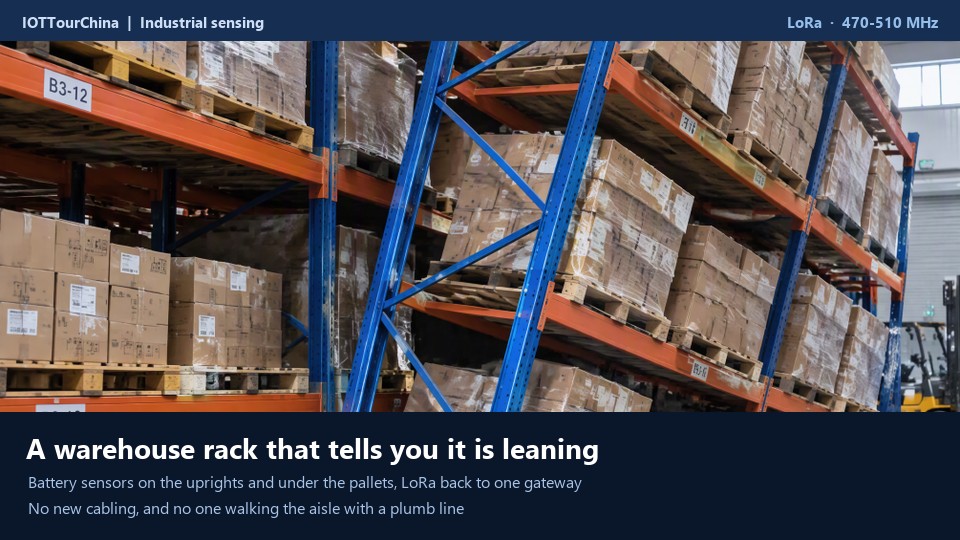
A pallet rack that has started to lean rarely announces itself. The damage begins at a connection or a base plate, the geometry shifts by a fraction of a degree, and for a long time the only visible symptom is a load that no longer sits level. The conventional check is someone walking the aisle with a plumb line on a schedule, which finds problems late and only where the walk happens to go.
Rejeee, the Nanjing sensor maker behind the insertion temperature probe, the busbar infrared head and the pipeline monitoring scheme we covered earlier, has published a fourth document built on the same low-power LoRa hardware. This one is about warehouses: tilt and vibration sensors on the racking, a weighing sensor under the pallets, temperature and humidity in the aisle, and one gateway per building collecting the lot. It is a solution proposal rather than a product launch, so it describes its hardware in categories instead of part numbers, but the parts behind those categories are all in the vendor's published catalogue.
What the proposal describes
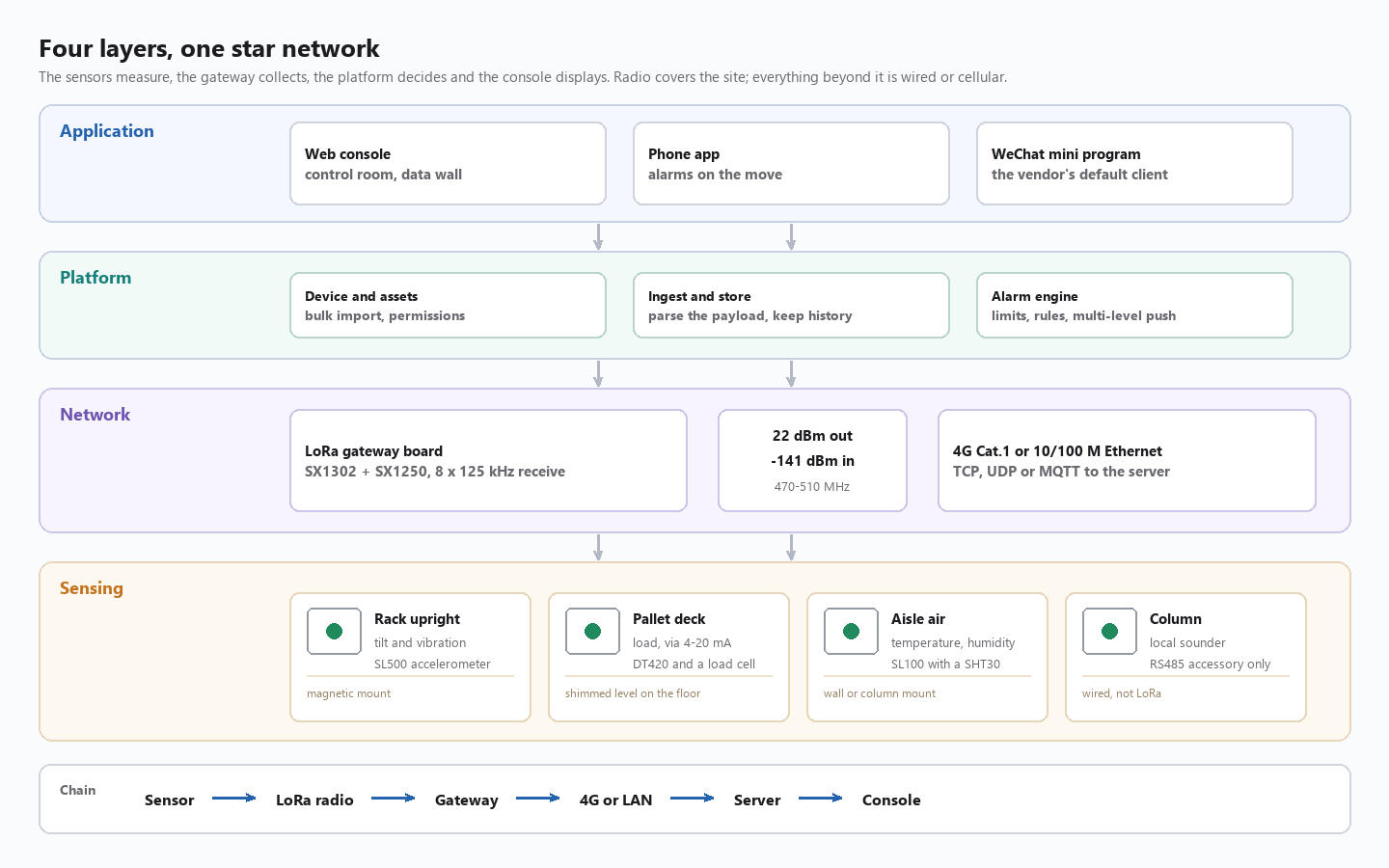
Four layers again, and the same star-shaped radio network in the middle. The sensing layer is a set of battery terminals: a tilt and vibration sensor, a weighing sensor, a temperature and humidity sensor and a sounder for the local alarm. The network layer is a LoRa gateway with eight receive channels. The platform layer is the vendor's cloud service, doing device and asset management, payload parsing and storage, alarm rules and multi-level notification. The application layer is a data wall on a PC, a phone app and a mini program.
The chain the vendor draws runs from the sensors on 470 to 510 MHz, to the gateway, over 4G Cat.1 or Ethernet to the cloud, and out to whatever screen is nearest. The stated objectives are the familiar ones: no cabling to the sensors, three to five years of claimed battery life, a sounder loud enough for whoever is in the building, and a remote push by app, SMS or phone call for everyone who is not.
Two of those objectives are worth reading carefully. The local sounder matters because a warehouse alarm that only reaches a phone is not an alarm anyone in the building will act on, and the proposal is right to pair the two. The battery figure matters because it is the number that decides whether this is a maintenance-free installation or a site visit every year, and the published tables only support it on the lightest duty cycle available.
The sensors are battery boxes, and the catalogue names them
None of the four sensors is identified in the proposal. All four can be pinned down from the vendor's published catalogue, which lists exactly one product in each of the roles described.
| Role in the proposal | Catalogue part | The figures that matter |
|---|---|---|
| Tilt and vibration | SL500 accelerometer | plus or minus 2 g range, plus or minus 40 mg accuracy, 300 mg vibration trigger, 5 s detect period |
| Tilt, high precision | SL510 or the rechargeable SL511 | plus or minus 90 degrees, 0.05 degree accuracy, 0.001 degree resolution, 10 s detect period |
| Weighing | DT420 4-20 mA logger with a load cell | 4-20 mA input, 2, 3 or 4 wire, 38 Ah cell, IP64 housing |
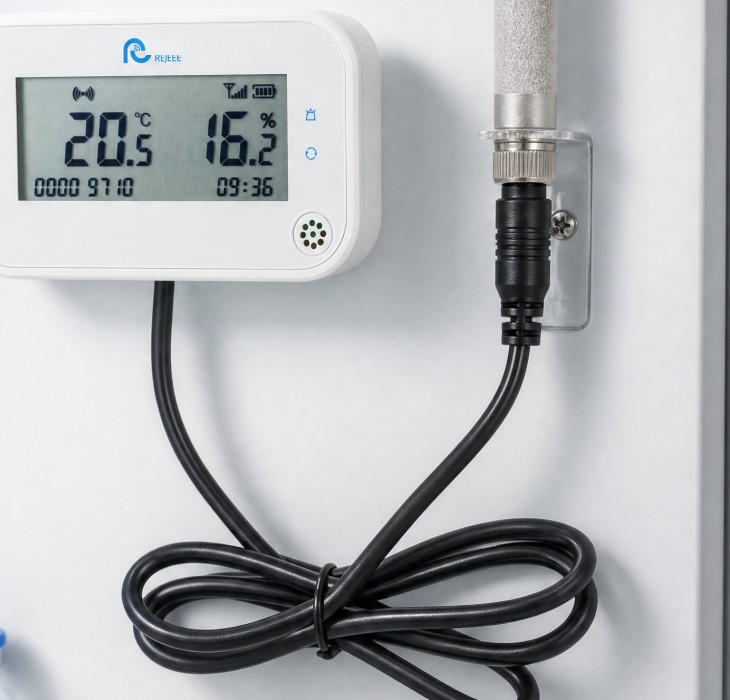
| Temperature and humidity | SL100 with a Sensirion SHT30 | minus 40 to 85 degrees internal, minus 40 to 125 degrees on a remote probe, plus or minus 1 degree and plus or minus 5 percent RH |
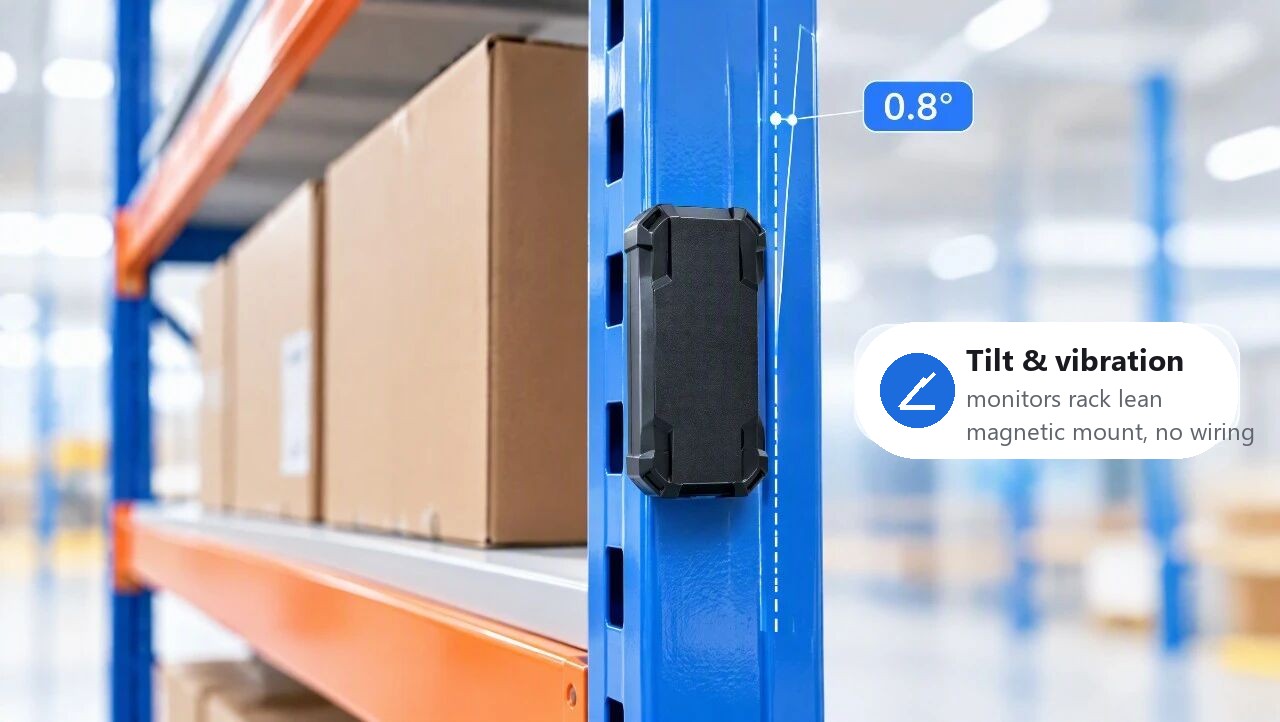
Three of those need a note. The vibration sensor is an accelerometer, not an inclinometer: it reports whether the rack moved and how hard, and it also reports a coarse angle, which the manual defines as the angle between its Z axis and vertical rather than a calibrated tilt reading. The high-precision tilt sensor is a different product and reports in thousandths of a degree. A rack monitoring scheme that wants a trend line rather than a shock log needs the second one, and the proposal does not say which of the two it means.
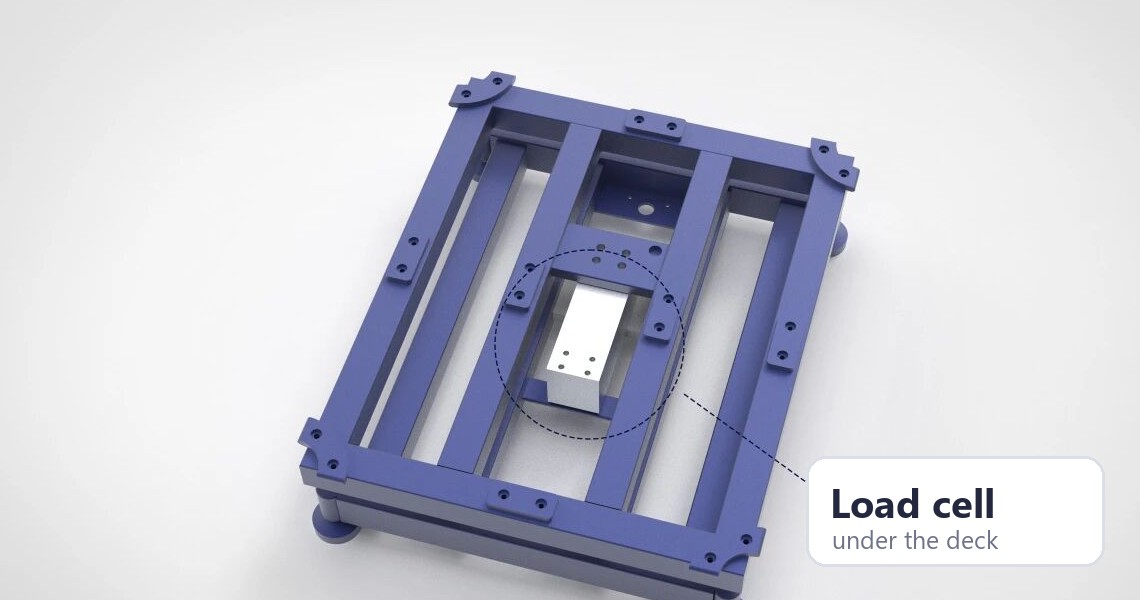
The weighing position is the one that needs the longest look. The proposal calls it a high-precision digital weighing module, and the render shows a low steel platform with a load cell inside it. The documented device that fits everything else in the description is the DT420, which is a 4-20 mA loop logger: it measures a current, converts it to a float against a full-scale value the installer enters, and reports both the raw microamp reading and the scaled value. A strain-gauge load cell produces a millivolt output rather than a loop current, so the chain needs either a load cell with a transmitter built in or a separate transmitter between the two. Nothing in the proposal says which. What the logger does bring is a change threshold, 100 microamps by default, that overrides the reporting period when the reading moves, which is the behaviour a load sensor actually wants.
The load platform itself is the simplest part of the design and the one that needs the most site work, because a load cell only reads what is actually resting on it.
The gateway behind it is a documented board
The proposal's gateway section quotes a main processor at 900 MHz, 8 GB of eMMC with 128 M of DDR memory, a maximum transmit power of 25 dBm, and a receive sensitivity of minus 141 dBm. Three of those four numbers are wrong against the vendor's own datasheets, and the datasheets agree with each other across the whole gateway range.
| Item | Proposal | GL6xx datasheets |
|---|---|---|
| Processor | Cortex-A7 at 900 MHz | Cortex-A7 at 528 MHz |
| Memory | 128 M DDR with 8 GB eMMC | 512 MB RAM with 8 GB flash |
| Transmit power | 25 dBm | 22 dBm |
| Receive sensitivity | minus 141 dBm | minus 141 dBm at SF12 and 125 kHz |
| Receive channels | 8 independent plus 1 transmit channel | 8 channels at 125 kHz decoding SF5 to SF12, plus 1 standard channel at 125, 250 or 500 kHz |
| Uplink | 4G Cat.1 and 10/100 M Ethernet, TCP, UDP, MQTT | the same |
| Operating system | embedded Linux | embedded Linux |
The rest of the gateway description matches the family closely, down to the third-party server support and the option of extra local storage. The range covers four shapes: the GL610 indoors with dual Ethernet, an RS485 port and a 24 volt output, the GL620 indoors with Power over Ethernet as well as a DC input, the GL600 and GL601 outdoors under IP67, and the GL680 as a custom outdoor variant. The indoor board measures 116.7 by 92.05 by 26.6 mm and runs from 9 to 24 volts DC, which is worth knowing because a warehouse office usually has a socket and a rack aisle usually does not.
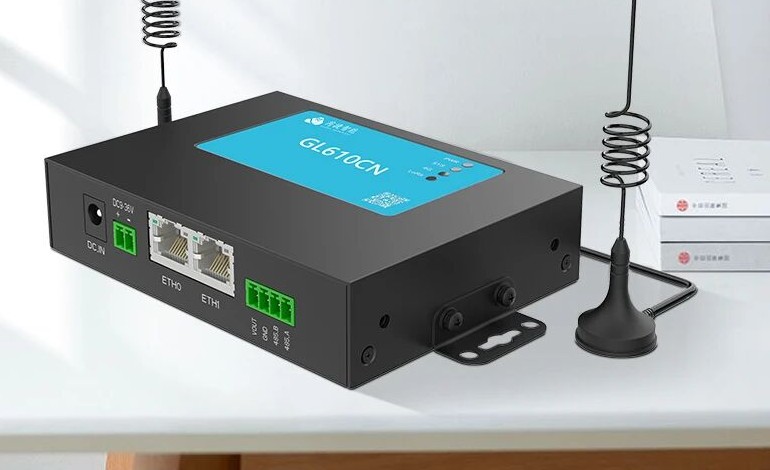
The proposal also states that one gateway can carry over a thousand terminals. No such figure appears in any of the gateway documents. Eight receive channels on a shared band will accept a large number of slow-reporting battery nodes, and the arithmetic is not unreasonable, but it depends entirely on how often each sensor talks, and the documentation leaves it to the integrator.
What the sensors actually send
The frame definition is the most useful part of the vendor's documentation and it is the same one used across the range. Outside LoRaWAN the radio sends a one-byte header, a four-byte device address, a control byte and a two-byte packet counter, then the readings, closed with a two-byte CRC16 computed over everything before it. Inside LoRaWAN the prefix and the CRC are dropped and only the readings go out as the payload on port one. Multi-byte values are big-endian throughout.
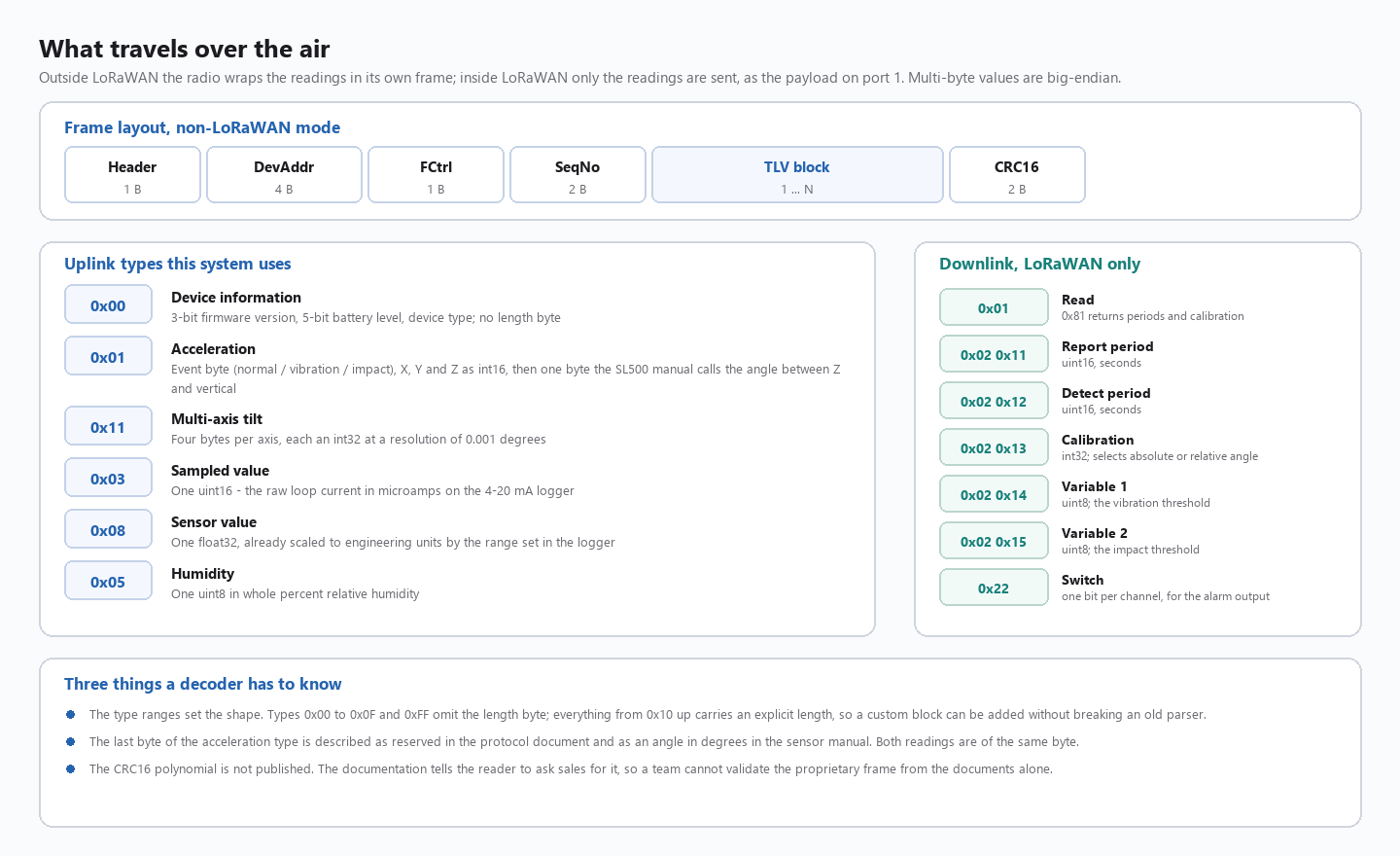
The readings are a sequence of type-length-value entries, and the type range decides the shape. Types from 0x00 to 0x0F and 0xFF are fixed base types that omit the length byte; everything from 0x10 up carries an explicit length so that a custom block can be added later without breaking an existing parser. For this solution the relevant ones are the device-information block, which packs a three-bit firmware version, a five-bit battery level and a device-type byte into a single fixed entry; the acceleration type, which carries an event byte, three int16 axes and one further byte; the multi-axis tilt type, whose length is four bytes per axis at a resolution of 0.001 degrees; the sampled-value and sensor-value types that carry the load reading raw and scaled; and the humidity type, one byte in whole percent.
That extra byte at the end of the acceleration entry is worth flagging for anyone writing a decoder. The protocol document calls it reserved. The vibration sensor's own manual calls it the angle in degrees between the Z axis and vertical, which is the value the coarse angle reading is made of. Both are describing the same byte, and a parser written from the protocol document alone will drop the one number that makes the sensor useful for tilt trending.
Downlink is documented as LoRaWAN-only and covers the settings a commissioning engineer changes: the reporting period and the detection period in seconds, a calibration value that on the tilt sensor selects absolute or relative angle, two variables that on the vibration sensor set the vibration and impact thresholds, and a switch command for the alarm output. The threshold mechanism is the same one that stretches battery life on the vendor's temperature products: on each detection cycle the sensor compares the new reading with the last one it sent and transmits immediately if the difference is large enough, instead of waiting for the reporting period.
Where the hardware goes
The proposal asks for a survey of rack structure and warehouse layout before anything is fixed, which is the right first step, because a rack has more places to put a sensor than it has places worth measuring.
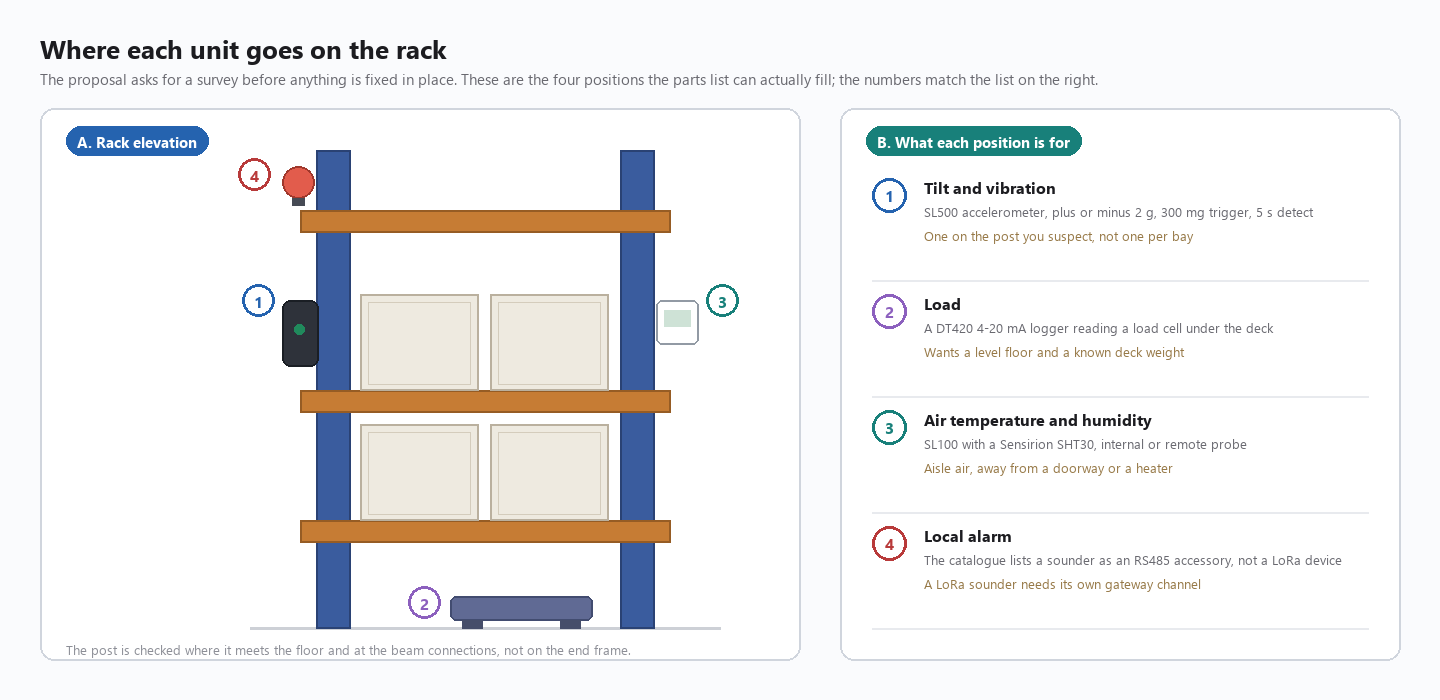
The upright is where a tilt or vibration sensor earns its place: it is the member that carries the lean, and it is where the base plate and the beam connections that fail first are. The proposal specifies a magnetic mount, which is convenient on a steel upright and worth checking against the paint and the load, since a magnet that lets go during a rack impact is worse than no sensor.
The load sensor belongs on the floor with the deck resting on it, not in the beam, and it needs the floor to be level and the empty deck weight to be known before the readings mean anything. Temperature and humidity belong in the aisle air at working height, away from a doorway or a heater, because the point of the reading is the general condition of the building rather than the condition of the sensor's own wall.
The sounder is the position that the parts list cannot fill as described. The proposal says it uses LoRa, and no LoRa sounder appears in the catalogue: the one sounder listed there is an RS485 and Modbus accessory that needs a controller to drive it. A LoRa sounder would either need its own radio channel and gateway registration or a wired connection back to something that has one, and neither route is described.
The tiers, and a second reading of the same proposal
The proposal offers three configurations, and what changes between them is worth more attention than the price ladder suggests.
| Item | Low | Mid | High |
|---|---|---|---|
| Edge gateway | 1 per warehouse | 1 per warehouse | 1 per warehouse |
| Sensors | vibration and tilt, as needed | vibration and tilt, as needed | tilt, weighing and temperature or humidity, as needed |
| Sounder | 1 per warehouse | 1 per warehouse | 1 per warehouse |
| Cameras | none | into the gateway over Ethernet | optional |
| What is monitored | rack vibration and tilt | rack vibration and tilt | cargo weight, rack tilt, warehouse environment |
| Alerts | app, SMS, phone | app, SMS, phone | app, SMS, phone |
The load sensor only appears in the top tier, which is honest: weighing a pallet position is the expensive half of the scheme and the half that needs the most site work. What does not change between tiers is the gateway and the sounder, one of each per warehouse at every level. A single gateway per building is the assumption the whole proposal rests on, and it is the number to test first, because the answer depends on the rack layout in that particular building rather than on the radio.
Two extension applications are offered. The first turns the sounders into a tray locator: one sounder per tray area, each with a unique identifier, a handheld terminal that signals the one you want, and a gateway somewhere in the area. The second suggests the tilt and vibration sensor can double as an asset tracker for pallets and containers. The catalogue lists no tracker, and the vibration sensor has no positioning hardware, so that second idea rests on the protocol's geographic-coordinate type rather than on a product anyone can buy.
Where the proposal and the datasheet disagree
This proposal is not unusual in being written by a marketing team rather than an engineering one, and its architecture, its installation advice and most of its sensor descriptions line up with the published documents. Six items need care before anything is specified from it.
- The gateway numbers. A 900 MHz processor with 128 MB of DDR and 25 dBm of transmit power would be a different and better gateway than the one the vendor sells. The published figures are 528 MHz, 512 MB and 22 dBm, and they are consistent across four models and two product generations of documentation. Take the datasheet figures into any quotation.
- Battery life. Every sensor in the proposal is quoted at five years. The datasheets attach conditions: five years for the accelerometer at a 5 second detection cycle and a 10 minute reporting cycle, five years for the 4-20 mA logger at a 10 minute report, three years for the high-precision tilt sensor at 10 minutes, and three years for the temperature and humidity sensor at a 5 minute report or five years at 10 minutes. The last two have the largest cells in the range. A site that wants faster reporting should expect the shorter figures.
- The weighing chain. A 4-20 mA logger is not a digital weighing module. The interface between the load cell and the logger is the part of this design that carries the most risk of a surprise, and it should be settled with the vendor before the platform is ordered.
- The sounder. Its radio is described as LoRa and the vendor's own catalogue lists an RS485 accessory. This is the one item where the proposal describes something that does not obviously exist.
- The tilt sensor choice. Vibration and tilt are two products in the catalogue with a twenty-fold difference in angle resolution. A rack lean trend wants the second one.
- The detection period ceiling. Four of the sensor datasheets give a maximum configurable detection period of 65553 seconds. Sixteen bits of seconds cannot hold that number; the ceiling is 65535, and the gateway's own configuration guide uses the correct figure elsewhere on the same site. It is a typographical error rather than a limitation, but it has been copied into every manual in the family.
One further thing applies to the whole scheme. The CRC16 algorithm used on the non-LoRaWAN frame is not published anywhere in the vendor's documentation, which tells the reader to ask a sales contact for it. A team that wants to validate the proprietary frame, or decode it without using the vendor's gateway, cannot finish that job from the documents alone. LoRaWAN mode avoids the problem entirely by using the standard frame, and for a new installation that is probably the right choice.
How it compares
| Option | Wiring | What you get | What you still own |
|---|---|---|---|
| This scheme | none to the sensors | rack lean, shock, load and aisle climate, with a local alarm | A survey, a gateway position, the platform |
| Wired inclinometers and load cells | a cable and an input channel per point | higher accuracy and a faster sample rate | Cable runs, power, cabinets, and a rack that has to be offline to fit them |
| Periodic inspection with a level | none | whatever the inspector sees on the day | A walking route, a schedule, and the gap between visits |
| Handheld or fixed laser scanning | none to the rack | a full geometric survey of the aisle | Someone to run it, and a repeatable reference point |
Practical notes
- Choose the sensor by the question you are asking. Shock and impact damage, a slow lean and a seated load are three different measurements, and the catalogue has a different product for each. The proposal's single tilt and vibration category hides that choice.
- Fix the detection and reporting periods before the battery arithmetic is quoted. The difference between a five second detect cycle and a sixty second one is the difference between a five-year claim and a much shorter one, and the alarm latency the site actually needs is usually less than the shortest interval offered.
- Put the gateway where the racking is dense rather than where the network cabinet is. Steel racking is a worse radio environment than open floor space, and eight channels do not help if the antennas cannot hear the far end of the building.
- Test the rack environment before the platform is built. Pallet racking is a conductive box: mounting heights, load density and the pallet material all move the received signal, and none of that is in the datasheet.
- Ask for the load cell interface in writing. Whether the load cell has an integral transmitter, and what its full-scale output is, decides whether the logger's scaled value means anything without a separate calibration step.
- Treat the sounder as an open question. Decide whether the local alarm is driven from a LoRa node with its own channel, from the gateway's RS485 port, or from a mains unit triggered by the platform, and buy accordingly.
- The default band is 470 to 510 MHz, which is not licence-free everywhere. The datasheets list other regional bands as available on request, so raise the band at quotation time.
- Day-to-day configuration is through the vendor's desktop tool over a USB serial connection, with a wireless AT path for the sealed enclosures. A team without the vendor's tooling should confirm what is available before designing it into a commissioning workflow.
- There is no published price and this is closed commercial hardware. Nothing here can be inspected or maintained independently, so the vendor relationship carries the same weight it does for any closed product.
- We have not tested any of this hardware. Everything above comes from the vendor's published documentation and the proposal itself, and the two disagree in the places listed, so treat both as the start of a conversation with the vendor rather than as a settled specification.
IOTTourChina covers China-made IoT devices and their integration details as part of its developer resource. This is editorial coverage, not an endorsement or an advertisement; specifications, editions and pricing should be confirmed with the vendor.