Rejeee pipeline monitoring: PT100 probes on steam pipes, LoRa out to an explosion-proof base station
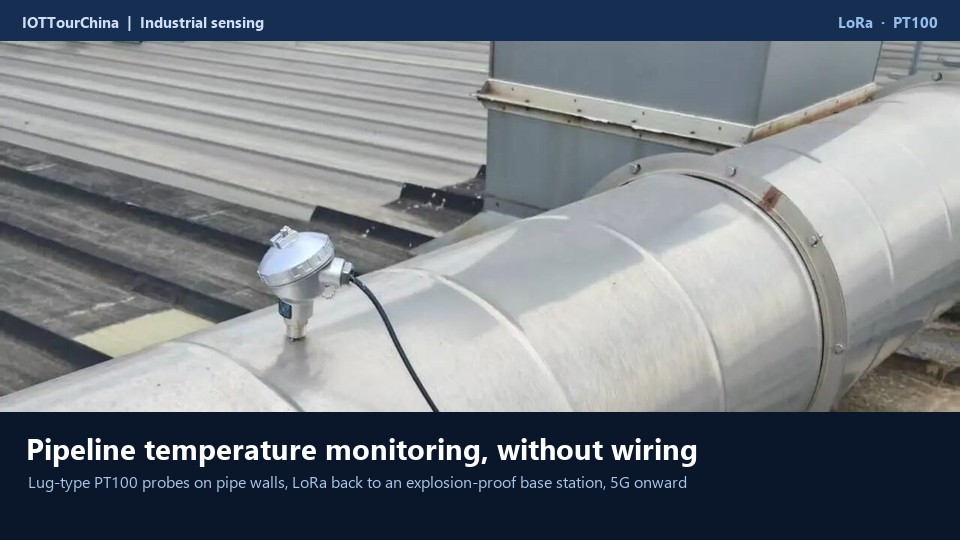
A steam pipe that loses its lagging does not fail loudly. The insulation degrades, the wall temperature climbs, and the first person to notice is often someone who happens to walk past. The conventional answer is a thermocouple or an RTD strapped to every joint, which brings a cable run to every one of them and, on a live plant, a permit to go with it.
Rejeee, the Nanjing sensor maker behind the insertion probe and the busbar infrared head we covered earlier, has published a third build on the same theme. This one is aimed at pipe networks rather than grain piles or switchgear: lug-type PT100 probes clamped onto pipe walls, LoRa terminals on brackets nearby, and a base station that collects the readings and forwards them over a cellular link. The document is a solution proposal rather than a product launch, and it names its own hardware only in passing, but the terminal it describes can be identified from its published dimensions.
What the proposal describes
The system is laid out in four layers, with a star-shaped LoRa network in the middle. Terminals measure, a base station collects, a server decides what counts as an alarm, and a console or phone displays the result. The chain the vendor draws is terminal to base station, base station to the cellular network, network to server, server to whoever is looking.
The sensing layer is one terminal per measuring point, each with an external PT100 probe. The network layer is a LoRa base station with eight receive channels, built to accept several hundred terminals by sharing the airtime between them, with a cellular module and optional VPN for the uplink. The platform layer receives, decodes and stores the readings and runs the alarm rules, and can forward what it has over MQTT, Modbus or JSON to a plant's existing SCADA or MES. The application layer is a web console for the control room, a phone app and a WeChat service account for field staff.
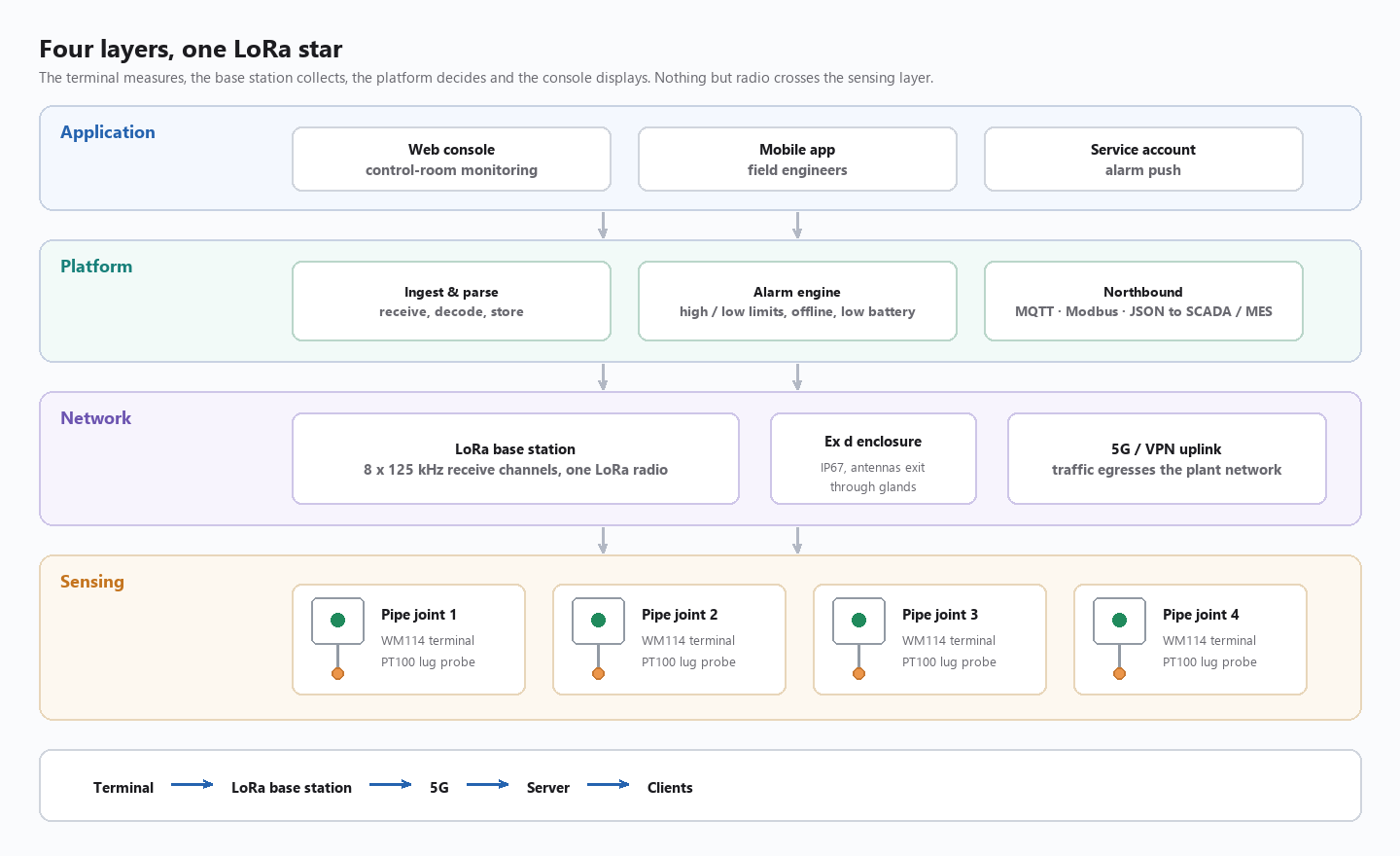
Two claims in that layout deserve attention early, because they are where the proposal is doing its real work. The first is that the terminal is intrinsically safe on its own, so it can be mounted inside a hazardous area without a separate enclosure. The second is that the base station is not, so it goes into an explosion-proof box with its antennas brought out through sealed glands. That is an honest split, and it is also the reason the arrangement can be retrofitted on a running plant rather than during a shutdown.
The terminal is a PT100 logger with a two-metre lead
The probe is a lug-type platinum resistance element, the kind with a flat eyelet that a metal band presses against the surface being measured. Two wires leave the lug, and the terminal that reads them is a white box on a bracket a short distance away, out of the radiant heat.
The published dimensions pin the terminal down. At 103.87 by 123.70 by 44.36 mm it matches the WM114-LF-A0, the LoRa PT100 logger in the same vendor's catalogue, whose datasheet carries the same figure and the same two-metre probe lead. A 4G variant, the WM114-C1-B1, uses the identical housing. Nothing in the article states which one is meant, but the radio it quotes, 470 to 510 MHz with a maximum of 22 dBm and a three to five kilometre open-air range, is the LoRa version.
| Item | Proposal | WM114 datasheet |
|---|---|---|
| Probe range | minus 100 to 300 °C, for pipes up to 250 °C | minus 200 to plus 200 °C |
| Accuracy | not stated | plus or minus 0.3 °C |
| Battery | 25.5 Ah lithium-thionyl chloride | 25 Ah lithium-thionyl chloride |
| Service life | at least five years | not stated |
| Ingress and safety | IP66, Ex ia IIC T5 Ga intrinsic safety | not stated |
| Radio | LoRa, 470 to 510 MHz, 22 dBm, 3 to 5 km | same |
| Storage | local caching with automatic resend | 128 Mbit |
| Configuration | Bluetooth with a phone app, magnet trigger, status LEDs | Bluetooth with the vendor's mini-program, two magnetic zones |
| Operating envelope | minus 40 to plus 85 °C, 0 to 99.9 %RH | same |
| Dimensions | 103.87 x 123.70 x 44.36 mm | same |
| Mounting | hook, bracket or pole | same |
The parts that match are the parts that matter for a retrofit. The terminal is battery powered, so no cable has to be pulled down a pipe rack. The magnet trigger means the housing stays sealed while a technician sets the reporting interval and alarm thresholds over Bluetooth. The 128 Mbit of on-board storage is what makes the promise of caching during a network dropout real, and the datasheet defines a stored-record type so that cached samples can be replayed rather than lost.
The base station is a gateway in a box
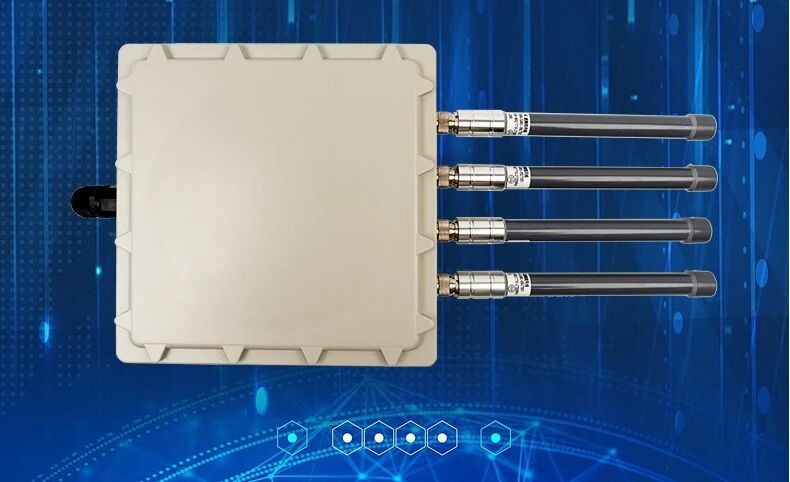
The proposal is candid that the gateway board does not meet an explosion-proof standard by itself, and that the certified assembly is the board plus a flameproof enclosure. The box it quotes is 300 by 300 by 150 mm and rated Ex db IIC T6 Gb and IP67, fed from mains AC, with the LoRa and cellular antennas led out through certified glands.
That enclosure size is worth reading carefully, because it is several times the footprint of the gateway inside it. The publicly documented gateway in this family is a Cortex-A7 board with eight 125 kHz LoRa receive channels plus one standard channel, 22 dBm of transmit power, a receive sensitivity of minus 141 dBm, dual Ethernet, a cellular module, a watchdog and an RTC, with a built-in web server for configuration and TCP, UDP or MQTT for transport. Its own dimensions are 116.7 by 92.05 by 26.6 mm and it is normally powered from 9 to 24 volts DC. Everything in the proposal's feature list, down to the watchdog and the RTC clock, maps onto that board.
Two numbers do not map. The proposal specifies a 5G module where the published documentation of the range describes 4G Cat.1, and it specifies mains AC where the board is described as DC powered. Both are plausible as project-specific variants, and both are exactly what you ask a vendor to confirm before writing a specification around them.
What the terminal actually sends
The useful part of the vendor's documentation is the frame definition, and it is unusually complete for hardware in this price bracket. Outside LoRaWAN the radio sends a one-byte header, a four-byte device address, a control byte and a two-byte packet counter, then the sensor data, closed with a two-byte CRC16 computed over everything before it. Inside LoRaWAN the prefix and the CRC are dropped and only the sensor data goes out as the payload on port one.
The sensor data is a sequence of type-length-value entries, and the type ranges tell you which shape each one takes. Types from 0x00 to 0x0F, plus 0xFF, are fixed base types and omit the length byte; everything from 0x10 up carries an explicit length so that custom payloads can be added later without breaking a decoder.
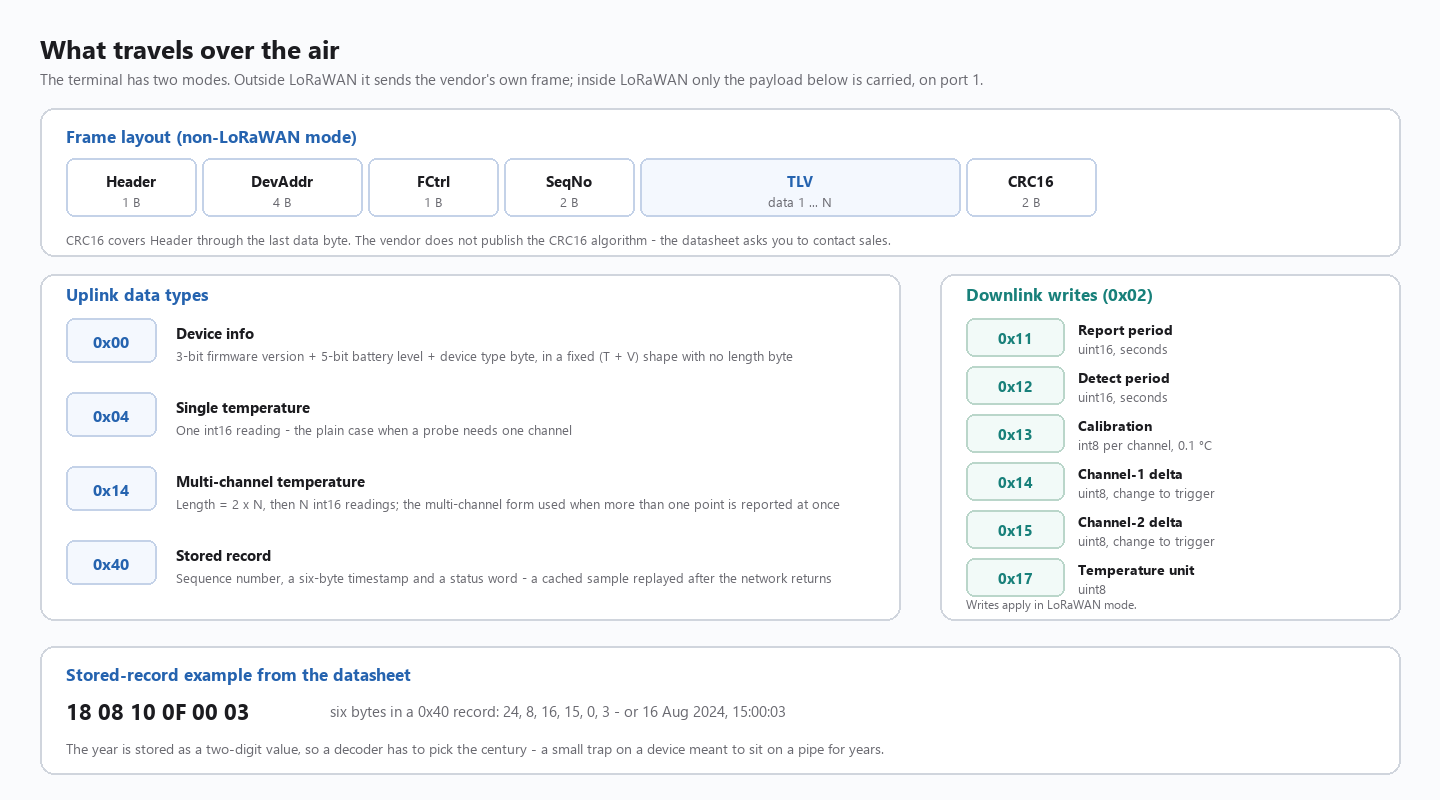
Four types cover the device. Type 0x00 is a device-information block: a three-bit firmware version, a five-bit battery level and a reserved device-type byte. Type 0x04 is the basic single-temperature type, named in the documentation as the simpler option when only one channel is reported. Type 0x14 is the multi-channel form, a length byte followed by that many bytes of readings, which is what a device reporting several points at once would use. Type 0x40 is a stored record, built from a sequence number, a six-byte timestamp and a status word, and it is the type that makes the offline-caching claim concrete. The vendor's worked example is eighteen zero-eight one-zero zero-F zero-zero zero-three, six bytes that read as 24, 8, 16, 15, 0 and 3, or 16 August 2024 at 15:00:03.
Downlink is documented as LoRaWAN-only and covers the settings a commissioning engineer actually changes. A read command asks for the configuration block, whose length varies with what is requested, and write commands set the reporting period and the detection period in seconds, a per-channel calibration in tenths of a degree, a change threshold per channel, and the temperature unit. That change threshold is the mechanism that stretches the battery: on each detection cycle the device compares the new reading against the last one it sent and transmits immediately if the difference is large enough, instead of waiting for the reporting period to come round.
Where the probe goes
The proposal describes two mounting positions, and the choice between them is a measurement question rather than a convenience one.
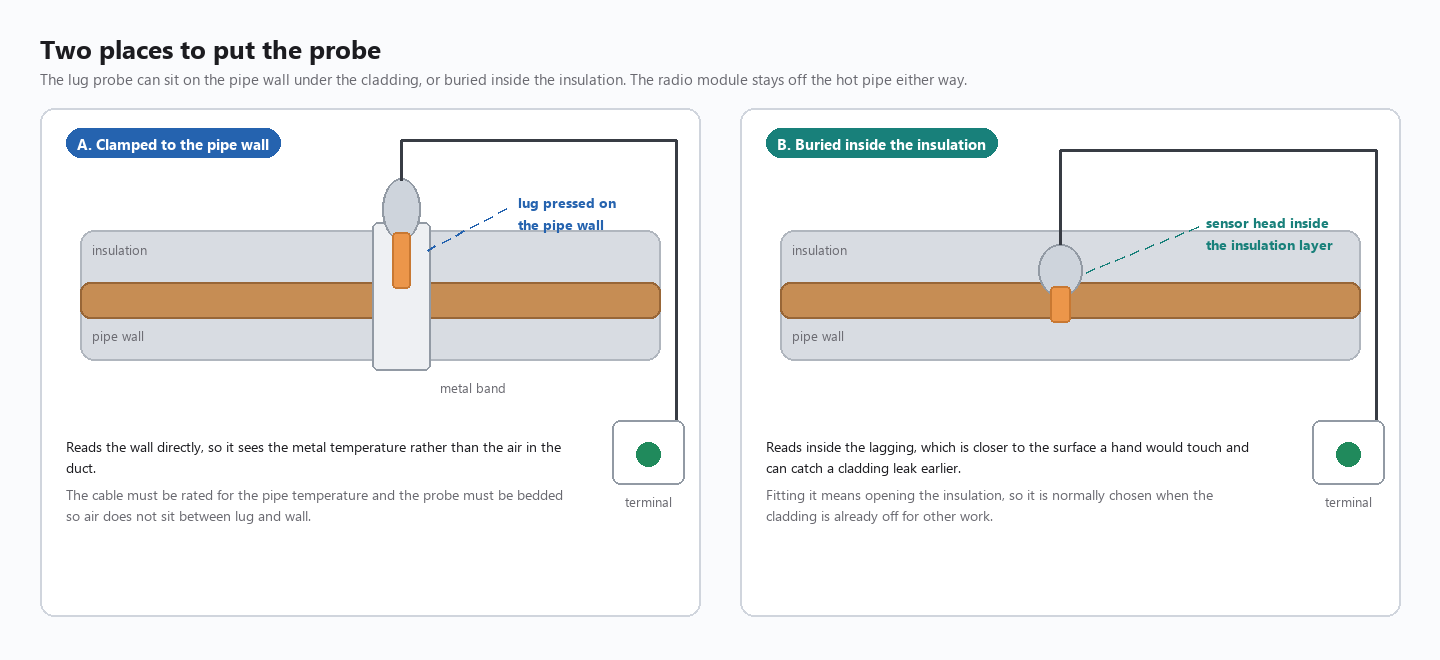
Clamped to the wall, under a metal band, the lug reads the temperature of the metal itself. That is the most direct reading of the pipe, but it requires the cladding to be opened and the probe bedded so that no air pocket sits between the lug and the surface, and the lead has to be rated for the pipe temperature. Buried inside the lagging, the element sits nearer the surface a hand would touch, which can catch a cladding leak earlier, at the cost of opening the insulation to fit it. In both cases the terminal stays on a bracket away from the pipe, which is the whole reason the radio module can have a normal operating range of minus 40 to plus 85 degrees while the pipe runs at a few hundred.
Where the proposal and the datasheet disagree
The proposal is more careful than most documents in this genre. Its architecture, its installation steps and most of its terminal figures line up with the published datasheet, and its admission that the gateway needs a separate enclosure is the kind of thing marketing copy usually omits. Four items still need care.
- The temperature range. The proposal gives the probe as minus 100 to 300 degrees and says it suits pipes up to 250 degrees. The datasheet's measuring range for the same terminal is minus 200 to plus 200 degrees. A PT100 element is happy well past 300 degrees, but the measuring range is a property of the terminal reading it, and on the published figure a 250 degree pipe sits outside it. Confirm the range for the specific terminal before specifying it on a high-temperature line.
- The safety and ingress ratings. Intrinsic safety to Ex ia IIC T5 Ga and IP66 are stated in the proposal and appear nowhere in the terminal's datasheet, which does not mention an ingress rating or a hazardous-area approval at all. The gateway's enclosure rating is a separate matter and is stated as part of the enclosure, not the board. Treat the terminal certifications as something to obtain as paperwork before designing them into a hazardous area.
- The service life. At least five years is a reasonable expectation for a 25 Ah lithium-thionyl chloride cell on a slow reporting cycle, but the datasheet does not state a life figure at all, so the number in the proposal cannot be checked against a stated duty cycle the way a published figure could.
- Single or multi-channel payload. The datasheet's uplink overview lists the device-information, multi-channel-temperature and stored-record types as the ones in use, while the multi-channel definition says that a single channel may instead use the simpler single-temperature type. Which one a single-probe terminal actually emits is not written down, and the calibration command still carries a second channel's field, a leftover from the two-channel product the page was evidently adapted from. A decoder should accept both shapes, and the exact payload should be captured from a live unit before the platform is built around it.
One more thing is worth knowing before a decoder is written at all. The CRC16 algorithm used on the non-LoRaWAN frame is not published. The datasheet tells the reader to ask a sales or technical contact for it, which means a team that wants to validate the proprietary frame cannot finish the job from the documentation alone.
How it compares
| Option | Wiring | What you get | What you still own |
|---|---|---|---|
| WM114 terminal with a lug PT100 | none to the pipe | pipe-wall temperature at each point, cached and replayed | Gateway, network, platform, probe bedding |
| Wired RTD or thermocouple to a logger | a cable and an input channel per point | one point per channel, higher absolute accuracy | Cable runs, logger, power, cabinet space |
| Infrared head on the enclosure wall | none | no contact with the live part, good for switchgear | Line of sight, emissivity work, same back end |
| Handheld thermal camera survey | none | whatever is in frame, at the moment of the visit | A walking route and a schedule |
Practical notes
- Plan the probe bedding as carefully as the radio. A lug that is not pressed flat against the wall, or one sitting on a layer of air inside the lagging, will read something, and that something will be wrong in a way no amount of platform tuning will fix.
- Establish a baseline per point after commissioning and watch each point against its own history. Pipeline monitoring is a trend exercise; comparing one insulated joint against another on a different run invites false alarms.
- The change threshold is the setting that decides battery life, not the reporting period alone. Set it loosely on a stable line and the radio stays quiet; set it tightly and the five-year arithmetic in the proposal stops applying.
- The default band is 470 to 510 MHz, which is not licence-free everywhere. The datasheet lists the other regional bands as available on request, so raise the band at quotation time.
- Decide the payload question before writing the platform. Whether the terminal emits a single-temperature type or the multi-channel type changes the decoder, and the documentation does not settle it.
- Configuration in day-to-day use is a WeChat mini-program on a phone, with a desktop path through a virtual Bluetooth serial port. A team that does not use WeChat should confirm the desktop route before designing it into a commissioning workflow.
- There is no published price, and this is a closed commercial product. Nothing here can be inspected or maintained independently, so the vendor relationship carries the same weight it does for any closed hardware.
- We have not tested this hardware. Everything above comes from the vendor's published documentation and the proposal itself, and the two disagree in the places listed, so treat both as the start of a conversation with the vendor rather than as a settled specification.
IOTTourChina covers China-made IoT devices and their integration details as part of its developer resource. This is editorial coverage, not an endorsement or an advertisement; specifications, editions and pricing should be confirmed with the vendor.