Rejeee SL163: four live busbar joints read through the air, over LoRa
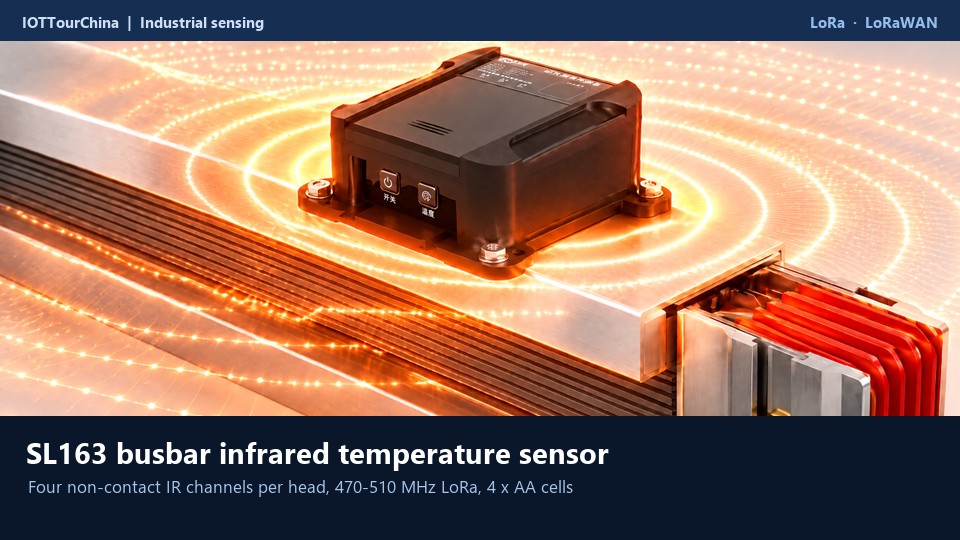
A busbar joint rarely announces that it is failing. Contact resistance climbs as a bolt loosens or a contact face oxidises, and the heat that follows is the symptom rather than the cause. The conventional way to watch for it is to clamp a thermocouple or an RTD onto every joint, which means a cable run to every joint and either a planned outage or a live-work permit to fit each one.
Rejeee, the Nanjing sensor maker whose insertion temperature probe we looked at earlier, sells the opposite approach. The SL163-LF-A0 is a head that sits on the outside of the enclosure and reads four joints at once through the air, without touching the conductor and without a cable.
What the device is
The head is 120.1 x 92.1 x 44.4 mm and about 400 g. Inside are four independent infrared thermopiles, a LoRa radio, a Bluetooth 4.2 radio and a compartment holding four AA alkaline cells in series. The four channels are arranged so that one head can watch the phase A, B, C and neutral joints of the same trunking run, which is the unit the vendor is selling: one device and no wiring instead of four probes and four cable runs.
Set-up is deliberately shallow. A base plate goes onto the enclosure with screws or adhesive tape, the head slides onto the base, and every parameter afterwards is set over Bluetooth rather than through a serial port or a DIP switch. The radio is configured either for the vendor's own frame format or for standard LoRaWAN, defaulting to 470 to 510 MHz with other regional bands selectable in configuration. The vendor's list of scenarios is data centres, shopping malls, factory busbars and retrofit work in older electrical rooms, and the common thread in all of them is a busbar that is already in service and cannot easily be taken out of it.
Reading a live joint without touching it
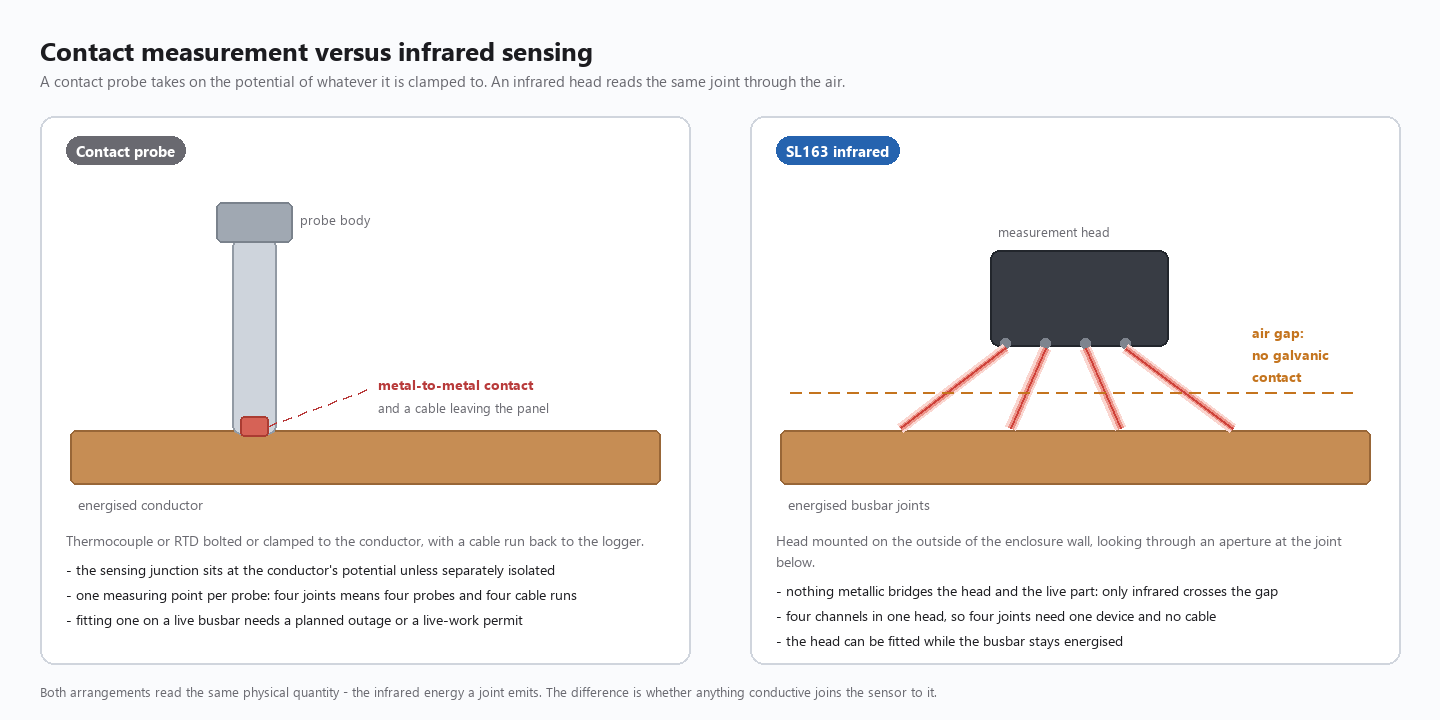
The safety argument is straightforward and worth stating plainly, because it is the whole reason the category exists. A contact probe is a conductor: once it is bolted to a busbar, the sensing junction sits at the potential of that busbar unless it is separately isolated, and fitting it means working near a live part or waiting for an outage. An infrared head has no metallic path across the gap at all. It reads the energy the joint radiates, so the head and the live conductor can be separated by air and by the enclosure wall, and the head can be installed while the busbar stays energised.
The trade is accuracy, and it is easy to miss in the marketing. The SL163 is specified at plus or minus 2 degrees Celsius, against roughly plus or minus 0.5 degrees for a good contact probe. That is a narrower absolute guarantee, and it is compounded by the physics of the method: an infrared reading depends on the emissivity of the surface being viewed, so a polished or recently cleaned contact face reads differently from an oxidised one, and nothing in the path may obstruct the aperture. For spotting a joint that has drifted 30 degrees above its neighbours, which is what this class of device is for, plus or minus 2 is more than adequate. For a calibrated measurement of absolute temperature, it is not the right instrument.
What the four channels look like on the wire
This is where the SL163 is documented considerably better than most hardware in its class. The vendor publishes the complete uplink and downlink layout, including the type that carries the four channel readings.
Frames come in two shapes. In the vendor's own format the radio sends a one-byte header, a four-byte device address, a control byte and a two-byte packet counter, followed by the sensor data and closed with a two-byte CRC16 computed over everything before it. In LoRaWAN mode the prefix and the CRC are dropped and only the sensor data is sent, as the FRMPayload on FPort 1, which is exactly what a standard network server wants.
| Field | Non-LoRaWAN mode | LoRaWAN mode |
|---|---|---|
| Preamble | header, device address, control byte, packet counter | supplied by the LoRaWAN stack |
| Sensor data | TLV triplets | TLV triplets, as FRMPayload |
| Port | not applicable | FPort 1 |
| Trailer | CRC16 over all preceding bytes | MIC from the LoRaWAN stack |
The sensor data itself is a sequence of type-length-value entries, and the type ranges tell you which shape each one takes:
| Type range | Format | Meaning |
|---|---|---|
| 0x00 to 0x0F, and 0xFF | type and value | fixed base types, length byte omitted |
| 0x10 to 0x1F | type, length, value | generic types with an explicit length |
| 0x20 to 0x3F | type, length, value | project-specific types |
| 0x80 and above | type, length, value | user parameter read and write |
For a busbar deployment the three types that matter are short and unambiguous. Type 0x00 carries device information as a three-bit firmware version, a five-bit battery level and one reserved byte. Type 0x04 carries a signed 16-bit temperature in tenths of a degree, so the vendor's own example of 04 FF 88 decodes to minus 12.0 degrees, and in this product the documentation states that 0x04 is used for the ambient temperature inside the enclosure rather than for a joint. Type 0x14 is the one that carries the measurement, and it is defined as a length byte followed by N signed 16-bit values, one per channel; for busbar trunking N is four, with each channel taking two bytes.
Two details are worth confirming with the vendor rather than assuming. The 0x14 definition does not restate its unit, and while the same tenth-of-a-degree scaling as 0x04 is the obvious reading, it is not written down. And the CRC16 algorithm for the non-LoRaWAN frame is not published at all: the document says to ask a sales or technical contact for it, which means a platform that wants to validate the proprietary frame has to send an email before it can finish a decoder.
Downlink is LoRaWAN-only and is documented to match. A read of type 0x01 with value 0x81 returns the configuration block, whose length varies with what is asked for: four bytes returns the report and detection periods, eight adds the calibration value, and further bytes add the two configuration variables. Writes use type 0x02 with a sub-code, covering the report period and detection period as 16-bit seconds, the temperature change threshold as a byte, and the high-temperature alarm threshold as a byte. A write sub-code of 0x00 followed by a timestamp handles time synchronisation.
Configuration, and a battery figure quoted at the wrong duty cycle
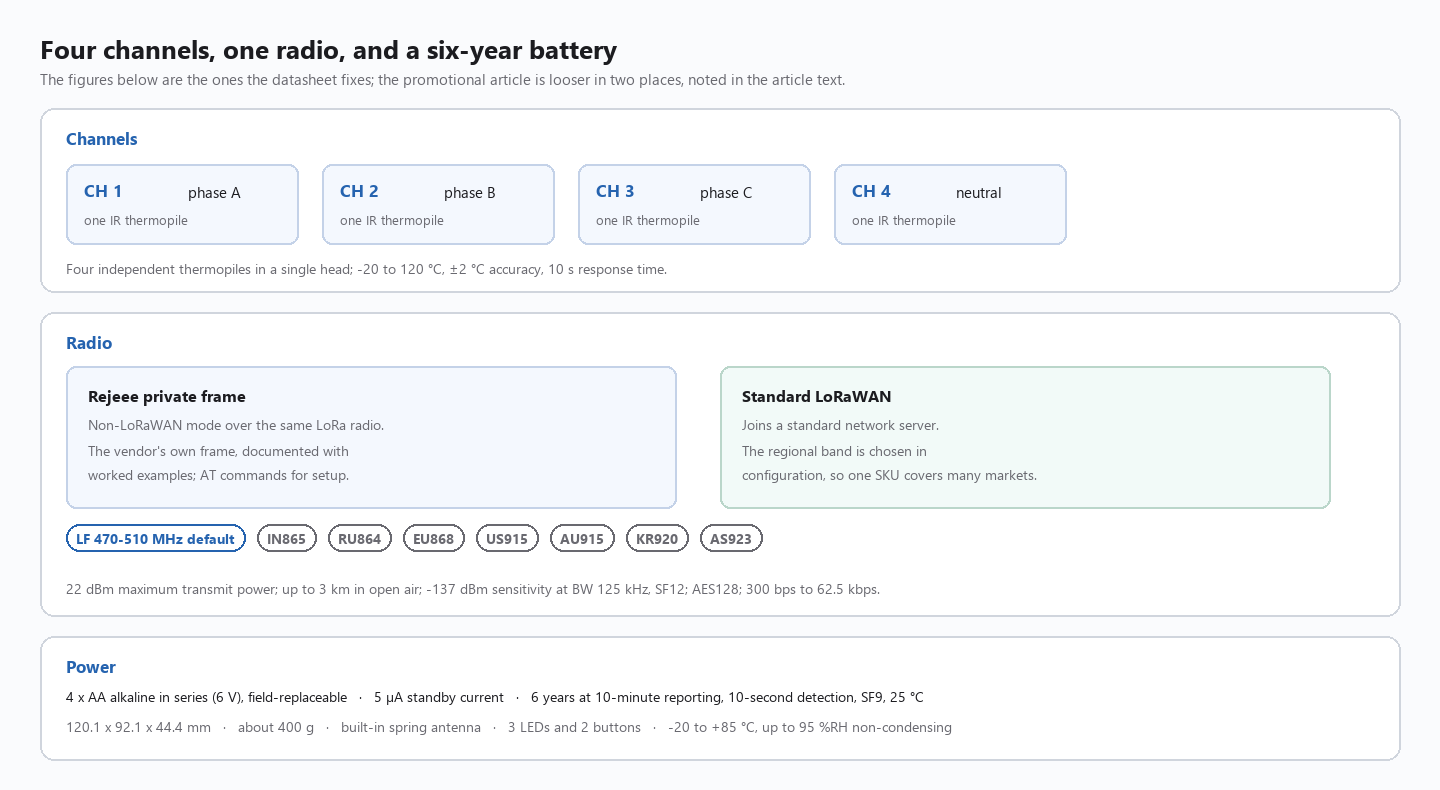
The headline power claim is six years on four AA cells, and the specification table is careful to qualify it: ten-minute reporting, ten-second detection, spreading factor 9, at 25 degrees. What the same document says elsewhere is that those are not the settings you get. Section 2.4 gives the shipped defaults as an 1800-second report period, described as a heartbeat, with detection every 180 seconds. The detection period is configurable from 1 second up to a stated maximum of 65553 seconds, which is very slightly past the 65535 that a 16-bit counter can hold and looks like a typo in the documentation rather than a real limit.
The practical consequence is reassuring rather than alarming. The published six-year figure is calculated at a duty cycle roughly three times heavier than the default for reporting and eighteen times heavier for detection, so a device left at its factory settings should comfortably exceed it. The number to distrust is not the six years; it is the idea, which the promotional article encourages, that ten minutes and ten seconds are the conditions the device ships in.
The mechanism that makes the battery figure work is a change threshold. On every detection cycle the device compares the new reading against the last value it sent, and if the difference exceeds the configured threshold it transmits immediately instead of waiting for the report period. Set the threshold loosely and the radio stays quiet in a stable cabinet; set it tightly and the six-year arithmetic stops applying.
Where the article and the datasheet disagree
The promotional article is unusually accurate for its genre. Most of its numbers match the specification table exactly, including the probe count, the temperature range, the battery type, the six-year figure with its qualifying conditions, the 22 dBm transmit power, the three-kilometre open-air range, the dimensions, the weight and the operating envelope. That is worth saying, because it is not the norm. Three things still need care.
- Water-immersion detection. The article lists an integrated water-immersion function as a second risk it covers, described as solving both overheating and seepage with one device. No water-detection row appears in the specification table, and the feature list names four infrared channels and nothing else. The vendor does sell electrode water-immersion sensors as a separate product line, so the capability exists in the catalogue; it is just not documented as part of this device.
- A wired sibling. A closing note recommends an SL164A-RS, described as an RS485 four-channel infrared sensor for the same busbar job. That model has no public datasheet: the busbar section of the vendor's documentation library contains the SL163 page and nothing else. Treat it as announced rather than specified, and ask for a document before designing it in.
- Band lists. The article says the device covers CN470, EU868, US915 and others. The specification table's selectable list is IN865, RU864, EU868, US915, AU915, KR920 and AS923, while the overview prose adds CN470, CN779 and EU433 to that set. The two lists inside the datasheet do not agree with each other, so confirm the exact band you need at quotation time.
- Documentation reuse. The desktop configuration walkthrough is illustrated with screenshots labelled as coming from the SL715, and it instructs the reader to wake Bluetooth with a magnet, which is how that pressure sensor works. The SL163 has two physical buttons and no magnetic zone, as its own button section describes. The vendor's habit of copying pages between products is visible here in the same way it was on the insertion probe.
How it compares
| Option | Wiring | Measurement | What you still own |
|---|---|---|---|
| SL163 infrared head | none | four joints, plus or minus 2 degrees | Gateway, network server, decoder |
| Wired PT100 or thermocouple per joint | a cable and an input channel per joint | one joint each, plus or minus 0.5 degrees | Cable runs, logger, power, enclosure |
| Portable thermal camera survey | none | whatever is in frame, at that moment | A person to walk the route and a schedule |
| Generic LoRa temperature node | none | one external probe | Mounting near the joint, plus the same back end |
Practical notes
- The channels are fixed optics, not a scanning sensor. Each one looks at one point, so the four joints you want to watch have to line up with the four the head can see through the aperture. Plan the mounting before ordering, and check that nothing sits between the head and the joint.
- Emissivity matters more than it does with a contact probe. Establish a baseline reading for each joint after installation and watch the trend against its own history, rather than comparing across joints with different surface finishes.
- The default band is 470 to 510 MHz, which is not licence-free everywhere. The other bands are documented as available on request, so raise the band at quotation time rather than at installation time.
- LoRaWAN support means the device can join a standard network, but the vendor's proprietary frame is the default mode, and the downlink commands are documented as LoRaWAN-only. Decide which mode you want and make sure the decoder matches it.
- The configuration tooling for day-to-day work is a WeChat mini-program on a phone. A desktop path exists through a virtual Bluetooth serial port and the vendor's SensorTool utility, which needs a serial driver installed, but the documentation for this product illustrates that path with another model's screenshots. A team that does not use WeChat should confirm the desktop route before designing it into a workflow.
- Four alkaline cells are replaceable in the field, which is a maintenance commitment rather than a hidden cost, and the vendor's own duty-cycle arithmetic shows the figure depends on how you configure it. Do the calculation for your report period and change threshold rather than quoting the headline.
- There is no published price, and this is a closed commercial product. Nothing here can be inspected, forked or self-maintained, so the vendor relationship carries the same weight it does for any closed hardware.
- We have not tested this hardware. Everything above comes from the vendor's published documentation, and two figures inside it are inconsistent, so treat the specifications as the start of a conversation with the vendor rather than as a settled datasheet.
IOTTourChina covers open-source IoT projects and China-made devices as part of its developer resource. This is editorial coverage, not an endorsement or an advertisement; specifications, editions and pricing should be confirmed with the vendor.