Rejeee's insertion temperature probe: reading the inside of a grain pile, over 4G or LoRa
Grain does not fail loudly. A heap of wheat or a fermentation pit heats up from the inside, where nobody can see it, and by the time the smell or the crust gives it away the loss is already banked. The standard answer is to push a temperature probe into the material and leave it there. The standard problem with that answer is the cable: a site with forty silos and no spare conduit is not going to run forty cables.
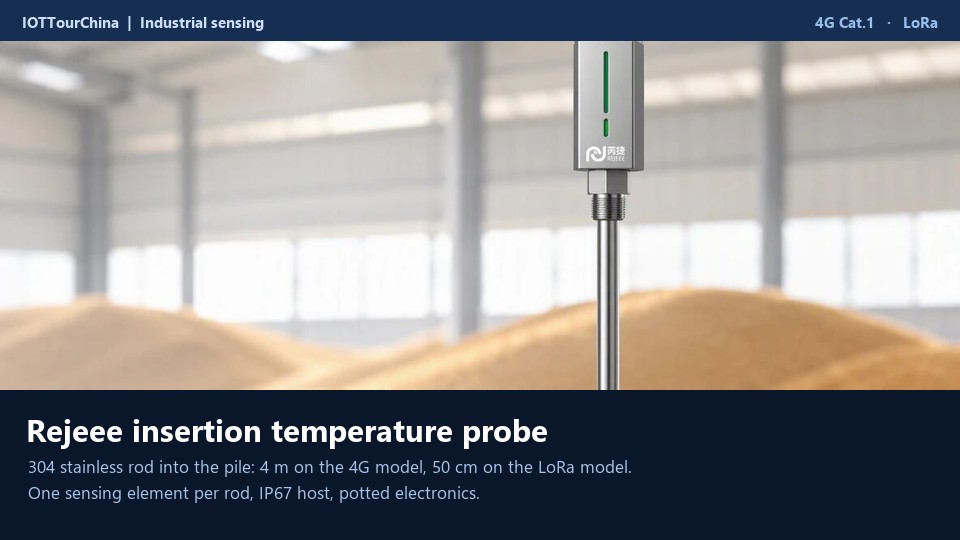
Rejeee, a sensor manufacturer based in Nanjing, sells a family of wireless probes built for exactly that job. The shape is a stainless rod you push into the pile, a sealed head that carries the radio and the battery, and no wiring at all. The vendor's documentation names the scenarios as grain storage warehouses, straw and grass stacks, tobacco warehouses, brewing mash heaps and fermentation pits.
What the probe is
The rod is 304 stainless steel. The head is sealed and, on the 4G model, potted internally to reach IP67. Configuration happens over Bluetooth from a phone rather than through a serial port or a DIP switch, and the whole assembly is designed to be inserted into the product rather than mounted beside it.
The intended applications are agricultural and industrial rather than domestic: reserve grain warehouses, straw bales and grass stacks, tobacco storage, brewing mash heaps, fermentation pits and fermentation tanks. The common thread is a bulk material whose core temperature matters and whose surface temperature tells you nothing useful.
Two models, one family
Here the promotional material and the documentation part company. The vendor's article presents the hardware as a single body with a choice of radio; the datasheets describe two different products with different heads, different probes and different power supplies.
| SL715-C1-18B20-4M | SL712-LF-SHT | |
|---|---|---|
| Radio | 4G Cat.1 | LoRa (SX1268) |
| Bands | LTE-FDD B1/3/5/8; LTE-TDD B34/38/39/40/41 | 470 to 510 MHz default; IN865, RU864, EU868, US915, AU915, KR920 and AS923 on request |
| Sensing element | One external DS18B20 | SHT30, temperature and humidity |
| Temperature range | -55 to +125 °C | -40 to +125 °C |
| Temperature accuracy | ±0.5 °C | ±0.5 °C |
| Humidity | not measured | 0 to 99.9 %RH, ±3 %RH |
| Probe | 4 m default, custom lengths | 50 cm default, custom lengths |
| Head | 155 × 48 × 48 mm, internal antenna | 50 × 52 × 107.4 mm, segment LCD, internal antenna |
| Protection | IP67 head, potted electronics | not stated in the specification table |
| Power | 1 × lithium-thionyl-chloride cell | 4 × AA alkaline, user-replaceable |
| Battery life as documented | 3 years at 1 h reporting, 25 °C | 6 years at 10 min reporting, SF9, 25 °C |
| Default report period | 600 s | 600 s |
| Default detection period | 60 s | 5 s |
| Head ambient | -40 to +85 °C, 0 to 99.9 %RH | -20 to +70 °C, up to 95 %RH non-condensing |
| Protocols | UDP, TCP, MQTT | Rejeee frame or standard LoRaWAN |
| Documentation revision | V1.0, 2026.04 | V1.0, 2026.04 |
The split is not just a radio swap. The 4G version trades a short probe for a very long reach inside the material and a wider head ambient range; the LoRa version adds humidity, a display and a field-replaceable battery, but ships with a 50 cm rod and a narrower temperature envelope for the head itself.
Getting the reading out
A LoRa probe is the conventional arrangement: the rod transmits, a GW-series gateway in range receives, and the gateway forwards the payload onward to a network server or to the vendor's platform. The 4G probe has no gateway, so the vendor takes the opposite approach and makes the probe behave like one.
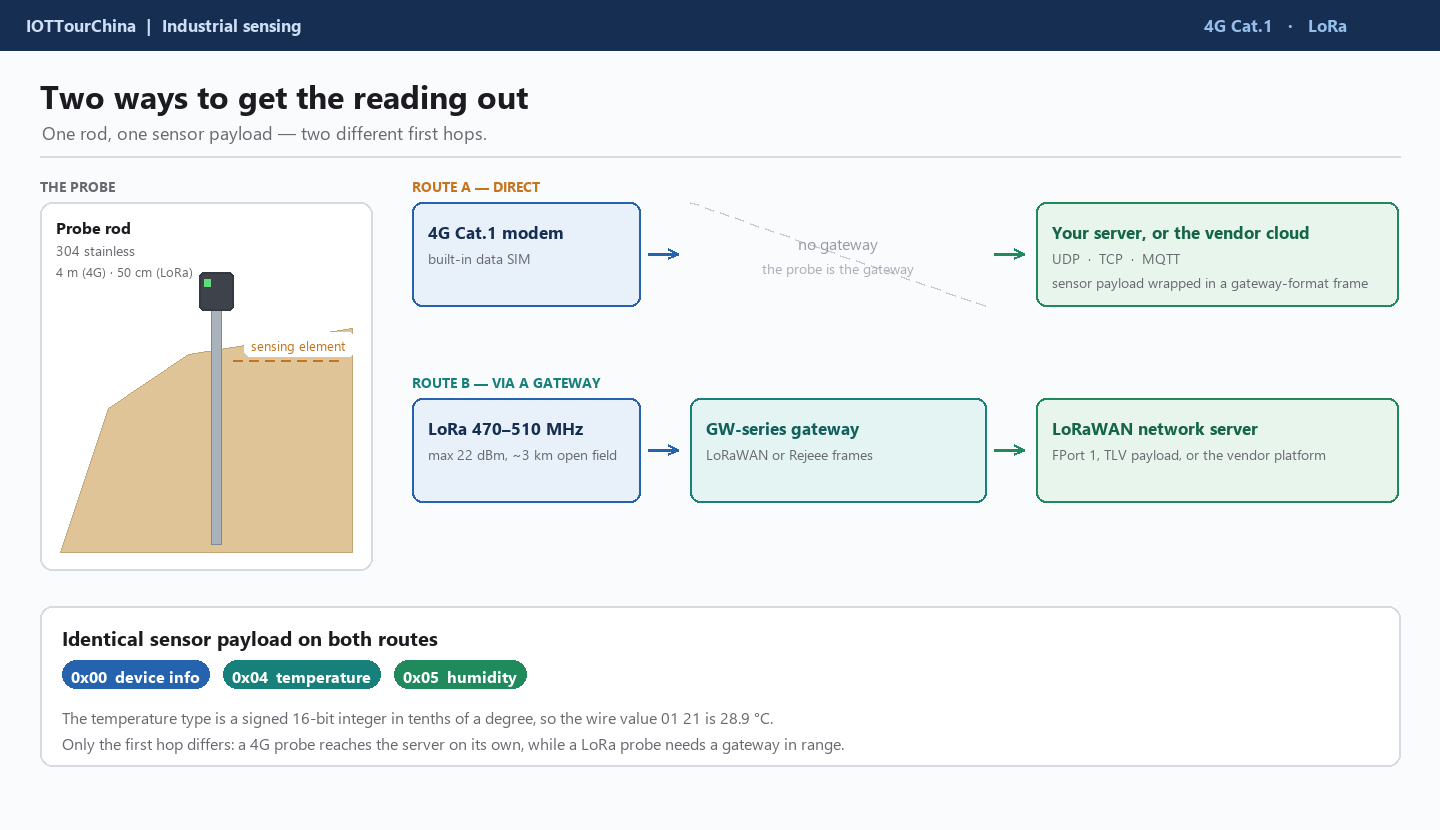
On uplink, the 4G model wraps its sensor payload inside the same gateway-format frame that the vendor's gateways use. A platform that already decodes Rejeee gateway traffic therefore keeps working when a probe appears on the network with no gateway behind it, and one decoder covers both the 4G and the gateway-mediated LoRa paths. That is a small decision with a large effect on integration cost, and it is the kind of detail that is usually discovered only after a pointless argument with a platform vendor.
The payload on the wire
The frame format is documented in unusual detail, including one worked example, which makes the device easier to evaluate on paper than most hardware in this category.
The 4G and non-LoRaWAN form of the frame begins with a one-byte header, then a four-byte device address, a control byte and a two-byte sequence number. Sensor data follows as TLV triplets, and the frame closes with a CRC16. In LoRaWAN mode only the TLV part is transmitted, as the FRMPayload on FPort 1, so a standard network server sees a compact payload that a JavaScript decoder can unpack.
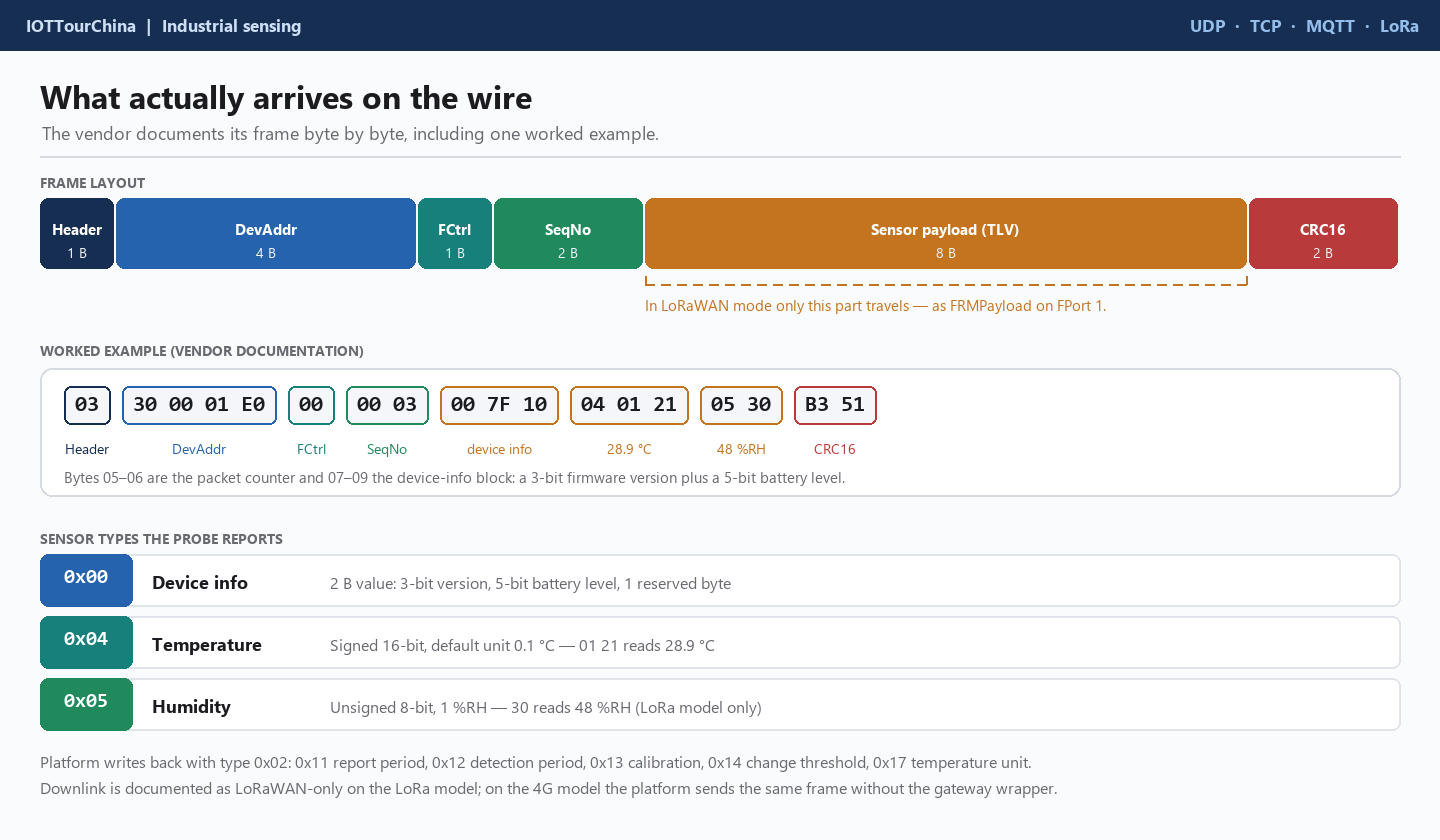
The types that matter for a temperature application are short and unambiguous:
| Type | Meaning | Encoding |
|---|---|---|
| 0x00 | Device info | Firmware version (3 bits), battery level (5 bits), one reserved byte |
| 0x04 | Temperature | Signed 16-bit, unit 0.1 °C, so 01 21 reads 28.9 °C |
| 0x05 | Humidity | Unsigned 8-bit, unit 1 %RH, so 30 reads 48 %RH; documented for the LoRa model |
The vendor's published example frame, with the byte groups separated:
03 | 30 00 01 E0 | 00 | 00 03 | 00 7F 10 | 04 01 21 | 05 30 | B3 51
 |        |        |      |        |          |         |       |
 |        |        |      |        |          |         |       +-- CRC16
 |        |        |      |        |          |         +---------- humidity, 48 %RH
 |        |        |      |        |          +-------------------- temperature, 28.9 °C
 |        |        |      |        +------------------------------- device info, version and battery
 |        |        |      +---------------------------------------- packet counter, 2 bytes
 |        |        +----------------------------------------------- control byte
 |        +-------------------------------------------------------- device address, 4 bytes
 +----------------------------------------------------------------- header, 1 byte
Writes from the platform use type 0x02 with sub-codes for the report period, the detection period, calibration, a temperature change threshold, a humidity change threshold and the temperature unit. The documentation describes downlink as LoRaWAN-only on the LoRa model; on the 4G model the platform sends the same structure without the gateway wrapper.
Configuration, and the WeChat dependency
Everyday configuration runs over Bluetooth from a phone. The probe wakes its Bluetooth radio on a trigger, the phone connects through the vendor's application, and the report period, detection period, change thresholds, calibration and firmware are set from there. The two heads differ here too: the 4G head has no physical buttons and instead uses two magnetic sensing zones, one for power and Bluetooth and one to force a reading, while the LoRa rod keeps two physical buttons and adds a small segment LCD for the live value, battery and signal.
The friction point for a deployment outside China is where that tooling lives. Data viewing, alarms and report export are a mini-program inside WeChat, and the account is bound to a phone number; firmware updates also travel over Bluetooth from that application. Nothing in the radio link or the payload requires WeChat, and the vendor publishes a Windows configuration tool for its wider product family, so a desktop path exists in the ecosystem. A team that does not use WeChat should confirm that path covers the specific probe model before designing it into a product.
Where the article and the datasheets disagree
The promotional article is a fair summary of the concept but an unreliable source for numbers, and it is worth listing the gaps plainly, because the datasheets are the more conservative side of each one.
- Body and probe. The article describes the LoRa and 4G versions as structurally identical hardware. The datasheets describe a 155 × 48 × 48 mm head with a 4 m rod on the 4G model and a 50 × 52 × 107.4 mm head with a 50 cm rod and an LCD on the LoRa model.
- Battery life. The article gives 3 years at a one-hour reporting interval for the LoRa version. The LoRa datasheet gives 6 years at a ten-minute interval, which is the heavier duty cycle of the two. Both figures cannot describe the same hardware.
- Reporting interval. The article states a one-hour report period. The documented default is 600 seconds, and one hour is the assumption behind the 4G model's three-year battery figure rather than the shipped setting.
- Environmental rating. IP67 is documented for the 4G head. The LoRa rod's specification table carries no protection rating, and its documented head ambient range is the narrower of the two.
- Housing. The article describes an anodised aluminium-alloy head. Neither probe datasheet states a housing material; aluminium alloy is what the vendor documents for its pressure sensor.
- Document quality. The LoRa probe's page repeats the word pressure in its display description and again in its mini-program walkthrough, apparently copied from the pressure-sensor page. Budget one clarification email before quoting a specification onward.
How it compares
| Option | Wiring | First hop | What you still own |
|---|---|---|---|
| Insertion probe, LoRa | none | Your own LoRaWAN gateway | Gateway, network server, payload decoder |
| Insertion probe, 4G | none | Built-in cellular modem and SIM | Server endpoint and payload decoder |
| Wired PT100 loggers | cable to every measuring point | Local logger | Cable runs, logger, power, enclosure |
| Generic 4G data logger plus a probe | cable from probe to logger | Built-in cellular modem | Wiring, enclosure, power, firmware |
The wireless options replace cable and conduit with a battery and a radio, which is the entire point at a site where the interesting part is a pile of material rather than a cabinet.
Practical notes
- One sensing element per rod means one temperature at one depth. Sampling several depths means several rods or a longer custom rod; this is not a multi-node probe with sensors strung along its length.
- The 4G variant ships with a built-in data SIM and China LTE bands. Confirm coverage, SIM terms and the configurable server address for any deployment outside mainland China.
- The LoRa variant's default band is 470 to 510 MHz, which is not licence-free everywhere. The other regional bands are documented as available on request, so raise it at quotation time rather than at installation time.
- LoRaWAN support means the rod can join a standard network, but the vendor's proprietary frame is the default mode. Decide which mode you want and make sure the decoder on the platform side matches it.
- The defaults are conservative in one direction and aggressive in the other: detection is frequent and reporting is frequent, while the published battery life assumes you lengthen the reporting interval. Do the arithmetic for your own interval before believing the multi-year figure.
- There is no published price, and this is a closed commercial product. Nothing here can be inspected, forked or self-maintained, so the vendor relationship carries the same weight it does for any closed hardware.
- We have not tested this hardware. Everything above comes from the vendor's published documentation, and one documented figure is internally inconsistent, so treat the specifications as a starting point for a conversation with the vendor rather than as a settled datasheet.
IOTTourChina covers open-source IoT projects and China-made devices as part of its developer resource. This is editorial coverage, not an endorsement or an advertisement; specifications, editions and pricing should be confirmed with the vendor.