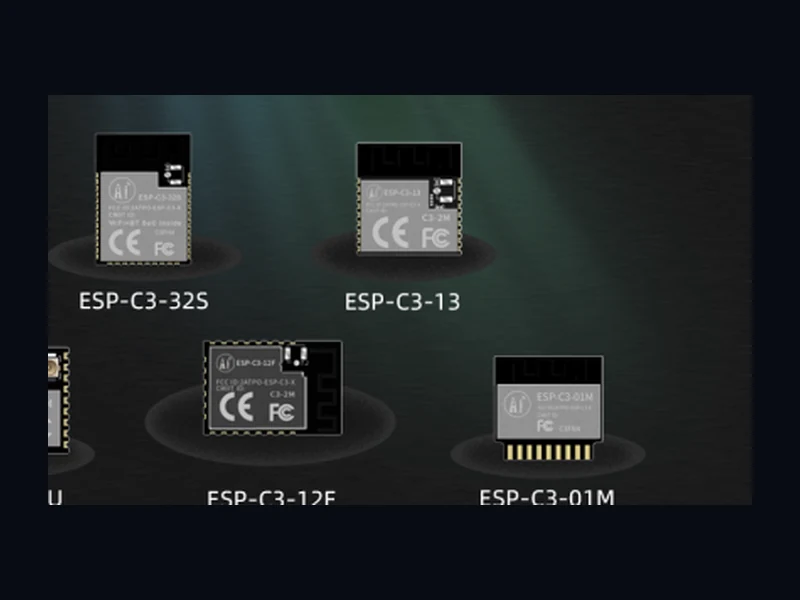
Wireless Modules
ESP32-C3 Series Wi-Fi + BLE Modules
Seven ESP32-C3 modules on a 160 MHz RISC-V core, spanning 15 to 21 GPIO, PCB and IPEX antennas, and a wide-temperature variant for industrial housings.
Capabilities below are vendor-documented. We have not tested this device or its integrations.
Sources checked:
Also known as: ESP-C3-12F, ESP-C3-01M, ESP-C3-32S, ESP-C3-13, ESP-C3-13U, ESP-C3-M1, ESP-C3-M1-I, Ai-Thinker ESP32-C3, 安信可 ESP32-C3 模组
Suitable projects
- Cost-sensitive controllers that need a certified radio module in the bill of materials rather than a development board.
- Battery-powered sensors that need Wi-Fi and BLE on one module instead of two radios.
- Devices that need the wide-temperature C3FH4 version of ESP-C3-M1 inside an unheated industrial enclosure.
- Boards designed around an ESP8266 module where the footprint lines up and the extra GPIO is not needed.
Before you buy
- 2.4 GHz only; there is no 5 GHz variant in this family.
- BLE only. The datasheets state explicitly that traditional Bluetooth is not supported.
- These are bare modules. Carrier board, antenna, matching, impedance and the regulatory filing all stay with the integrator.
- The vendor's product page lists five modules while its documentation topic lists seven. ESP-C3-M1 and ESP-C3-M1-I are missing from the product page, and the topic page names the fourth module ESP32-C3U in one place and ESP-C3-13U in another. The datasheets use ESP-C3-13U.
- Flash options differ per variant, and some of them are order-code level decisions that only the per-model datasheet resolves.
- Supply current has to stay above 500 mA. The datasheets recommend an LDO, or a DC-DC with ripple kept under 30 mV.
Official resources
- Ai-Thinker ESP32-C3 series module documentation topic
- Ai-Thinker ESP32-C3 series module product page
- Espressif ESP32-C3 chip datasheet
Related guides
- Silicon
- Espressif ESP32-C3, single-core RISC-V, up to 160 MHz
- Chip memory
- 400 KB SRAM, 384 KB ROM, 8 KB RTC SRAM
- Flash
- 4 MB on chip on every variant; a 2 MB version and an external-flash version exist on ESP-C3-13U and ESP-C3-32S
- Wi-Fi
- 802.11 b/g/n on 2.4 GHz only, up to 150 Mbps, 1T1R
- Bluetooth
- BLE 5.0 with Bluetooth mesh; 125 Kbps, 500 Kbps, 1 Mbps and 2 Mbps; extended advertising, multiple advertising and channel selection
- Interfaces
- UART, GPIO, ADC, PWM, I2C, I2S and SPI, plus a temperature sensor on the module
- UART
- 110 to 4608000 bps, 115200 bps by default
- Power
- 3.0 V to 3.6 V, supply current above 500 mA
- Operating temperature
- -40 °C to 85 °C on most variants; ESP-C3-M1 and ESP-C3-M1-I also ship as -40 °C to 105 °C (C3FH4) versions
- Storage temperature
- -40 °C to 125 °C, below 90 % RH
- Security
- WEP, WPA-PSK and WPA2-PSK; hardware AES, SHA and RSA accelerators, RNG, HMAC, digital signature, flash encryption and secure boot signature verification
- GPIO
- 15 on ESP-C3-12F, ESP-C3-13, ESP-C3-13U, ESP-C3-01M, ESP-C3-M1 and ESP-C3-M1-I; 21 on ESP-C3-32S
- Provisioning
- SmartConfig by app and AirKiss by WeChat, on Android and iOS
- Firmware
- UART local upgrade and remote FOTA; secondary development on ESP-IDF
Choosing an Ai-Thinker ESP32-C3 Module
This profile is based on official documentation, not our own device testing.
The ESP32-C3 series is a family of radio modules built on Espressif's ESP32-C3, a single-core RISC-V chip that runs at up to 160 MHz and carries Wi-Fi and BLE on the same die. Ai-Thinker publishes seven modules on that chip, and they are not interchangeable: the package, the antenna, the GPIO count and the flash options all differ between them. The vendor's own documentation topic names one model two different ways, so this page follows the datasheets rather than the product page.
What the family is for
- A board that needs Wi-Fi and BLE in one part, without a second radio alongside it.
- A cost-driven controller where a certified module belongs in the bill of materials and a development board does not.
- An existing ESP8266 footprint that the C3 can be dropped onto, where the extra GPIO is not needed.
The seven variants at a glance
| Model | Package | Size (mm) | Antenna | GPIO | Flash |
|---|---|---|---|---|---|
| ESP-C3-12F | SMD-22 | 24.0 × 16.0 × 3.1 (±0.2) | On-board PCB antenna / IPEX | 15 | 4 MB on chip |
| ESP-C3-13 | SMD-18 | 20.0 × 18.0 × 3.1 (±0.2) | On-board PCB antenna / IPEX | 15 | 4 MB on chip |
| ESP-C3-13U | SMD-18 | 14.0 × 18.0 × 3.1 (±0.2) | IPEX | 15 | 4 MB by default, 2 MB version and external-flash version |
| ESP-C3-01M | DIP-18, gold-finger plug-in | 18.0 × 18.0 × 2.8 (±0.2) | On-board PCB antenna | 15 | 4 MB on chip, no flash expansion |
| ESP-C3-32S | SMD-38 | 25.5 × 18.0 × 3.1 (±0.2) | On-board PCB antenna / IPEX | 21 | 4 MB by default, 2 MB version and external-flash version |
| ESP-C3-M1 | SMD-61 | 16.6 × 13.2 × 2.4 (±0.2) | On-board PCB antenna | 15 | 4 MB |
| ESP-C3-M1-I | SMD-61 | 12.5 × 13.2 × 2.4 (±0.2) | IPEX interface | 15 | 4 MB |
The size figures are the module outline, not the land pattern. All seven share the same 2400 to 2483.5 MHz band, a 3.0 V to 3.6 V supply with a current above 500 mA, and a storage range of -40 °C to 125 °C below 90 % RH.
The three decisions that actually pick a module
Antenna: PCB or IPEX
This is the first fork, and it is a layout decision rather than a feature decision. A PCB antenna saves the cost of a connector and the space of a cavity, but it fixes the radiation pattern to whatever the carrier board ends up being. An IPEX module moves the antenna outside the enclosure, which is what you want when the box is metal, or when the board sits next to something that interferes.
- ESP-C3-13U is IPEX only.
- ESP-C3-M1-I is IPEX only, and it is the narrowest module in the family at 12.5 mm across.
- ESP-C3-12F, ESP-C3-13 and ESP-C3-32S are published as on-board PCB antenna with an IPEX option.
- ESP-C3-01M and ESP-C3-M1 are on-board PCB antenna only.
GPIO count
Five of the seven expose 15 GPIO: IO0 to IO10 plus IO18 to IO21. ESP-C3-32S breaks the pattern with 21, adding IO12 to IO17.
If your design needs more than 15 lines, the choice collapses to ESP-C3-32S, and the extra six pins are the only ones the family offers.
Temperature
Most variants are specified from -40 °C to 85 °C. ESP-C3-M1 and ESP-C3-M1-I are also offered as high-temperature versions, marked C3FH4, rated from -40 °C to 105 °C. The normal-temperature version is marked C3FN4.
That distinction is a part-number decision, not a module decision. The same M1 and M1-I outline runs both.
Two models that look alike
ESP-C3-M1 and ESP-C3-M1-I share the SMD-61 package, the same 15 GPIO, the same flash and the same temperature options. They differ in the antenna and in width: M1 is 16.6 mm wide with an on-board PCB antenna, M1-I is 12.5 mm wide and takes an external antenna on an IPEX base.
The M1 datasheet also carries a full antenna parameter section with S-parameters, gain, efficiency and a radiation pattern, because the PCB antenna is part of the certified design. The M1-I datasheet instead specifies the IPEX base footprint, and the module requires an external antenna.
Naming: the vendor contradicts itself
The documentation topic states that the company has seven modules and lists them as ESP-C3-12F, ESP-C3-32S, ESP-C3-01M, ESP-C3-13, ESP32-C3U, ESP-C3-M1 and ESP-C3-M1-I. The specification list in the same page calls the fourth one ESP-C3-13U, and the product page lists only five models. The datasheet for that variant is published as ESP-C3-13U, and that is the name to put on a purchase order.
This matters when you search for a datasheet or a PCB footprint: ESP32-C3U and ESP-C3-13U are the same part under two different labels.
Power
Every variant needs more than 500 mA of supply current. The design guidance recommends an LDO, or a DC-DC with ripple kept under 30 mV, and suggests adding ESD protection on the 3.3 V rail. The M1-I datasheet additionally recommends reserving a place for a dynamic response capacitor so the output ripple stays under control when the load changes quickly.
IO20 is used as U0RXD and needs an external pull-up. IO9 is the boot control pin: high is normal operation, low puts the chip into firmware programming mode, and the internal default is high.
Check before ordering
- Read the per-model datasheet. Package, antenna, GPIO and flash options are not interchangeable across the family, and the product page does not carry the full line-up.
- Confirm the antenna type against your enclosure. A PCB antenna in a metal box is a layout decision you cannot fix in firmware.
- If you need more than 15 GPIO, the only member of the family that provides it is ESP-C3-32S.
- If the enclosure runs hot, order the C3FH4 version of ESP-C3-M1 or ESP-C3-M1-I rather than the C3FN4 one.
- Check the certification status for the exact variant. The datasheets cover electrical and mechanical data; the radio approvals are published separately.
- If you are replacing an ESP8266 module, confirm the footprint. The vendor states the C3 package is compatible with ESP-12F, ESP-12S, ESP-07S and ESP32-S, but a matching outline does not mean matching flash, matching IO or matching current draw.
Next step
The buying guide on this page covers the variants. The Wi-Fi module selection guide compares this family with the ESP8266 modules it can replace, and the ESP32 chip comparison guide covers the silicon underneath.
The module schematics and PCB footprints are published by the vendor for each variant.
Quick Start — Ai-Thinker ESP32-C3 Modules
This profile is based on official documentation, not our own device testing.
The ESP32-C3 modules are bare parts. This sequence takes one from the packet to a joining network, and it is the same shape for all seven variants. The steps that differ between variants are marked where they do.
1. Check what arrived
Read the part marking before anything else. The family contains seven modules, and the vendor publishes them under two different labels for one variant, so the marking on the reel is the authority.
- A module marked ESP-C3-12F, ESP-C3-13, ESP-C3-13U, ESP-C3-01M, ESP-C3-32S, ESP-C3-M1 or ESP-C3-M1-I.
- For ESP-C3-13U, the datasheet is published under that name, not under the ESP32-C3U label that appears in the documentation topic prose.
Check the antenna variant too. A module with an IPEX base needs an antenna that is not in the box.
2. Lay out the carrier board
Follow the module footprint published by the vendor for your exact part. The land patterns are published per variant and they are not the same: the M1 and M1-I packages differ in width, and the 12F, 13, 13U, 01M and 32S differ in pin count.
- Keep the RF keep-out area free of copper and of components.
- Route the antenna trace or the IPEX launch per the vendor's antenna layout requirements.
- Leave a place for the dynamic response capacitor if you power the module from a DC-DC.
3. Bring up the power rail
Every variant in this family needs more than 500 mA of supply current at 3.0 V to 3.6 V.
- Use an LDO, or a DC-DC with output ripple kept under 30 mV.
- Add ESD protection on the 3.3 V rail.
- Bring the rail up before the module tries to boot. A module that browns out during transmit will appear as a flaky failure rather than as a power fault.
4. Wire the boot and serial lines
- IO9 is the boot control pin. It is high in normal operation and low puts the chip into firmware programming mode. The internal default is high.
- IO20 carries U0RXD and needs an external pull-up.
- Connect the USB-UART adapter to IO20 and IO21 for the log and the download mode.
5. Flash the firmware
Secondary development runs on ESP-IDF, which the vendor points to directly. The module also accepts a UART local upgrade and a remote FOTA.
- For first contact, use the UART local upgrade path with the USB-UART adapter attached.
- Check the UART rate. The module supports 110 to 4608000 bps and defaults to 115200 bps.
- If the download fails, pull IO9 low and retry before suspecting the board.
6. Join a network
The module supports SmartConfig by app and AirKiss by WeChat, on both Android and iOS, plus STA, AP and STA+AP modes.
- Use the simplest mode first. Join one network as a station before trying to run an access point.
- SmartConfig or AirKiss is the fast path for a first bring-up, and it is also the path most likely to fail on a crowded 2.4 GHz channel. Move the board a few metres from the router and try again.
7. Check the radio
The chip supports Wi-Fi 802.11 b/g/n on 2.4 GHz only, and BLE 5.0 with Bluetooth mesh. There is no 5 GHz and no Bluetooth Classic.
- Verify data rate and RSSI for the deployed antenna, not for the module on the bench.
- If the product needs classic Bluetooth, this family is the wrong choice.
8. Move to deep sleep
- Verify the current draw in each sleep state on the finished board, with the radio idle as it will be in the field.
- The ESP-C3 family datasheets give the chip's own figures. A carrier board with a regulator, an LED and a sensor on the same rail will not match them.
Mistakes that ruin a module
- Ordering on the family name instead of the order code. Flash options and temperature grades are decided at the part number.
- Assuming the product page carries the full line-up. It does not; the documentation topic is the complete list.
- Expecting Bluetooth Classic. The datasheets state that traditional Bluetooth is not supported.
- Running the 3.3 V rail from a source that cannot deliver 500 mA. Transmit bursts are what expose this.
- Using an IPEX variant without an antenna, or fitting a PCB antenna inside a metal enclosure.
- Assuming a pin-compatible outline means an interchangeable part. The footprint can match while flash, IO and current draw do not.
FAQ — Ai-Thinker ESP32-C3 Modules
This profile is based on official documentation, not our own device testing.
How many modules are in this family?
Seven, on the vendor's own count. The documentation topic states that the company has seven modules on the ESP32-C3: ESP-C3-12F, ESP-C3-32S, ESP-C3-01M, ESP-C3-13, ESP32-C3U, ESP-C3-M1 and ESP-C3-M1-I.
The vendor lists one model under two names. Which is right?
The topic page names the fourth model ESP32-C3U in its prose, and ESP-C3-13U in the specification list below it. The datasheet is published as ESP-C3-13U, so that is the name to use when ordering or searching for a footprint.
The product page only shows five models. Where are the other two?
ESP-C3-M1 and ESP-C3-M1-I are missing from the product page and present on the documentation topic. The topic page itself was last changed in April 2023, which is the more likely place for a complete list.
Which module has the most GPIO?
ESP-C3-32S, with 21. The other six expose 15: IO0 to IO10 plus IO18 to IO21.
Do any of them take an external antenna?
Yes. ESP-C3-13U is IPEX only, and ESP-C3-M1-I is IPEX only. ESP-C3-12F, ESP-C3-13 and ESP-C3-32S are published as on-board PCB antenna with an IPEX option. ESP-C3-01M and ESP-C3-M1 are on-board PCB antenna only.
What is the difference between ESP-C3-M1 and ESP-C3-M1-I?
The same SMD-61 package, the same 15 GPIO, the same flash and the same temperature options. M1 is 16.6 mm wide with an on-board PCB antenna; M1-I is 12.5 mm wide and takes an external antenna on an IPEX base. The M1 datasheet publishes the antenna's S-parameters, gain, efficiency and radiation pattern, because the PCB antenna is part of the certified design.
Is there a high-temperature version?
Yes, for ESP-C3-M1 and ESP-C3-M1-I. The normal version is marked C3FN4 and runs from -40 °C to 85 °C. The high-temperature version is marked C3FH4 and runs from -40 °C to 105 °C. The same module outline covers both.
How much flash do they carry?
4 MB on chip on every variant. ESP-C3-13U and ESP-C3-32S also come in a 2 MB version and in an external-flash version. ESP-C3-01M is built for the 4 MB part only and does not support flash expansion.
Can it replace an ESP8266 module?
The footprint can. The vendor states that the C3 package is compatible with ESP-12F, ESP-12S, ESP-07S and ESP32-S. A matching outline does not mean an interchangeable part: the C3 has a RISC-V core where the ESP8266 has a Tensilica L106, the IO counts differ, the flash sizes differ and the current draw differs. The pin that is boot control on the C3 is not the same function it has on the ESP8266.
Does it support Bluetooth Classic?
No. The datasheets state that traditional Bluetooth is not supported. This is a BLE 5.0 part with Bluetooth mesh, at 125 Kbps, 500 Kbps, 1 Mbps and 2 Mbps, with extended advertising, multiple advertising and channel selection.
What radio bands are supported?
2.4 GHz only. Wi-Fi 802.11 b/g/n up to 150 Mbps, 1T1R, and BLE 5.0. There is no 5 GHz variant in this family.
How much current does it need?
The supply range is 3.0 V to 3.6 V and the datasheets specify a supply current above 500 mA. An LDO is recommended, or a DC-DC with ripple under 30 mV.
What is the security story?
WEP, WPA-PSK and WPA2-PSK for the radio. On the chip there are hardware AES, SHA and RSA accelerators, plus RNG, HMAC and digital signature blocks, with flash encryption and secure boot signature verification. The vendor's series graphic adds RSA-3072 and AES-128-XTS for flash.
How is the module provisioned onto a network?
SmartConfig by app and AirKiss by WeChat, on Android and iOS. The module also supports STA, AP and STA+AP modes, and STA plus promiscuous mode on the M1 variants.
Can the firmware be updated in the field?
Yes. The module supports a UART local upgrade and a remote FOTA. Secondary development runs on ESP-IDF, which the vendor links directly from the documentation topic.
Where are the official figures published?
Each variant has its own datasheet, linked from the ESP32-C3 documentation topic, together with PCB footprints, module package drawings and the minimum system design. The chip-level data is in the Espressif ESP32-C3 datasheet.