Olimex UEXT-CH390 adds a wired 10/100 Ethernet port to Pico and ESP32 over SPI
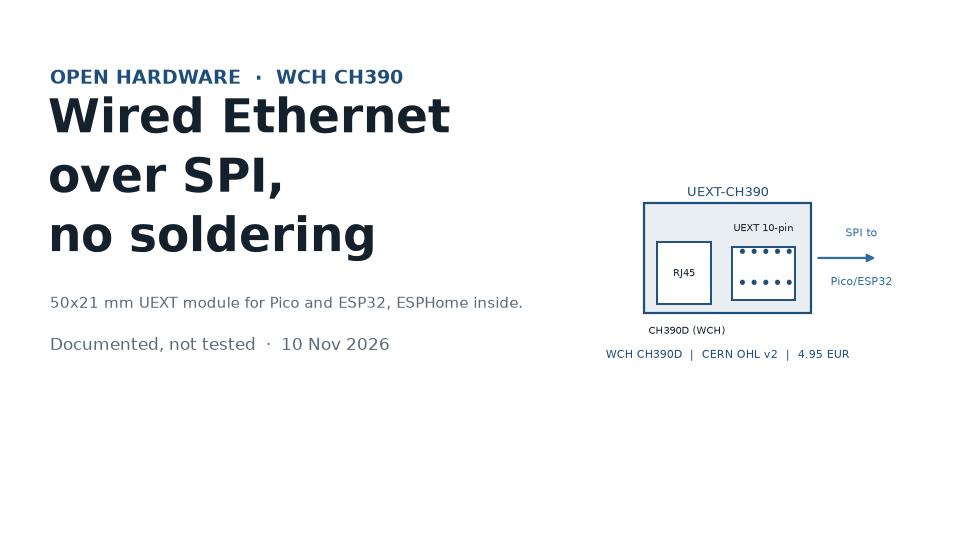
Adding a wired network port to a Raspberry Pi Pico or an ESP32 usually means buying a W5500 module, running six wires and reading a register manual for two days. Olimex took a different route with the UEXT-CH390: it places WCH's CH390D controller on a 50x21 mm red board behind its own UEXT connector, so the module plugs in without soldering.
UEXT is a 10-pin extension header that Olimex has promoted for years. It carries 3.3 V, ground, UART, I2C and SPI, and most of the company's own boards expose it. The new module keeps that footprint.
What is on the board
The CH390D is a QFN-20 part in a 3x3 mm package that integrates both the MAC and the PHY in one chip. It is a 10/100 Mbit/s controller with HP Auto-MDIX, so the cable works either way, and it carries 16 KB of internal SRAM. A 25 MHz crystal provides the clock, and the RJ45 connector, an LPJ4033DNL, includes the isolation transformer, the 75 ohm termination and the 1 nF, 2 kV isolation capacitors. Two LEDs report link speed and activity. The board runs from 3.3 V and exposes both the classic 10-pin UEXT and a 1.0 mm pitch pUEXT with the same pinout, so old and new boards can both connect.
Wiring and the one rule
Olimex documents the connection against its own RP2040-PICO30U-16 board. It is a 10-conductor SPI0 link in mode 0 at 10 MHz: MISO on GPIO4, MOSI on GPIO7, clock on GPIO6 and chip select on GPIO5. The two power and ground pins supply the module, and the six UART and I2C pins are left unconnected.
The 10 MHz clock is a value the author confirmed repeatedly, and the advice is not to raise it on a first attempt. The CH390 side has its RSTB pin pulled up by a 10 k resistor on the board, and the interrupt pin is not brought out to the UEXT connector. That means the firmware cannot use an interrupt and cannot pull the reset line either; it writes a software reset to a network control register and polls the link status. The one hard rule from the documentation is never to feed 5 V into the 3V3 pin.
Software: ESPHome and a Pico SDK example
ESPHome originally supported the CH390 only on the ESP32, not on the RP2040. Olimex founder Tsvetan Usunov's summary of the work was simply that they wrote it. The ESPHome project in the repository is pinned to version 2026.9.0 and builds a 553 KB UF2. Hold BOOT1, plug in USB and drag the file onto the RPI-RP2 drive to flash. On boot it picks up an address by DHCP, Home Assistant discovers it automatically, later firmware updates go over the wired link, and the board serves a fully offline web page. The author ran it on real hardware on 2 October for more than three hours without a dropout, and Home Assistant exposes five entities: the LED1 switch and its state, the BOOT1 button, a button counter and a Notice entity.
| Build | Stack | Measured throughput | Notes |
|---|---|---|---|
| ESPHome | CH390 on RP2040 | auto-discovered by Home Assistant | offline web page, wired OTA |
| Pico SDK | lwIP, dashboard, iperf2 | 5.8 Mbit/s TCP both ways | bottleneck is RP2040, 10 MHz SPI and polling |
A separate Pico SDK example uses lwIP with a dashboard and iperf2 and measured 5.8 Mbit/s TCP in both directions. That is only a fraction of the 100 Mbit/s port, and the author is explicit that the bottleneck is the single-core RP2040, the 10 MHz SPI bus and the polled driver, not the CH390. The iperf3 client could not connect to the service at all. The published pitfalls include two tasks touching SPI at once, which locks the board; link-register reads confined to a protected Ethernet task; the Home Assistant API watchdog restarting the board when Home Assistant is offline, which should be disabled for standalone use; and BOOT1 sharing a chip-select line with the QSPI flash, handled by a BOOTSEL helper kept in RAM.
Licensing and price
The hardware is released under CERN OHL v2, the software under MIT and the documentation under CC BY-SA 3.0. The silkscreen keeps the names Bernardo Kastrup and Dean Belfield. The board costs 4.95 euro and was in presale, with shipping dated 9 November.
How this was checked
The source article, the published schematic notes, the wiring table, the throughput figures and the licensing terms were read directly. The GitHub repository OLIMEX/UEXT-CH390 was confirmed to exist as a public repository. CH390 was identified as a WCH (Nanjing Qinheng Microelectronics) controller from the source text. No module was purchased, soldered or benchmarked for this article, and the 5.8 Mbit/s figure was not independently measured.
Source: Embedded Miscellany, WeChat, 10 November 2026.