MicroScope Power: an adjustable supply that also shows microamp waveforms, for 129 RMB of parts
Most open adjustable supplies stop at the first half of the problem: they give you a voltage. Measuring what the load does with it — a sleep current of a few microamps, a wake edge tens of microseconds wide — is left to a multimeter that averages, or a bench analyser that costs more than the whole board.
MicroScope Power puts both on the same branch. Power leaves a linear regulator, passes through two shunt resistors in series, and reaches the load, so every ampere the load draws is measured rather than inferred. That is the design's whole argument, and its cost is stated plainly: 11 Ω permanently in series, which drops 0.55 V at 50 mA.
Two shunts, one impedance
The unusual part is the ranging. Most designs switch the shunt itself — a relay or a FET bypasses the larger resistor on the high range. That changes the impedance the load sees at the moment of switching, which puts a step in the very waveform you were trying to capture.
Here both shunts stay in series and only the amplifier output is switched:
| Range | Shunt | Span | Resolution | Full-scale drop |
|---|---|---|---|---|
| High | 1 Ω | 0 – 50 mA | 0.763 µA per code | 50 mV |
| Low | 10 Ω | 0 – 5 mA | 0.0763 µA per code | 50 mV |
Each shunt has its own INA296A3 current-sense amplifier at 50 V/V, Kelvin-connected, with 10 Ω and 1 nF at the inputs. Both amplifiers' reference pins are grounded, so zero current is zero volts and the measurement is unidirectional — a deliberate simplification that halves the useful range and removes a source of offset error. A TMUX1119 analogue switch picks one channel, an OPA320 buffers it at unity gain, and a 33 Ω / 1 nF RC feeds an ADS8866 16-bit SAR converter referenced to an independent REF3025 at 2.5 V.
The consequence is worth stating as a rule: constant load impedance is worth more than efficiency when you are measuring. The 11 Ω is a tax you pay on every measurement in exchange for never having the tax change mid-capture.
The supply side is linear on purpose
Output is a TPS7A9001 low-noise LDO, and the setpoint comes from a DAC60501 12-bit DAC injecting current into the feedback node. Higher DAC voltage pulls the output lower, so the transfer function runs backwards: VREG ≈ 4.956 − 1.65 × V_DAC, from a 33 kΩ / 9.31 kΩ / 20 kΩ divider, giving a nominal 0.8–5 V and a computed 0.831–4.956 V.
A switching regulator would be more efficient. It would also put its ripple on the same node you are measuring, and at microamp resolution that ripple is indistinguishable from a real load feature. Linear output is the only choice that keeps the measurement honest at this scale.
What the numbers look like
A 60-second window at 100 kSPS, 3.782 V rail, on a load that sleeps and wakes:
| Reading | Value |
|---|---|
| Instantaneous current | 3.815 µA |
| Mean | 997.744 µA |
| Peak-to-peak | 27,619.171 µA |
| AC RMS | 2,289.659 µA |
| Energy estimate | 144.155 mJ |
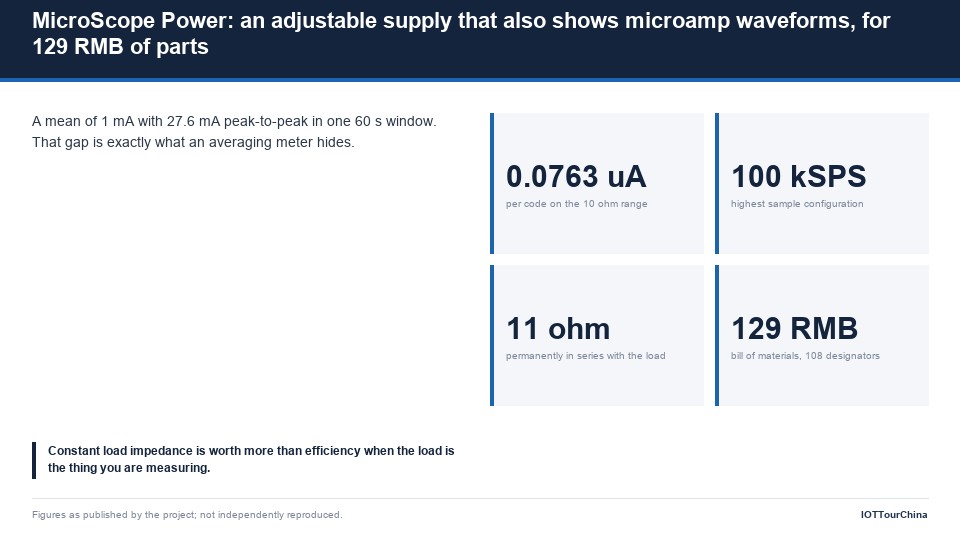
A mean of 1 mA with 27.6 mA peak-to-peak is the whole point. Averaging instruments report the 1 mA and hide the 27 mA; this shows both in one window, which is what tells you whether the fix is in the sleep state or the wake path.
The host side is a browser tool called ModuSignal reaching the device over WebUSB from Chrome or Edge — no driver, no install. It gives mean, peak-to-peak, AC RMS and energy, box-select zoom, A/B cursors, and a first-order digital low-pass with presets from 10 Hz to 20 kHz or a custom cutoff between 1 Hz and 45 kHz, capped at 45% of the estimated sample rate. Raw and filtered CSVs export separately, which is the right default: filter for the eye, keep the raw data.
Limits that are stated rather than hidden
100 kSPS is the highest configuration, not a verified 10 µs interval — conversion wait, SPI readback and framing all cost time with no DMA pipeline, so the host timestamps frames and flags timing overruns separately from real gaps. The 0.8–5 V range is a calculated figure; loaded output depends on input and drop. And acquisition pauses local voltage adjustment, because sampling and OLED refresh share one core: set the voltage first, then capture.
The BOM comes to ¥128.86 across 108 designators with the ADS8866 at ¥25.54 as the single most expensive part, which is a reasonable place for a 16-bit SAR to sit. Firmware is MIT, the host tool is Apache 2.0, and the schematic is a two-page A3 嘉立创EDA project that exports to vector PDF.
Project: txp666 on OSHWHub.