Luwu Dynamics open-sources XGO-Duck: a robot duck rebuilt around an Arduino Uno Q
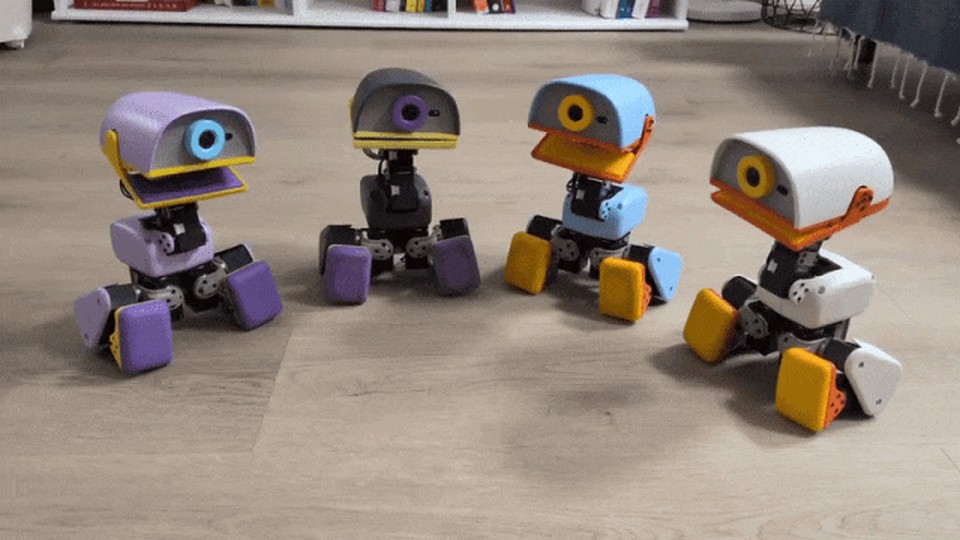
The MicroDuck made its name on charm: a small two-legged duck robot that walks, falls over and gets back up. When pre-orders opened on 27 August 2026, the order value passed 2.6 million US dollars within 24 hours, more than 5,000 units, at a peak of one every four seconds, with delivery quoted at four to six months.
A month later a Chinese team has published an upgraded take on the same idea, with the whole build released as open source.
The company is Luwu Dynamics, founded in November 2020, with a core team from the State Key Laboratory of Robotics and System at Harbin Institute of Technology. It is not a first-time open-sourcer: its XGO quadruped line has run three successful Kickstarter campaigns, and its RIG robots ship with open designs, support for Raspberry Pi, Micro:bit and ESP32, and development in Python, C++, Blockly and ROS. XGO-Duck was released on 24 September 2026.
Three skills, learned rather than scripted
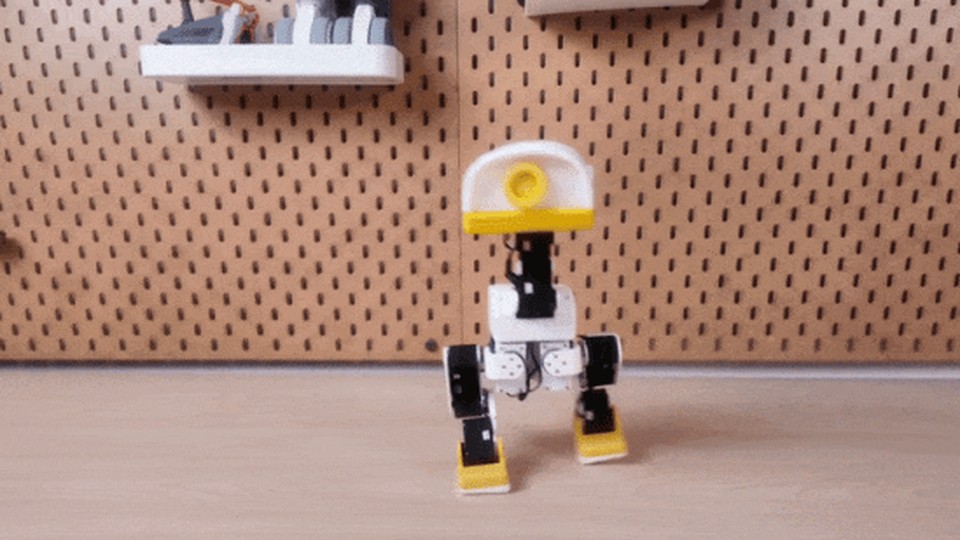
XGO-Duck does three things: it walks, it gets itself up after falling, and it lowers its head to pick up a small object with its beak. None of that is a hard-coded animation. The motion comes from reinforcement-learning policies trained in simulation, which is the line between this and a toy duck.
The release is split across two repositories. The hardware repository holds the 3D-printed structure, the expansion-board project, the full bill of materials and the assembly manual. The firmware repository holds the three policy models, the STM32 firmware and the browser control interface.
The parts list is deliberately plain: an Arduino Uno Q as the main controller, fifteen Feetech 1910 servos, a self-designed expansion board, one 18650 cell and thirty-two printed parts.
What changed from MicroDuck
The team is explicit in its README that the shell, the fifteen-servo joint layout and the joint order come from MicroDuck, and credits Pollen Robotics for them. The policy interface is identical too: sixty-one inputs per decision, fourteen servo angles out, fifty decisions per second. In principle a model trained for XGO-Duck can run on a MicroDuck.
Almost everything else was replaced.
| Subsystem | MicroDuck | XGO-Duck |
|---|---|---|
| Main compute | Single RK3566 | Arduino Uno Q (Qualcomm QRB2210 plus STM32U585) |
| Servos | 15 x Dynamixel XL330 | 15 x Feetech 1910 |
| Expansion board | Not applicable | Custom design |
| Sensing | Camera, ToF and two IMUs | One IMU |
The last row is the one that matters. Dropping the camera and the time-of-flight sensor turns XGO-Duck into a pure motion platform. It can walk, right itself and pick something up, but it cannot see. That is a deliberate cost decision, not an oversight, and it should be read before anyone treats the machine as a full embodied robot.
The dual-chip, dual-rate core
The interesting engineering is in how the two chips on the Uno Q divide the work. The board is effectively two computers stacked: a Qualcomm QRB2210 side runs Linux and the fifty-hertz policy loop, while an STM32U585 side runs Zephyr and the hundred-hertz servo bus.
The rule the design is built around is that the microcontroller never waits for Linux. The STM32 publishes a 240-byte state snapshot a hundred times a second. The Linux thread reads the newest frame at fifty hertz and skips any frame it missed, so nothing queues and nothing falls behind. If Linux stutters, the servos keep acting on the latest state, which is what lets a small biped stay upright.
Policies, recovery and the web UI
The heaviest part of the work, training, is already done. Three ONNX models for walking, getting up and picking are in the repository, loaded and warmed up at start, so nobody has to train a policy from scratch.
Recovery is a small state machine: a tilt beyond fifty-five degrees held for 0.15 seconds switches to the get-up model, and a return within fifteen degrees held for one second resumes walking. A web interface on port 9527 lets a browser select a mode and drive with WASD, and if the tab goes to the background for more than a second the torque is cut, so the robot does not wander off.
What is actually in the repositories
The manufacturing material is unusually complete for an open robot. On the hardware side the repository carries thirty-two STL files, an Altium schematic and PCB, an SMT bill of materials with placement coordinates, a full BOM with purchase links and a 4.8 MB illustrated assembly manual. On the firmware side it adds the three ONNX policies, STM32 source, a Python controller, the web UI and the deployment toolchain.
Two limits are worth stating up front. The Uno Q toolchain is version-locked, with fixed versions of the Zephyr core, RouterBridge and RPClite, which can stop anyone without embedded experience at the deployment step. And with no camera or ToF, XGO-Duck is a motion platform, not a perception platform.
That makes it a good fit for three groups: people who want a low-cost way into bipedal gait, people learning to put reinforcement learning on real hardware, and makers who already own a 3D printer and a soldering iron.
Official resources
IOTTourChina covers open-source robotics and the hardware around it as part of its developer resource. This is editorial coverage, not an endorsement; specifications, licensing and build requirements should be confirmed against the project's own repositories before you rely on them.