19 grams of piezo on a collar: what BCG buys a pet health monitor, and what it does not
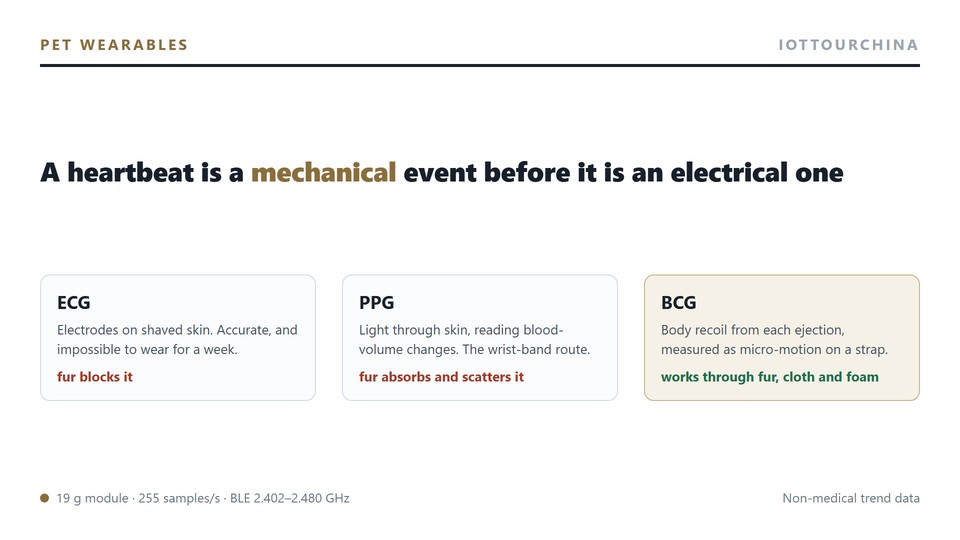
A pet cannot be asked to hold still for an ECG, and it will not sit under a pulse oximeter for a week. That is the whole problem with monitoring a dog's heart at home. The two sensors that work on humans both assume something a dog does not offer: shaved skin for electrodes, or an optical path for light. Fur defeats both.
Ballistocardiography, BCG, takes a third route. It does not measure the heart's electrical signal and it does not shine light through tissue. It measures the small mechanical recoil of the body each time the heart ejects blood, and that motion travels through fur, through a strap, and through the foam of a pet bed. A collar from a Shenzhen company called Huahe Pet Intelligence is built on exactly this, and it is now a shipping product with an FCC filing, an app on the App Store and a specification sheet. This piece looks at what the sensor can actually do, and at three numbers in the published material that do not survive arithmetic.
Why the two familiar sensors fail
An ECG electrode measures a potential difference on the skin, which means it needs a conductive path and low contact impedance. On a dog that path is behind a coat. Clinics deal with this by clipping a patch of fur and, often, by sedating the animal. The reading is excellent and the method is unusable for anything long-term. What you get is a snapshot taken during the one hour the animal is already at the vet.
PPG, the optical method in every wristband, is worse off. Green or infrared light is emitted into tissue and the reflected intensity is modulated by blood volume. On a wrist the light crosses a millimetre or two of skin. On a dog it first meets a coat that absorbs, reflects and scatters, and the fraction that reaches perfused tissue and returns is buried under surface reflection. The failure is not one of degree. There is no signal to recover.
Both methods therefore produce the same outcome, which is a measurement of the animal at its most stressed, in the place it least wants to be. The interesting number for a chronic condition is the opposite: the resting rate at three in the morning, in its own bed, across weeks. That is a baseline, and a baseline needs a sensor that survives daily life.
What a BCG signal actually is
Every ventricular ejection pushes a few tens of millilitres of blood into the aorta and the pulmonary artery. The body recoils, very slightly, in the opposite direction. The displacement is on the order of micrometres at the body surface, and the force is on the order of millinewtons, which is why the technique needed quiet laboratories and bed-mounted strain gauges for most of its history.
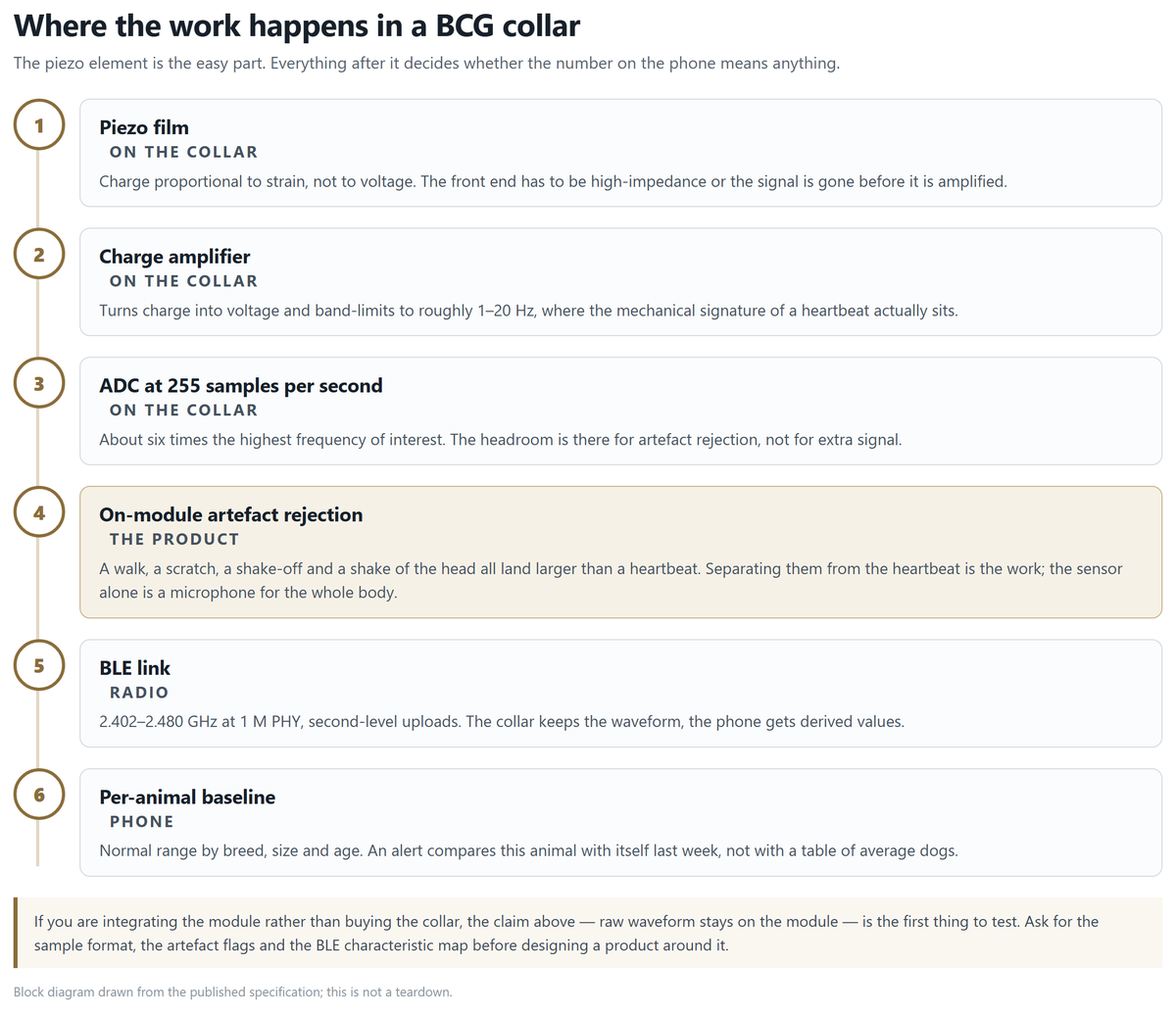
The useful part of the spectrum sits roughly between 1 and 20 Hz. Below that is respiration and postural drift; above it is a mixture of valve events, muscle noise and electronics. A piezo film bonded to a strap converts the strain into charge, and because charge leaks away, the amplifier that follows has to have an extremely high input impedance. That front end, not the film, is where most attempts at this fail.
Two properties make BCG attractive for animals. The first is that it is mechanical, so the coupling path can be indirect: strap tension, a harness, a mat under the bedding. The second is that it is a whole-body signal. You do not need a specific acoustic window, as you would for a stethoscope.
The cost is that a whole-body signal contains the whole body. A walk, a scratch, a shake of the head and the act of lying down all produce mechanical disturbances far larger than the cardiac component. On a human sleeping still in a laboratory bed this does not matter. On a dog wearing a collar it is the entire engineering problem, and it is the reason the interesting part of this product is not the sensor.
The device, as specified
The shipping model is the HPC011: a module that clips to a collar, sold in white, orange and black, with a companion app. The combined specification from the manufacturer's own product page and its export listing is short enough to put in one table.
| Item | Value |
|---|---|
| Module mass | 19 g |
| Module dimensions | 60 x 34 x 7.8 mm |
| Sensor | Piezo film, BCG, non-contact through fur and fabric |
| Reported channels | Heart rate, respiration rate, body motion, BCG waveform |
| Sampling | 255 samples per second |
| Radio | Bluetooth Low Energy, 2.402 to 2.480 GHz |
| Local storage | 7 days |
| Battery | 470 mAh, magnetic charging at 5 V 1 A, 2 to 3 hours to full |
| Runtime | Several days, described as up to 3 days in the export listing |
| Ingress protection | IP67 |
| Companion app | iOS 15.6 and later, Android via direct download |
The specification is coherent as a design. A 19 g module on a collar is light enough that a cat can carry it, IP67 covers rain and a wet nose, and magnetic charging removes the need for a sealed connector, which is the usual reason small wearable enclosures leak.
Number one: seven days of storage
Storage is the easiest claim to test, because it is arithmetic. A raw 16-bit sample at 255 samples per second costs 510 bytes per second per channel. That is 44 MB per channel per day, and 309 MB for a week on a single channel. Add respiration and motion and the week requires roughly 926 MB.
Very few wearable modules carry a gigabyte of flash, and the ones that do would not describe it as a footnote. So the seven-day figure must refer to derived values: a heart rate, a respiration rate and an activity count per minute, maybe with short waveform snippets kept around an alert. At one record per minute, three 16-bit fields, a week costs about 121 kB. That is three orders of magnitude away from the raw interpretation.
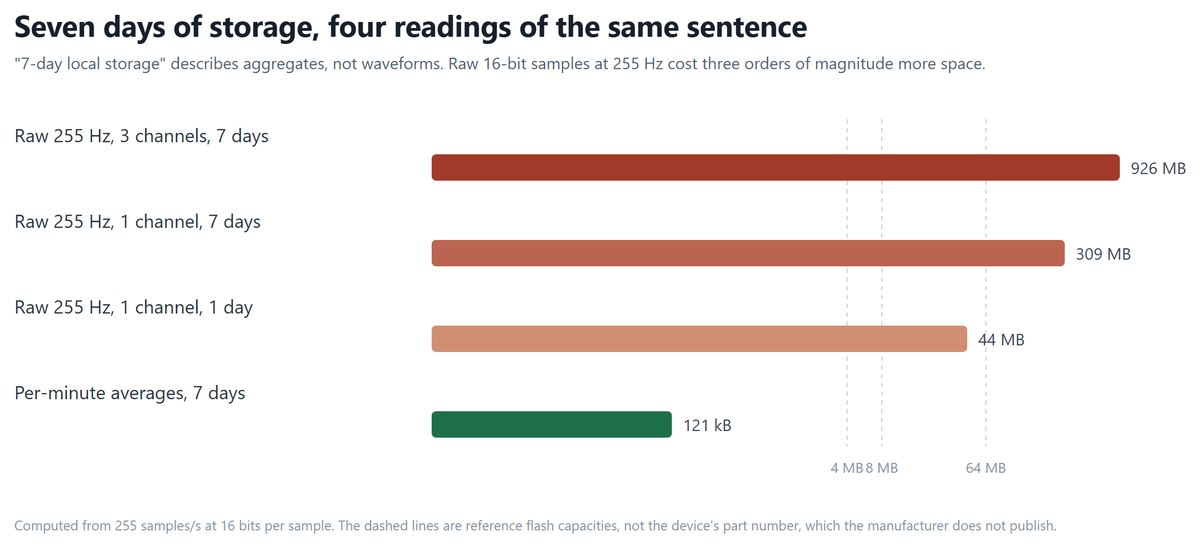
Neither reading is dishonest, but they are different products. If you are buying the collar, the practical question is what the app can show you after the fact: a continuous waveform for the last hour, or a dotted line of minute averages for a week. If you are integrating the module, the question is sharper, because raw waveform access is what decides whether you can build your own classifier on top of it.
Number two: the battery arithmetic
A 470 mAh cell lasting three days implies an average draw of about 6.5 mA. That is a reasonable budget for a microcontroller waking an accelerometer and a piezo front end at 255 samples per second, with a radio that transmits in short bursts. It is not a reasonable budget for continuous streaming, because a BLE link held open at a useful connection interval costs several milliamps on its own, and the radio plus the sampling would leave nothing for margin.
There is a wording detail in the export listing that matters here: the three-day figure is attached to standby, not to continuous monitoring. Those are different promises. The product's own FAQ says a charge lasts several days and that wearing it at night gives the best results, which is consistent with a device that samples continuously but uploads rarely. Anyone comparing this against a fitness band should expect a charging routine of a few times a week, not a month, and should ask the vendor for the runtime in the mode they intend to use.
Number three: the sampling-rate comparison
The specification sheet makes a point of 255 samples per second being well above the under-100 Hz used by most pet hardware, and the reasoning given is that denser sampling gives the algorithm more to work with.
The signal does not support quite that framing. If the cardiac band of interest ends around 20 Hz, then Nyquist puts the floor at 40 samples per second, and 100 samples per second already gives a factor of five. At 255 the factor is about six, which sounds like an upgrade but is really a statement about the anti-alias filter and the artefact rejection. A sharper filter needs a higher sampling rate to have room to roll off, and a classifier that has to separate a heartbeat from a scratch benefits from time resolution in the millisecond range.
So the higher rate is defensible, just not for the reason the marketing gives. It also costs power in direct proportion, which is why the battery number and the sampling number should be read together rather than as two independent achievements.
What the FCC filing adds
The collar holds FCC ID 2BTRK-HPC011, granted to Huahe Pet Intelligence (Shenzhen) Co., Ltd, with the equipment class DTS and an operating range of 2402 to 2480 MHz. The application was an original equipment filing, finalised on 15 January 2026, tested by a Shenzhen lab with a US agent on the paperwork.
Two things follow. The radio is BLE only, which is consistent with the first-generation product described as a pure health monitor with no cellular modem. And the grantee code holds exactly one filing. The 4G positioning models in the same catalogue do not appear under it, which suggests their cellular side is certified through the module vendor rather than through a host filing. Ask for the module grant before you assume either way. For an integrator that is not a problem, but it changes what you have to collect: the module's own grant, its carrier approvals if you plan to sell into North America, and the host-level RF exposure assessment for the final enclosure.
The App Store listing is worth reading for a different reason. The app is 1.0.5, first released in December 2025 and updated in March 2026, and the store lists four languages: English, French, Chinese and Spanish. The company's site advertises twelve languages across the app and the website. Both can be true, since the store field reflects the app bundle's localisations rather than the server-rendered content, but a distributor planning a launch in Japan or Germany should check the actual build rather than the homepage.
What the numbers support, and what they do not
The company's interview material goes well beyond the specification sheet: 20,000 units sold since the second-generation launch, more than 100,000 units of intent orders for next year, 75 percent of sales overseas with North America first, a domestic price of 1,599 yuan and an export price of 199 to 300 dollars, twelve core technologies, and a claimed 95 percent accuracy target for the health-warning model.
Almost none of that is independently checkable, and some of it is internally inconsistent. The company's own export profile states an export share of 61 to 70 percent, which is not 75 percent. The same profile lists a factory-to-port price of 58 to 69 dollars per unit at a minimum order of 100, which sits a long way below the retail figure quoted for overseas markets, and that gap is ordinary channel economics rather than a contradiction. The order figures have no public filing behind them.
| Claim | Status |
|---|---|
| 19 g module, 60 x 34 x 7.8 mm | Consistent across the product page and the export listing |
| BLE at 2.402 to 2.480 GHz | Confirmed by the FCC grant |
| 255 samples per second | Manufacturer specification, not independently measured |
| 470 mAh, 2 to 3 hours to charge, IP67 | Manufacturer specification |
| Seven days of local storage | Only plausible for aggregates, see the arithmetic above |
| Several days of runtime | Stated, but the export listing attaches three days to standby |
| FCC, CE, RoHS | FCC confirmed for HPC011; CE and RoHS not published as documents |
| 20,000 sold, 100,000 intent orders | Company statement, no public record |
| 75 percent exported | Company statement that conflicts with its own 61 to 70 percent profile |
| Twelve core technologies | Marketing language, no patent list published |
| Non-medical, HRV research grade | Company's own FAQ, and the most important line on the site |
That last row deserves emphasis because it is the vendor being straight with the buyer. The site states plainly that the system is an aid, that the reports are for reference, that HRV is research grade rather than clinical grade, and that abnormal readings should send you to a vet rather than replace one. A BCG trace is a trend, not a diagnosis, and a trend is exactly what a chronic condition needs, provided nobody mistakes it for a measurement of the same quantity an ECG produces.
Why the module is the more interesting product
The collar is the demonstration. The business underneath it is the sensing module, sold to other pet brands to go inside beds, harnesses, clothing and, in the company's own phrasing, odour-removal appliances. That is a reasonable strategy for a small company that owns a transducer design and does not own retail shelf space.
For anyone building on top of it, the questions to ask are the ones the specification sheet does not answer. What is the sample format and is the raw waveform exposed at all, or only filtered features. Are artefact flags published alongside the heart rate, so that a downstream model can drop bad windows. What does the BLE characteristic map look like, and is there a documented frame set rather than a proprietary app protocol. How is the baseline calibrated for a Chihuahua against an Alaskan Malamute, and what happens in the first week before a baseline exists. What is the current draw in streaming mode, not in the mode used for the headline number.
None of those questions is a criticism of the device. They are the difference between a product and a platform, and the company is explicitly selling the second.
The sensor is the easy part. A piezo film that turns body recoil into charge has been available for decades, and the physics of why it works through fur is not new. What is new is that a small team put a 19 g version on a collar, wrote the artefact rejection that makes the trace usable, and shipped it at a price that a pet owner will consider. Whether that turns into a standard, or into one product among many, depends on the two things no sensor can supply: enough clean data from enough breeds, and a reason for other brands to licence the module rather than build their own.