Forlinx OK3572-C: a Rockchip RK3572 board with 4 TOPS and a 998 yuan launch price
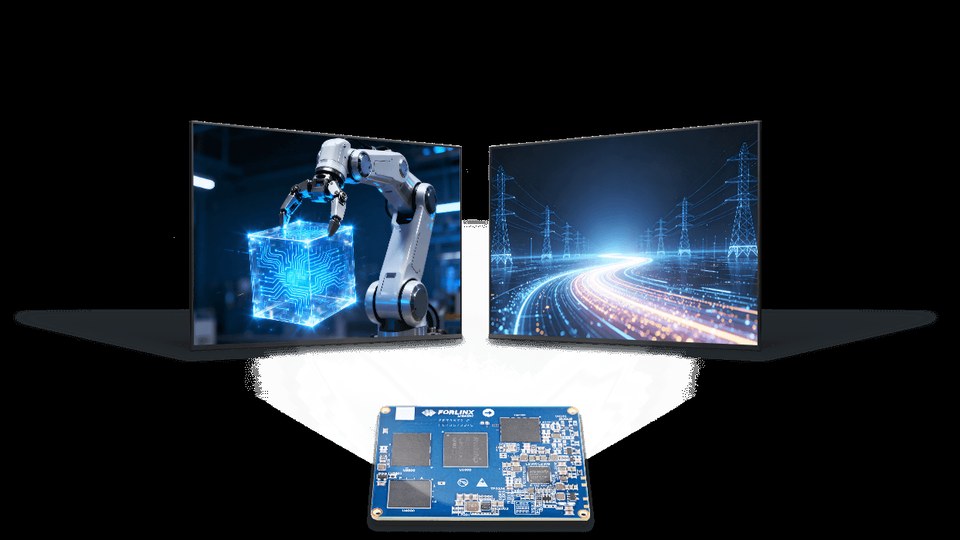
Rockchip's mid-range lineup has had a gap for a while. The RK3568 is getting old, the RK3576 costs more than many designs need, and the space between them has been filled by whatever the customer could stretch to. The RK3572, announced in May, is the part meant to sit in that gap: an eight-core, 8 nm chip with a 4 TOPS NPU, LPDDR5 support and industrial interfaces at a mid-range price.
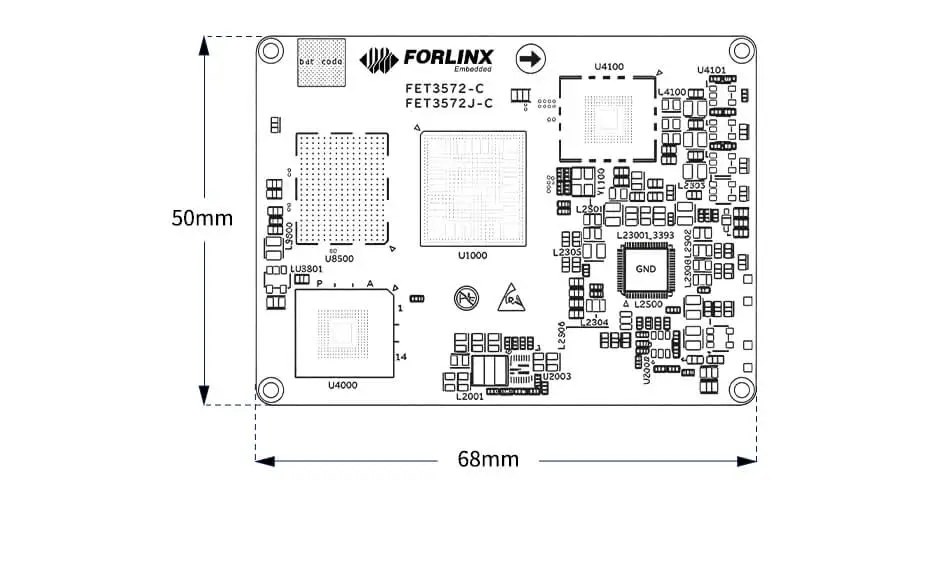
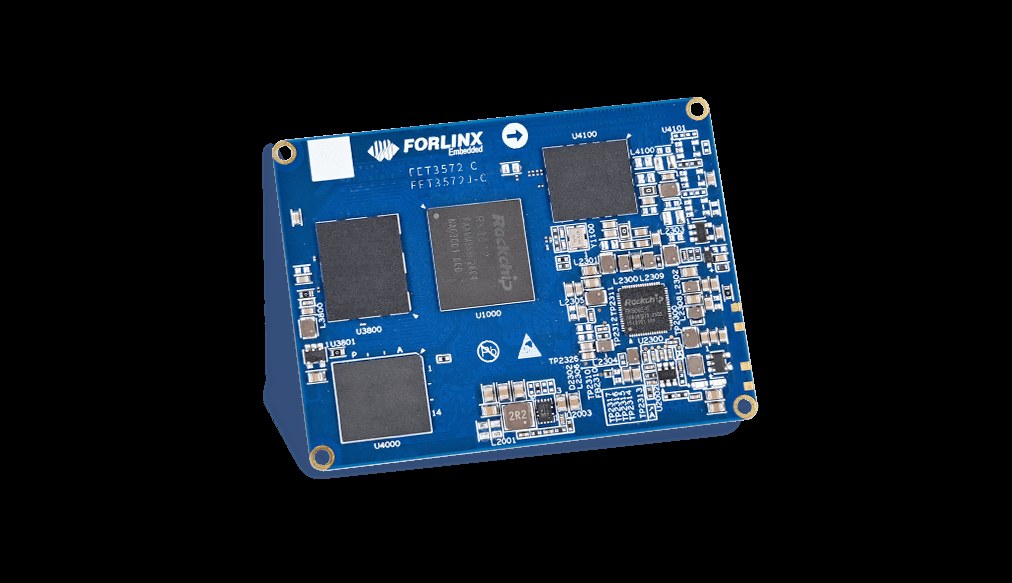
Forlinx is among the first to ship hardware around it. The FET3572-C is a 50 x 68 mm system-on-module carrying the processor, memory and storage, and the OK3572-C is the carrier board that exposes it.
What the RK3572 actually is
The CPU is a three-cluster arrangement rather than the simpler big.LITTLE split the naming suggests: two Cortex-A73 performance cores at 2.2 GHz, one quad-core Cortex-A53 cluster at 2.1 GHz, and a second dual-core A53 cluster. The split clusters let the scheduler scale without waking the whole A53 group, which is where a good part of the claimed efficiency gain comes from.
Rockchip also integrates a Nuclei N320 RISC-V core as a real-time microcontroller, which means a design can keep a control loop running without occupying a Linux core.
The NPU is rated at 4 TOPS INT8 and supports INT4, INT8, INT16, FP4, FP8, FP16 and BF16, plus W4A16 asymmetric MAC operations. Framework support covers TensorFlow, Caffe, TFLite, PyTorch, ONNX, Android NN and MXNet through the RKNN toolchain. The list of intended workloads is the usual one for this class: image enhancement, super-resolution, speech recognition, face recognition and license plate recognition.
Graphics is a Mali-G310V2 MC1 supporting OpenGL ES 1.1 through 3.2, OpenCL 3.0 and Vulkan 1.4. Multimedia runs to 8K at 30 frames per second decode for H.265, VP9, AV1 and AVS2, or 4K at 120 frames per second, with H.264 at 4K 60. Encoding covers H.264 and H.265 at up to 4K 40. A 12 MP ISP handles 4096 x 3072 input with HDR, noise reduction and lens distortion correction.


The module and the carrier
The FET3572-C module is 50 x 68 mm and connects to the carrier through four 100-pin board-to-board connectors, which is the standard Forlinx approach for this class and the reason the carrier can be reused across a module family. Memory options are 2 GB, 4 GB or 8 GB of LPDDR5, with 64 GB of eMMC on the module.
Two temperature grades exist. The standard FET3572-C is rated from 0 to 80 degrees C and the FET3572J-C from minus 40 to 85 degrees C. The RK3572 itself supports LPDDR4 and LPDDR4X up to 4266 MT/s as well as LPDDR5 and LPDDR5X up to 5500 MT/s, with configurations reaching 16 GB, so the 8 GB ceiling on this module is a product decision rather than a silicon limit.
Specifications
| Item | Specification |
|---|---|
| Processor | Rockchip RK3572, 8 nm |
| CPU | 2 x Cortex-A73 at 2.2 GHz plus 6 x Cortex-A53 at 2.1 GHz, in three clusters |
| Real-time core | Nuclei N320 RISC-V |
| NPU | 4 TOPS INT8; INT4, INT8, INT16, FP4, FP8, FP16, BF16 and W4A16 |
| GPU | Mali-G310V2 MC1, OpenGL ES 1.1 to 3.2, OpenCL 3.0, Vulkan 1.4 |
| Decode | H.265, VP9, AV1, AVS2 up to 8K at 30 fps or 4K at 120 fps; H.264 up to 4K at 60 fps |
| Encode | H.264 and H.265 up to 4K at 40 fps |
| ISP | 12 MP, up to 4096 x 3072 |
| Memory | 2 GB, 4 GB or 8 GB LPDDR5 on the module |
| Storage | 64 GB eMMC; eMMC 5.1, UFS 2.0, SD 3.0 and FSPI on the SoC |
| Operating system | Linux 6.12 and Android 16 shipping; Forlinx Desktop 24.04 and Debian 13 in development |
| Camera input | Four MIPI CSI, configurable as two 4-lane or four 2-lane |
| Display | HDMI 2.1 up to 4096 x 2160 at 60 Hz, MIPI DSI, eDP, RGB, EBC up to 1872 x 1404 |
| Dual display | 4K at 60 Hz plus 2K at 60 Hz simultaneously |
| Ethernet | Two gigabit ports |
| Expansion | One PCIe x1 slot, one M.2 Key M at 5 Gbps, three USB 3.0 host ports |
| Industrial buses | Two CAN or CAN-FD, two RS485 with onboard transceivers, DSMC |
| Wireless | Wi-Fi 5 and Bluetooth 5.0 on an AW-CM358SM module; M.2 slot for 4G or 5G |
| Debug and I/O | USB Type-C OTG for flashing, audio codec with microphone and speaker, RTC, three ADC channels, GPIO headers |
| Module size | 50 x 68 mm, four 100-pin board-to-board connectors |
| Module temperature | 0 to 80 degrees C standard, minus 40 to 85 degrees C on the J grade |
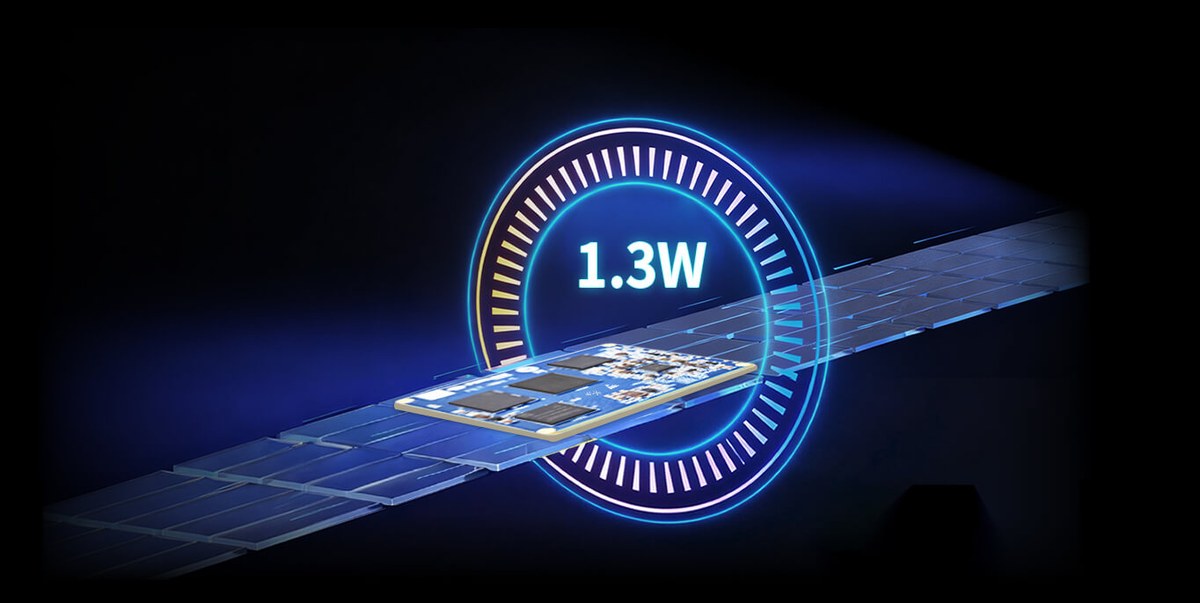
| Idle power | 1.32 W for the module and 3.00 W for the assembled board, no load |
The DSMC bus is the interesting interface
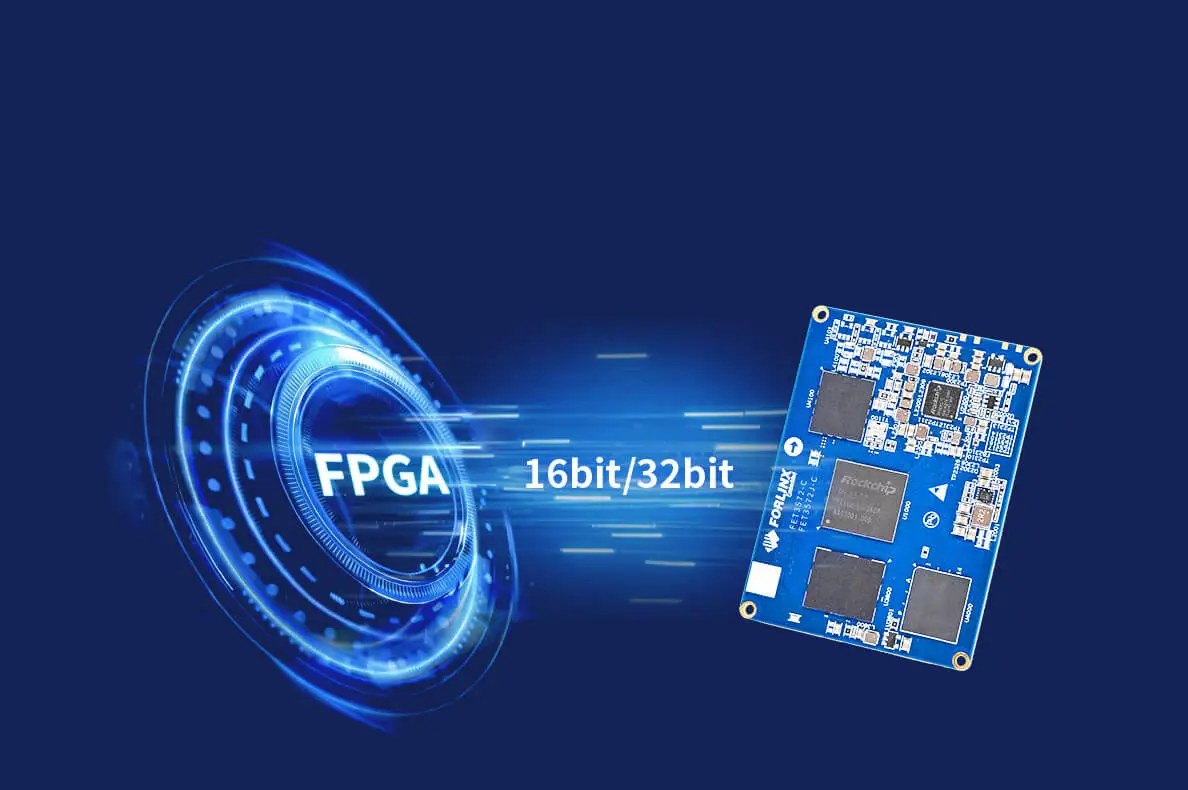
Of everything on the interface list, the one that stands out is DSMC, a parallel bus that Rockchip exposes on this platform and that most comparable SoCs do not have. It supports 16-bit or 32-bit widths and is intended for chip-to-chip links, specifically between the ARM side and an FPGA.
Forlinx quotes measured sustained read and write bandwidth above 300 MB/s. That is not competitive with PCIe, and it is not meant to be. It is a deterministic parallel bus with low latency, which is the property that matters in a PLC running multi-axis motion control, or in a data acquisition front end where samples have to arrive on a predictable schedule rather than in bursts. Designs that would otherwise put a small FPGA on a slow SPI link can use DSMC instead.
Power
Two sets of power numbers circulate for this platform, and they are measured at different levels, which is why they look inconsistent with each other.
Rockchip's figures describe the chip. The second-level standby state draws under 10 mW, playing 1080p video draws about 670 mW, and a light 3D game draws under 1 W. The comparison Rockchip makes is against the previous generation of mid-range platforms, where it claims more than double the performance at less than half the typical power.
Forlinx's figures describe the board, and the company has published a full set measured on the OK3572-C under Linux, with the 8 GB and 64 GB module fitted, a 7-inch Forlinx panel attached, a Quectel 4G module in the slot and both the module and the carrier supplied at 12 V.
| Test | Module only, W | Board with module, W |
|---|---|---|
| Boot peak, no load | 3.84 | 5.76 |
| Idle, no load | 1.32 | 3.00 |
| CPU, GPU, memory and eMMC stress | 4.80 | 6.36 |
| 7-inch panel, 4G, USB and video decode | 2.40 | 9.84 |
| 7-inch panel, 4G, USB and video encode | 2.28 | 9.60 |
| Power key long press, off | 0.0048 | 0.0048 |
| Power key short press, sleep | 0.60 | 2.16 |
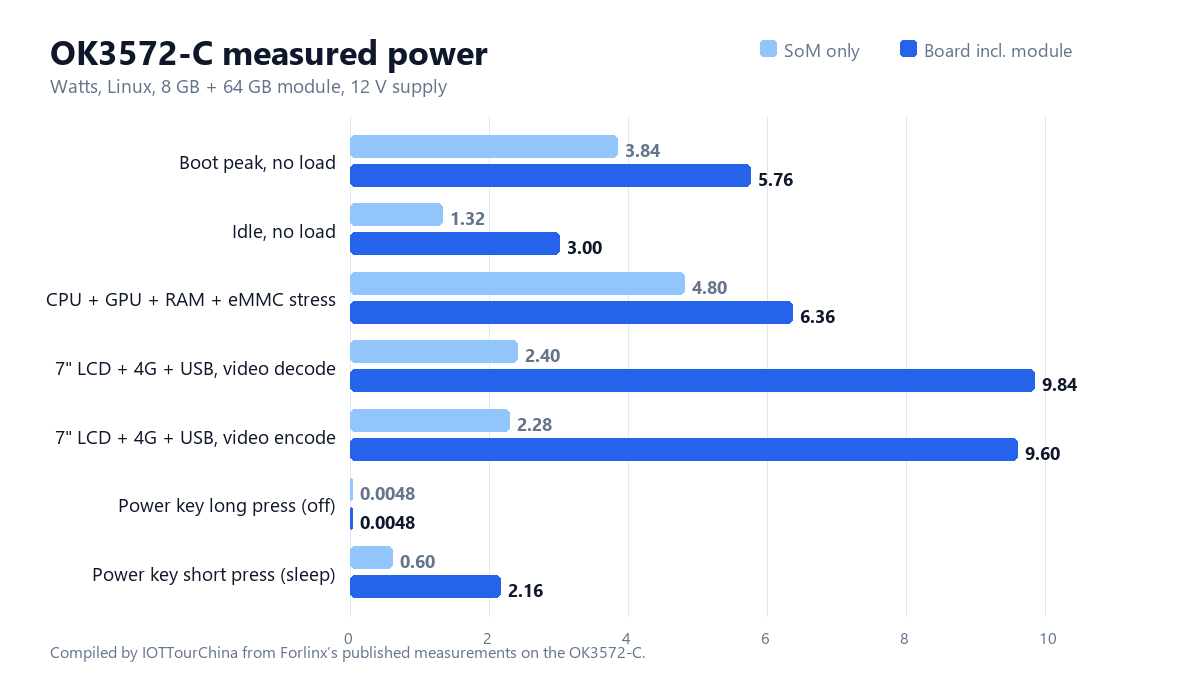
Three rows carry most of the weight. The module idles at 1.32 W and the assembled board at 3.00 W, which is what makes a sealed fanless enclosure realistic for a device that has to run continuously. With the processor, the GPU, memory and storage all under load the board reaches 6.36 W, so an eight-core part with an NPU fits inside a seven-watt envelope. Pressing the power key to shut down drops both figures to 0.0048 W, near enough to nothing for a device that spends most of its life waiting.
The rows with peripherals attached are the ones to plan against, however. A panel, a 4G module, a USB device and video work take the board to 9.84 W, more than three times the idle figure and before any camera or sensor load is added. The headline idle number describes a board that is waiting, not a board that is working.
Vendor benchmarks deserve a grain of salt, and the useful part is the ratio rather than the absolute figure. The AnTuTu v10 score Forlinx quotes is above 310,000, which is a comparison between Rockchip parts rather than a prediction of application performance. What the power table supports is a narrower claim than the marketing: this is a class of part where a fanless enclosure becomes possible, which is not true of the RK3588 designs one tier up.
Software and what ships with it
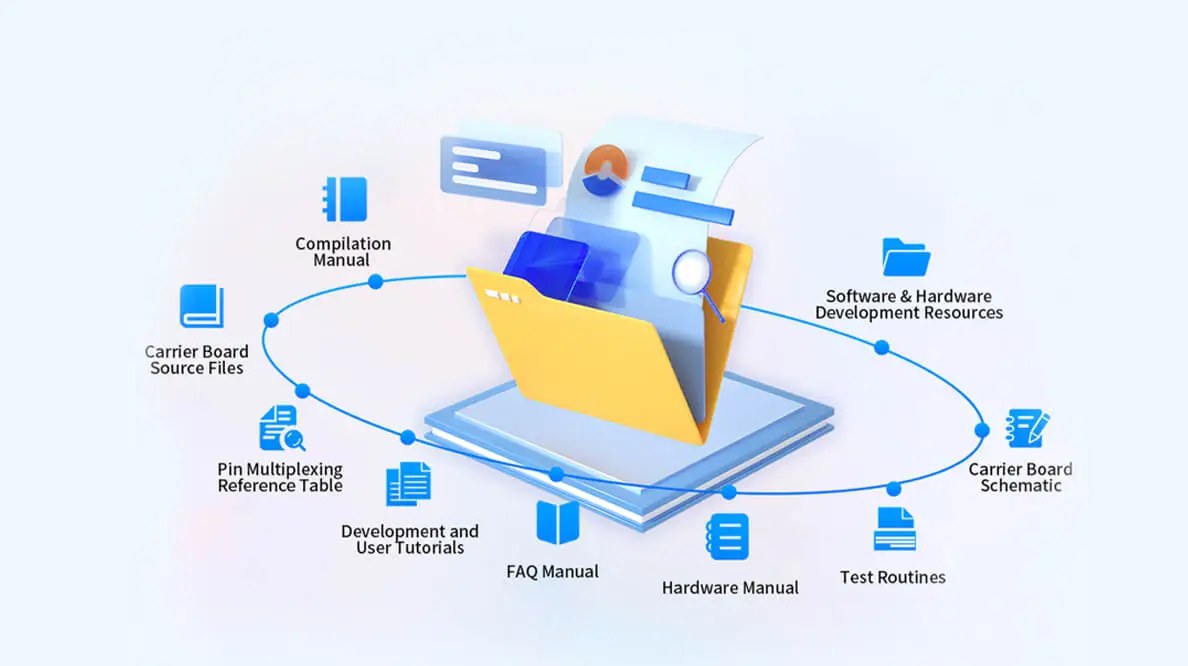
Linux 6.12 and Android 16 are the supported operating systems at launch, with Forlinx Desktop 24.04 and Debian 13 listed as in development. The documentation set is already published, and it is more complete than many vendors manage at launch: a hardware manual covering the module, the carrier and a hardware design guide, a Linux user and compilation manual, an Android manual covering flashing and OTA upgrade, a pin multiplexing table and the carrier board schematic.
The RKNN toolchain handles model conversion. On the security side, the processor includes a trusted execution environment for isolating secure resources, a hardware encryption engine and a secure boot chain that validates firmware integrity.

Price and availability
Forlinx opened pre-orders for the FET3572-C module and the OK3572-C board on the same announcement. The launch configuration advertised in China is 4 GB of memory with 64 GB of eMMC at CNY 998 including tax, roughly US$140, sold through the company's Tmall store. Other memory configurations and the module on its own were stated as following later.
Treat that as a China-market reference. Export pricing runs through distributors with their own margins, and launch campaigns on this class of hardware are usually limited in quantity.
Campaign pricing and the trade show
The board has since become one of the parts Forlinx is promoting hardest, and the advertised price has moved a long way from the launch figure.
At CIIF 2026, the industrial fair that opened in Shanghai on 12 October, Forlinx exhibited on stand 5.2H-A123 in the integrated circuit hall, with the OK3572-C in a line-up that also included the FCU3502 edge box and the UP4 and UP5 module families. Separately, the company has been running a twentieth-anniversary promotion on the board, advertised in China at CNY 488 for the 4 GB and 64 GB configuration with the development materials and shipping included.
Two things follow from that. The list price is a weak guide to what the board actually costs, and the offers are campaigns with eligibility rules and limited stock rather than permanent pricing. Confirm the configuration, the terms and the availability with the vendor or a distributor at the point of order rather than planning against an advertised figure.

Practical notes
- The 8 GB memory ceiling is the module, not the chip. The RK3572 supports more, and the limit on this board is a product decision. If a design needs more, that is a question for the vendor rather than for the silicon.
- Four MIPI CSI connectors are not four independent cameras at full rate. The lanes are shared, so four cameras means four 2-lane links and a corresponding bandwidth budget per camera.
- The standard module stops at 80 degrees C. Industrial deployments above that need the J grade, which is a separate part with its own temperature range at both ends.
- The order in which the operating systems ship is worth reading carefully. Linux 6.12 and Android 16 are available; Forlinx Desktop 24.04 and Debian 13 were still in development at announcement. A project that needs a Debian userland should confirm the release date before committing.
- Two RS485 and two CAN buses are routed through onboard transceivers, which saves a design from adding level shifters, but check the isolation scheme if the bus leaves the enclosure.
- The DSMC interface is the differentiator for anyone linking to an FPGA. It is also the interface with the least third-party documentation, so budget time for it.
- Wi-Fi and Bluetooth are on an AW-CM358SM module rather than integrated into the SoC, so the wireless performance is the module's, not the processor's.
- The AnTuTu score and the power figures come from vendor testing. They are useful for comparing Rockchip parts against each other, and less useful for predicting application performance.
- Budget for the periphery, not for the idle figure. The measured board power rises from 3.00 W at idle to 9.84 W once a panel, a 4G module, a USB device and video work are attached, and that is before any camera is connected.
- Advertised pricing on this board has ranged from the CNY 998 launch figure to campaign prices well below it. Treat the campaigns as limited and time-bound, and confirm the configuration and the price at the point of order.
IOTTourChina covers China-made IoT and edge hardware as part of its developer resource. This is editorial coverage, not an endorsement or an advertisement; specifications, availability and pricing should be confirmed with the vendor or a distributor before you buy.