Tronlong RK3572 core board packs 12 UARTs and 4 CAN FD into 35 by 57 mm
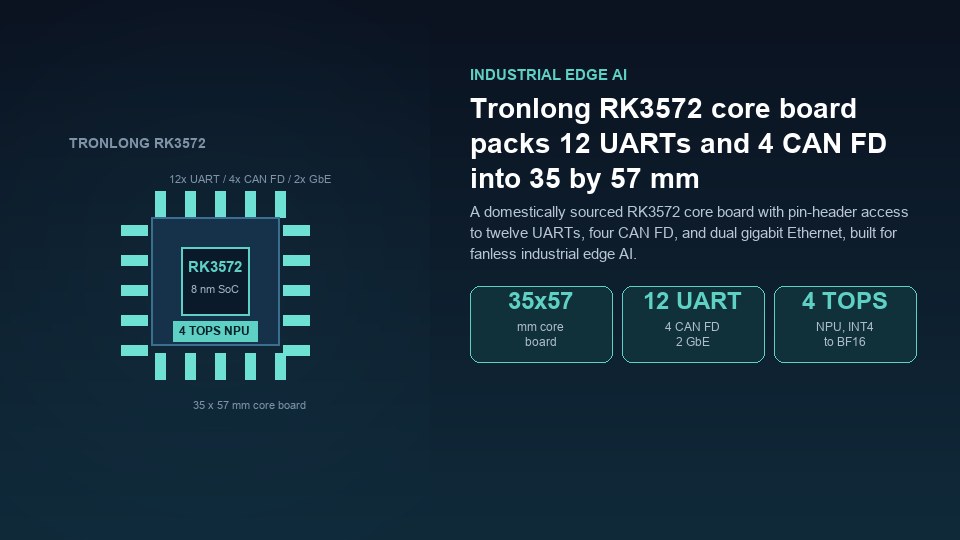
Rockchip's RK3572 has spent its first months inside system-on-modules from a handful of board vendors, and each one makes a slightly different trade on the same silicon. Tronlong, a Chinese industrial board maker, has now put the 8 nm processor on a core board that measures 35 by 57 millimeters and is built entirely from domestically sourced parts, a detail aimed at buyers who care where the bill of materials comes from.
A smaller carrier for the same chip
Most RK3572 modules sit in the 50 by 68 millimeter class and reach their carrier through wide board-to-board connectors. Tronlong's board is smaller and leans on pin headers for much of its I/O, which changes what an evaluation setup looks like. The board exposes twelve UARTs, four CAN FD controllers, two SPI, five I2C, PCIe 2.1, and GPIO through two 30-pin headers, alongside two gigabit Ethernet ports, three USB 3.0 ports, two MIPI CSI camera inputs, MIPI DSI, HDMI, and audio.
That pin-header approach matters for teams that want to prototype without a full carrier board. A fieldbus gateway or a motion-control prototype can be wired to the headers directly, with the CAN FD and UART lines already broken out and no adapter in between.
| Interface | Count |
|---|---|
| UART | 12 |
| CAN FD | 4 |
| SPI | 2 |
| I2C | 5 |
The chip underneath is unchanged
The RK3572 is the mid-range part Rockchip introduced in May 2026, and its outline is why so many industrial vendors are building around it. The CPU is a three-cluster arrangement of two Cortex-A73 cores at up to 2.2 GHz and six Cortex-A53 cores at up to 2.1 GHz, with a Nuclei N320 RISC-V core running as a real-time microcontroller. The NPU is rated at 4 TOPS and handles mixed precision from INT4 to BF16. Graphics is a Mali-G310 v2, and the video pipeline decodes 8K H.265 at 30 frames per second and encodes 4K at 40.
None of that changes from one board to the next, so the value a vendor adds is in the form factor, the connector style, and the supply chain rather than in the silicon.
Domestic sourcing as the pitch
The claim Tronlong leans on hardest is domestic. The core board is described as fully domestic supply, meaning the processor, memory, and supporting parts all come from Chinese suppliers. For a buyer weighing import risk or procurement rules, that is a concrete reason to pick this board over an otherwise similar module. Whether it matters to an overseas integrator depends on the end customer's sourcing policy, but it is the clearest differentiator on offer here.
DSMC for FPGA work
Like other RK3572 designs, the board keeps the DSMC parallel bus, the interface most comparable SoCs lack. Tronlong quotes measured sustained write of 260 megabytes per second and read of 200 megabytes per second, a little below what another vendor reports on its own board. That gap is expected, because DSMC throughput depends on the FPGA and the trace layout as much as on the SoC. For a design linking the ARM side to a small FPGA for deterministic, low-latency sampling, DSMC is the reason to choose this platform over a generic module.
Software
Tronlong lists Linux, Ubuntu, and Android as the supported operating systems, with Linux-RT, RT-Thread, and bare-metal options for real-time work. That range lets a team run a standard Linux userland for the application and keep a control loop on the RISC-V core or a real-time kernel without changing the hardware.
Where it fits
The board is aimed at industrial gateways, motion control, machine vision, and edge AI boxes that need native fieldbus interfaces inside a fanless envelope. Power follows the RK3572 reference numbers, with a minimum system that stays under a watt in typical standby. For an integrator comparing RK3572 modules, the decision now comes down to size, connector style, and sourcing rather than to the processor, which is the same across all of them.