Forlinx OK1126BJ-S: a 3 TOPS Rockchip RV1126BJ board with a Raspberry Pi 40-pin header
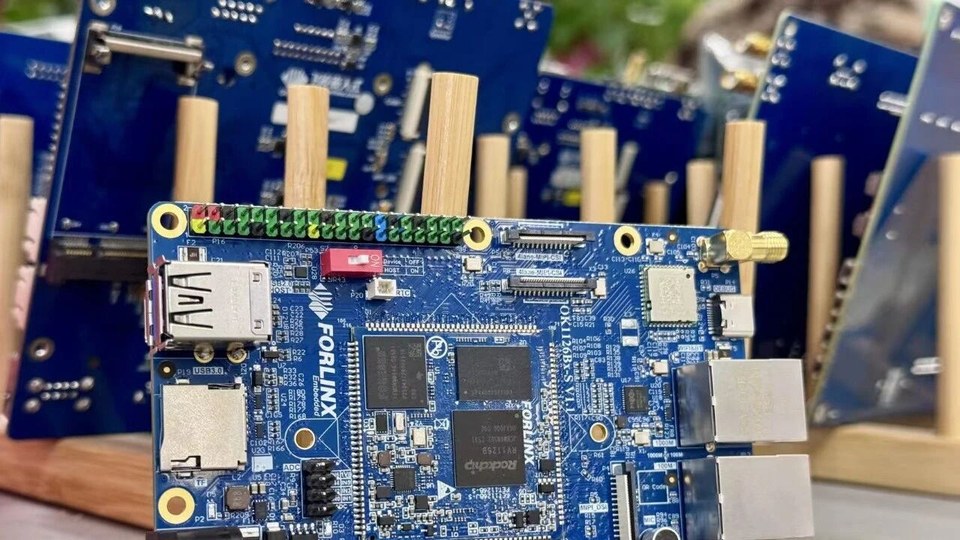
Most edge-vision boards are announced with a TOPS figure and little else. Forlinx's OK1126BJ-S is more interesting for what surrounds the NPU: an industrial temperature grade, a modular split between a small compute module and the carrier board, and a Raspberry Pi-compatible 40-pin header that lets a prototype borrow an existing accessory instead of waiting for a custom PCB.
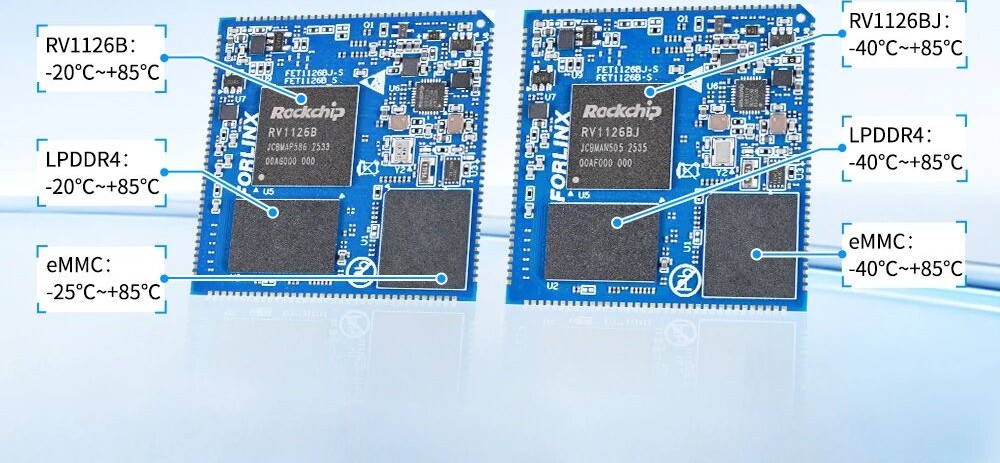
The board carries the FET1126BJ-S system-on-module, built around Rockchip's RV1126BJ. The module holds the processor, the LPDDR4 memory, the eMMC, the power tree and the reset supervisor, and exposes all 237 processor pins through a mix of stamp holes and LGA pads. A finished product therefore needs only a 5 V rail and its own carrier; the development board is the reference version of that carrier rather than a separate design.
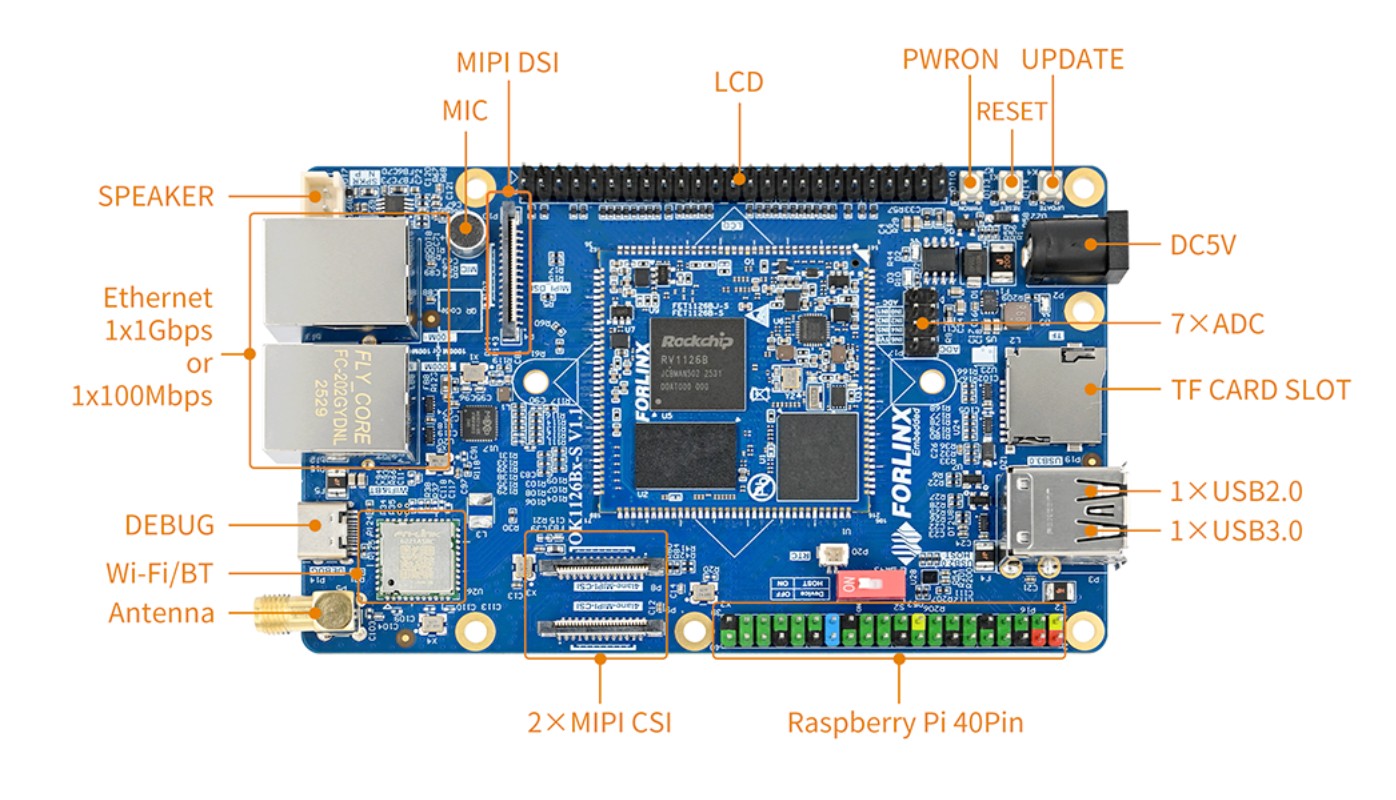
What the carrier board exposes
| Area | Specification |
|---|---|
| Processor | Rockchip RV1126BJ, 4 x Cortex-A53 up to 1.3 GHz; the RV1126B part runs to 1.6 GHz |
| NPU | 3 TOPS at INT8 |
| GPU | None. The 2D RGA block handles scaling, rotation and format conversion only |
| Memory | 1 GB, 2 GB or 4 GB LPDDR4 on the module |
| Storage | 8 GB, 16 GB or 32 GB eMMC on the industrial variant, 64 GB on the commercial one |
| Camera input | 2 x 4-lane MIPI CSI on FPC connectors |
| Display | 4-lane MIPI DSI plus an RGB LCD header, both with capacitive touch and backlight control |
| Ethernet | One RJ45 wired to a single MAC, so the 100 Mbps and gigabit ports are alternatives |
| Industrial buses | 2 x CAN-FD, up to 8 UARTs at 4 Mbps, 27 PWM channels, 24 ADC channels, 118 GPIO |
| 40-pin header | UART5, CAN0 and CAN1, I2C3 and I2C4, SPI1 and 7 ADC channels |
| Wireless | 802.11ac dual-band 1x1 Wi-Fi and Bluetooth 4.2 on a single antenna |
| USB and debug | 2 x USB 2.0, 1 x USB 3.0 host, debug console on Type-C |
| Other | microSD, RTC with a CR2032 backup cell, speaker output for a 4 ohm 3.3 W load, two microphones |
| Operating temperature | -40 to +85 degrees C on the BJ part, -20 to +85 degrees C on the B part |
| Operating system | Linux 6.1.141 |
| Module | 40 x 40 mm, stamp hole plus LGA, 237 pins |
| Board | 120 x 75 mm |
| Supply and lifecycle | DC 5 V, and the vendor states 10 to 15 years of supply |
The suffix is a temperature grade
Rockchip sells this processor in two grades and the naming is easy to misread. The RV1126B runs its four Cortex-A53 cores at up to 1.6 GHz and is qualified from -20 to +85 degrees C. The RV1126BJ is the industrial part: it drops to 1.3 GHz but extends the low end to -40 degrees C. The NPU, the ISP and the memory controller are the same, so the J version is not a faster chip. It is a slower chip with a wider thermometer.
The module also uses LPDDR4 rather than DDR4, which changes the temperature story for the cheaper commercial build. LPDDR4 parts are commonly rated from -20 to +85 degrees C, while DDR4 commercial parts often stop at +70 degrees C, so even the commercial-grade module covers the -20 to +85 degrees C window.
What changed from the original RV1126
This is the second generation of a part that already had a following, and the delta is worth spelling out because the marketing language buries it. Three things moved.
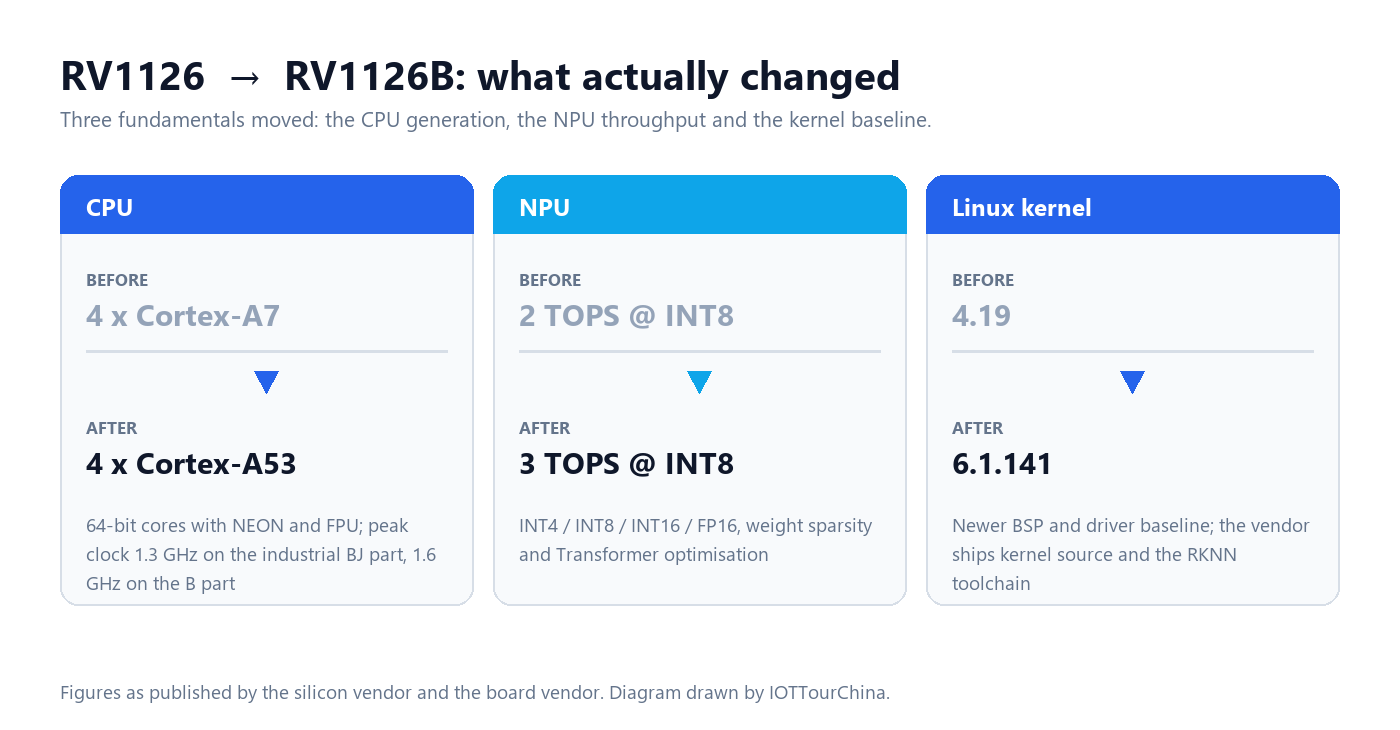
The CPU change matters most in practice. Cortex-A7 is a 32-bit core, while Cortex-A53 is 64-bit and carries NEON and FPU support. On a device that has to decode video, run a model and serve a network stream at the same time, that is a different class of headroom before the clock is even considered.
The vision pipeline
The camera path is the reason this part exists. The ISP accepts raw input from 8 to 16 bits per pixel through VICAP, with a maximum sensor input in the 12 megapixel class and a minimum of 264 x 264 pixels. Next to it sits a dedicated AI-ISP block that handles up to 8 megapixels at 30 frames per second and up to 4096 x 4096, and this is the detail worth remembering: it does not consume the 3 TOPS NPU while it runs. Denoising and enhancement are separate hardware, so they do not compete with inference for the same budget.
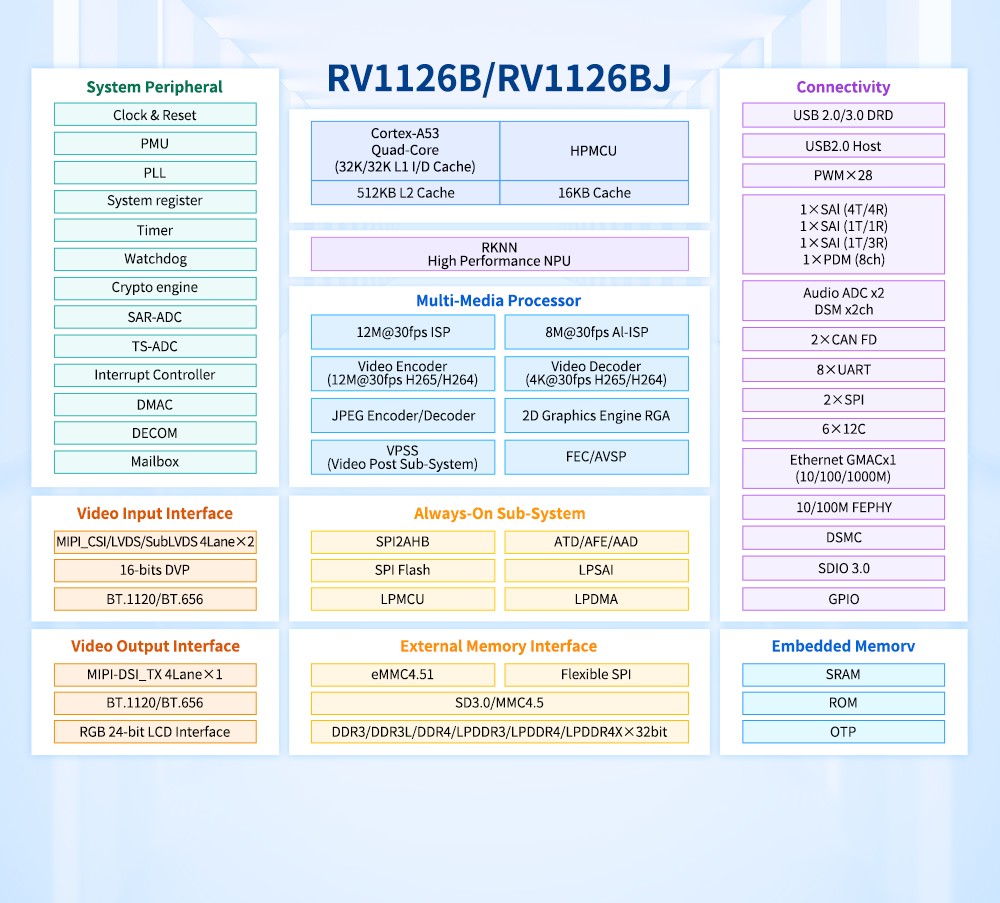
Video handling runs to H.264 and H.265 decode at up to 3840 x 2160 at 30 frames per second. Encoding covers HEVC, H.264 and JPEG up to 12 megapixels at 30 frames per second, including a parallel HEVC-plus-JPEG or H.264-plus-JPEG mode that writes a still image at the same time as the stream. The JPEG decoder accepts images from 48 x 48 up to 65520 x 65520 pixels, which is a wider range than most sanity checks assume.
There is no 3D GPU anywhere in that list. Everything visual that is not inference or video goes through the 2D RGA block: scaling, rotation, mirroring, alpha blending and format conversion. That is enough for a camera pipeline and a simple interface, and it is not enough for a Qt-based dashboard with smooth animation unless software rendering is acceptable.
Software and what ships with it
Forlinx provides a Linux 6.1.141 board support package with kernel source, a root filesystem, drivers and the RKNN toolchain. Model conversion goes through RKNN, and the framework support on the silicon side covers TensorFlow, Caffe, TFLite, PyTorch and ONNX. The NPU itself accepts INT4, INT8, INT16 and FP16, supports weight sparsity, and the vendor markets Transformer optimisation for small language models.
That last claim deserves a realistic frame rather than a headline. Rockchip positions the part at models under roughly 2 billion parameters, and deployment notes from the ecosystem point at memory rather than the NPU as the real constraint: 1 GB of LPDDR4 takes only a very small model, 2 GB is the practical floor for a 0.5 to 1 billion parameter model, and 4 GB is needed for a 1.5 billion parameter model with any context. Buy the 1 GB configuration for vision work, and step up only if a language model has to run alongside it.
The box contains the development board, a Wi-Fi antenna, a 5 V 3 A adapter, a Type-C cable, mounting standoffs and an RTC battery.
Price
The industrial 1 GB plus 8 GB configuration was advertised in China at CNY 408, roughly US$57, during a launch campaign, against a stated list price of CNY 768, roughly US$107, with a further discount for new enterprise customers. Treat those figures as a China-market reference rather than an export price. The campaigns are limited in quantity and change often, and distribution outside China runs through resellers with their own pricing, so confirm the number with the vendor or a distributor before budgeting.
Practical notes
- One MAC, two sockets. The carrier has both a 100 Mbps and a gigabit RJ45, but the processor has a single MAC, so the vendor's own documentation says the two ports are a choice rather than a pair. A dual-homed design needs a switch or a second interface from somewhere else.
- Check the grade before the clock. The industrial BJ part runs at 1.3 GHz, not 1.6 GHz. If the workload is CPU-bound rather than NPU-bound, that is a real cost, and it is easy to miss because both are sold under the same series name.
- Treat the 40-pin header as a prototyping tool. The layout is defined to match the Raspberry Pi standard and exposes UART5, CAN0 and CAN1, I2C3 and I2C4, SPI1 and seven ADC channels, but the pin functions belong to the SoC rather than to the Pi. Read the pinout before assuming an accessory will work, and check the budget on the 5 V input.
- Two camera connectors, four lanes each. A 4-lane connector is a useful count for a stereo or a front-and-rear design. The DVP path on the module is a separate interface with its own pin cost.
- No 3D acceleration means planning the interface. A product that needs a touch UI should budget for a lightweight toolkit or a separate display controller rather than a GPU-driven stack.
- The base memory is small. 1 GB of LPDDR4 is comfortable for vision inference and marginal for language models.
- Documentation is Chinese-first. The product pages exist in English, but the detailed manuals, schematics and sample code are Chinese-language material. Plan onboarding around that.
- Ten to fifteen years of supply is a stated commitment. It is a meaningful signal for an industrial product, and worth confirming in writing against your own production window.
IOTTourChina covers China-made IoT and edge hardware as part of its developer resource. This is editorial coverage, not an endorsement or an advertisement; specifications, availability and pricing should be confirmed with the vendor or a distributor before you buy.