Forlinx FCU3502: a 36-channel edge AI box built on an RK3588 plus an RK1828 accelerator
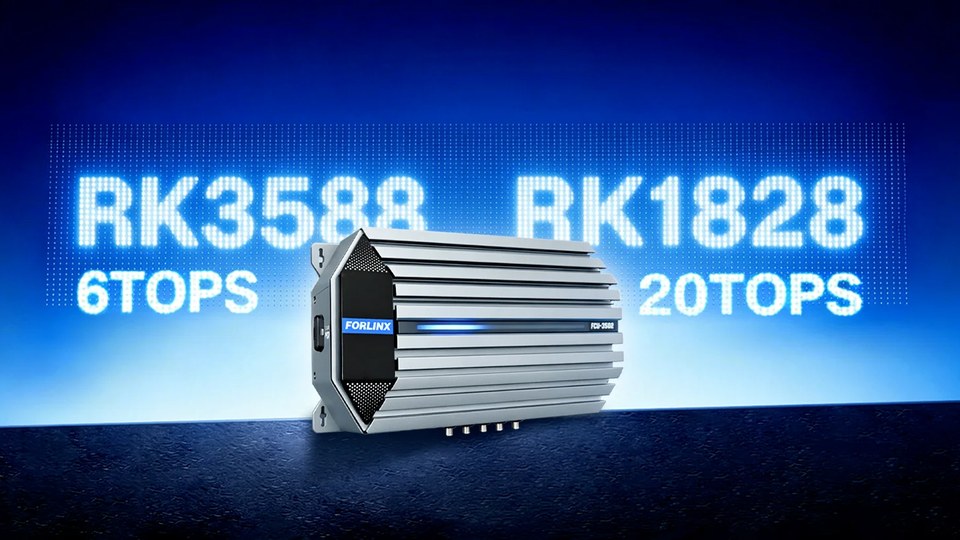
Most industrial video-analytics installations still start from the same shopping list: an x86 industrial PC, a discrete NVIDIA card, and a software stack that has to be integrated across several vendors. Forlinx is aiming at that list with the FCU3502, a fan-cooled edge box that replaces the x86 host with a Rockchip RK3588 and adds a second Rockchip part, the RK1828, on an M.2 card dedicated to AI.
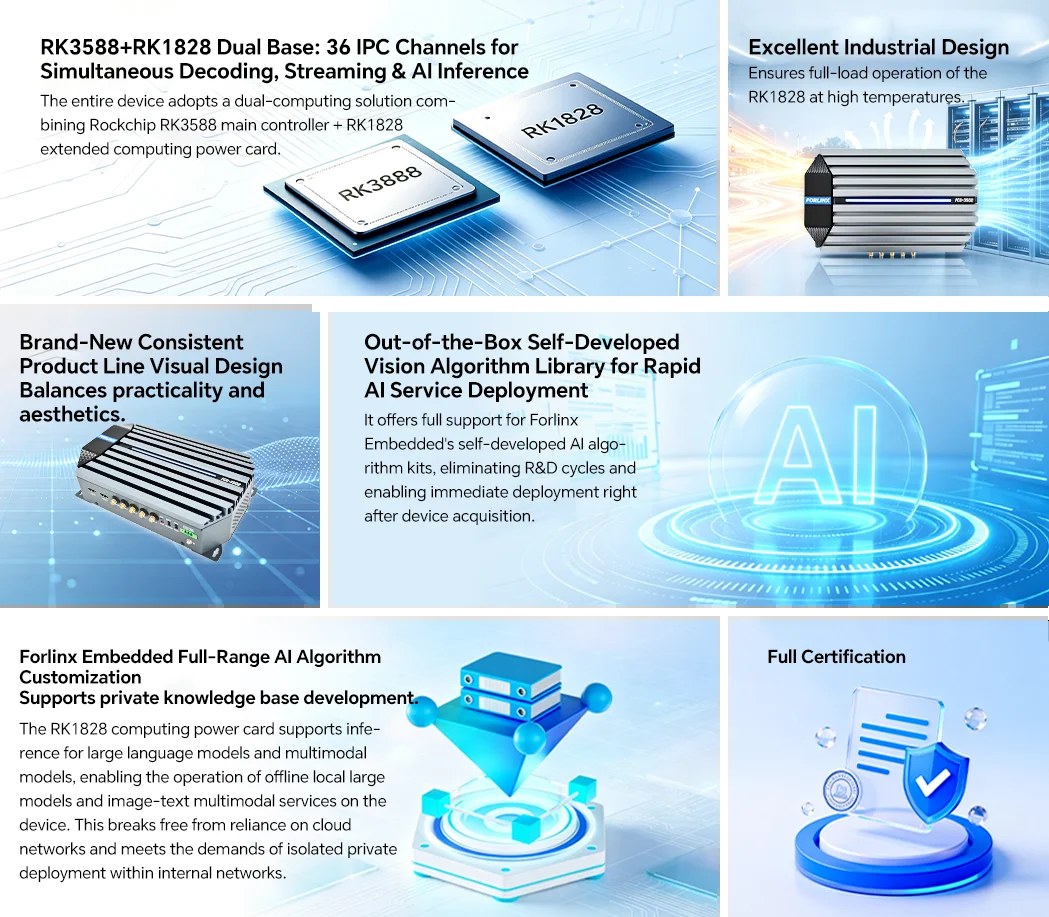
The pitch is straightforward: one chassis that ingests up to 36 network camera streams, runs the analytics locally, and can also host a 7-billion-parameter language model for offline retrieval-augmented question answering. No cloud link, no separate inference server.
Two chips, two jobs
The FCU3502 is built around a split that is worth understanding before comparing it with single-chip edge boxes.
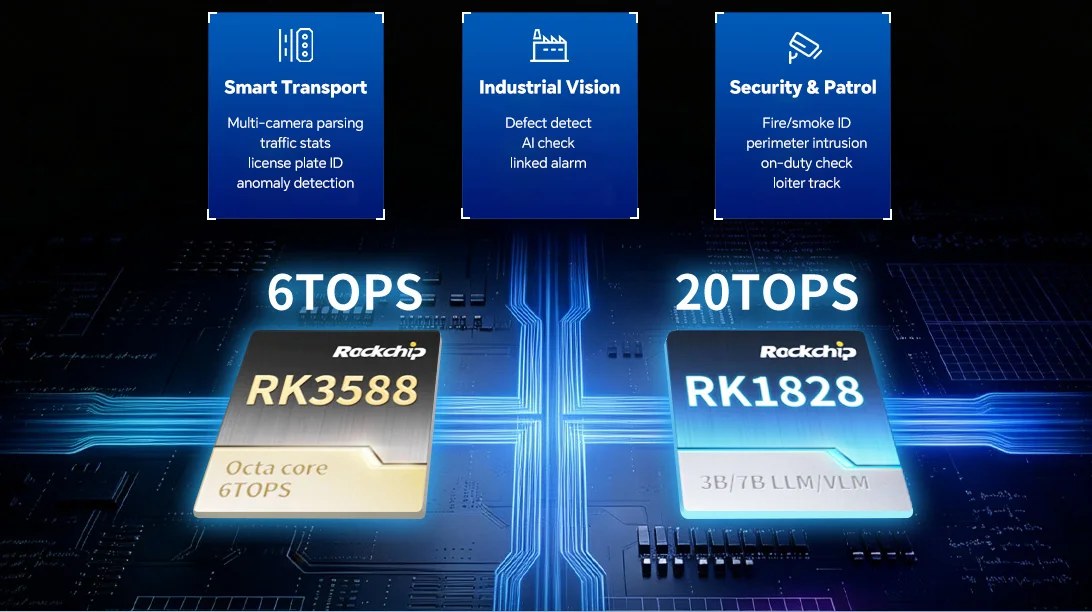
The RK3588 is the host. Its four Cortex-A76 cores run at 2.4 GHz in the commercial grade, or 1.6 GHz in the RK3588J industrial grade, alongside four Cortex-A55 cores at 1.8 GHz or 1.3 GHz. Its 6 TOPS NPU handles light inference, and its video pipeline does the heavy lifting on decode: H.265 and VP9 up to 8K at 60 frames per second, H.264 up to 8K at 30, and AV1 up to 4K at 60. Encoding covers H.265 and H.264 up to 8K at 30.
The RK1828 is the accelerator. It sits on an M.2 card, carries its own 5 GB of memory, and adds a 20 TOPS NPU. Because it is a separate device with its own memory, it does not compete with the host for DRAM bandwidth, which is the constraint that usually limits how many streams a single-SoC box can process.
Forlinx quotes a 26 to 46 TOPS range for the finished product, which is the sum of the 6 TOPS host NPU and an RK1828 configuration between 20 and 40 TOPS. The 20 TOPS figure is what the current product page lists.
What the 36-stream figure means
The number in the headline is a specific configuration rather than a general capability, and the details matter.
36 streams, each 720p at 20 frames per second in H.265, decoded, re-streamed and analysed simultaneously. Forlinx states a total inference output of roughly 300 frames per second across all channels, which works out to about 8 frames per second of inference per stream at full load, and an end-to-end latency of one second or less from capture to result.
That is a reasonable design point for perimeter security, production-line monitoring and inspection: the analytics do not need cinema frame rates, they need to stay behind the camera rather than a cloud round trip behind it. The numbers also describe the ceiling rather than the average. A deployment running detection on all 36 channels and a language model at the same time will be sharing the RK1828 with both workloads.
Specifications
| Item | Specification |
|---|---|
| Host processor | Rockchip RK3588, four Cortex-A76 plus four Cortex-A55 |
| Host clocks | A76 at 2.4 GHz and A55 at 1.8 GHz on the commercial grade; 1.6 GHz and 1.3 GHz on the RK3588J industrial grade |
| Host NPU | 6 TOPS, INT4, INT8, INT16 and FP16 combined operations |
| Host GPU | Mali-G610 MP4, OpenGL ES 1.1 to 3.2, OpenCL 2.2, Vulkan 1.2 |
| Decode | H.265 and VP9 up to 8K at 60 fps; H.264 up to 8K at 30 fps; AV1 up to 4K at 60 fps |
| Encode | H.265 and H.264 up to 8K at 30 fps |
| Accelerator | Rockchip RK1828 on an M.2 card, 5 GB of its own memory, 20 TOPS NPU |
| Memory | 8 GB system memory |
| Storage | 64 GB eMMC |
| Operating system | Forlinx Desktop 22.04 |
| Software stack | Docker, MySQL, FTP server, Modbus TCP and RTU, OpenVPN, MQTT, OpenSSL, OpenSSH |
| Camera input | Up to 36 network streams over RTSP, ONVIF or GB28181 |
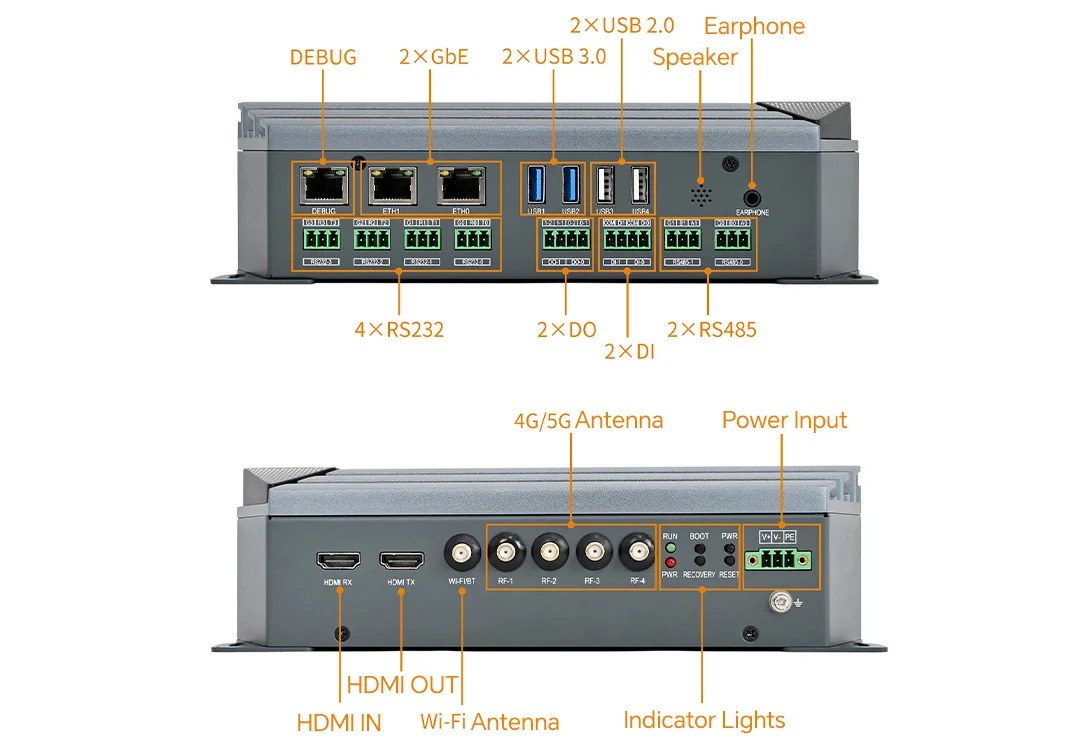
| Ethernet | Two 10/100/1000 Mbps ports |
| USB | Two USB 2.0 Type-A at 5 V 0.5 A, two USB 3.0 Type-A at 5 V 1 A |
| Display | HDMI output up to 7680 x 4320 at 60 Hz, HDMI input up to 4K at 60 Hz |
| Serial | Four isolated RS232 and two isolated RS485 ports on 3-pin terminal blocks |
| Digital I/O | Two optocoupler-isolated inputs and two relay-isolated outputs, dry contact |
| Expansion | Three M.2 slots: 4G or 5G module, solid-state drive, and the RK1828 card |
| Wireless | Wi-Fi 4 and Bluetooth 4.2 |
| Supply | 24 V nominal, 9 V to 36 V range, reverse-polarity and over-current protection |
| Cooling | Active, with a fan |
| Operating temperature | 0 to 70 degrees C |
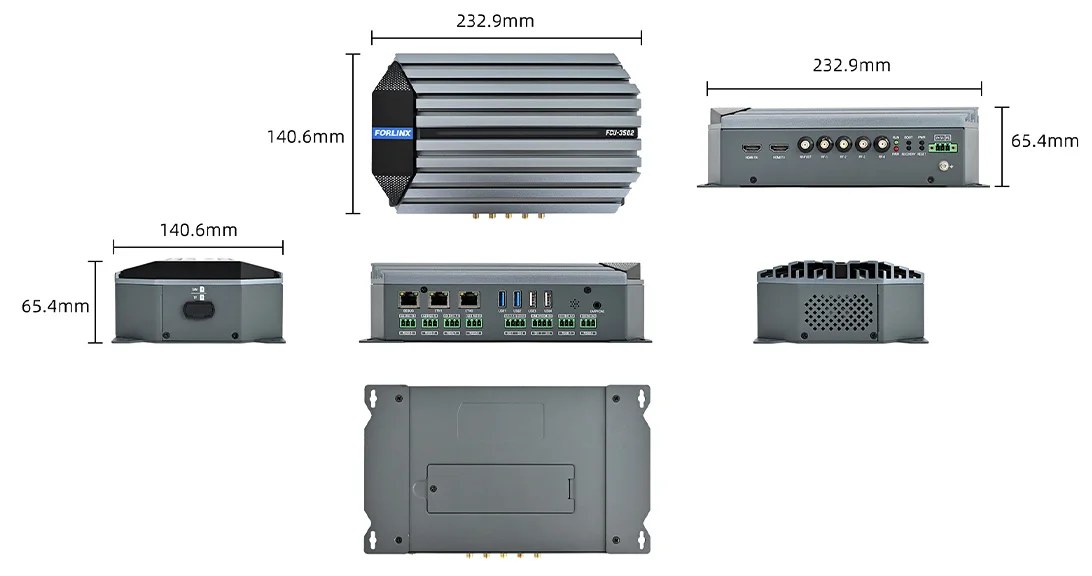
| Dimensions | 233 x 141 x 66 mm |
| Weight | 2.04 kg |
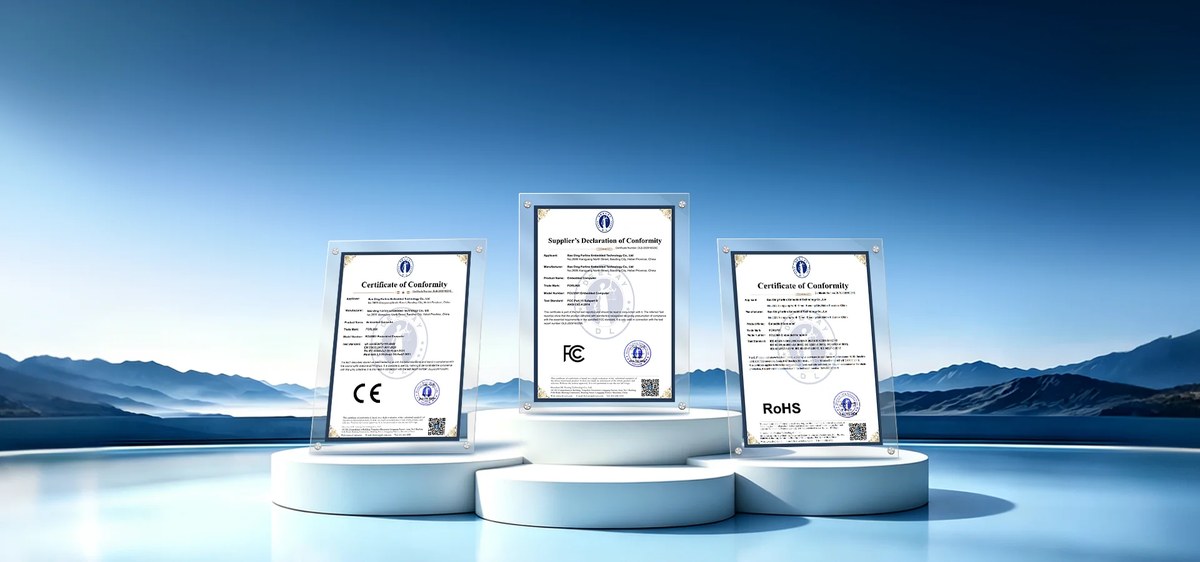
| Certification | CE, FCC and RoHS |
Local models and the memory question
The RK1828 card is what makes the offline language model claim possible, and the practical limit is memory rather than TOPS. Forlinx states that a 7B language or vision-language model runs at better than 40 tokens per second on this card, and that the system supports retrieval-augmented generation over a private knowledge base held on the device.
That framing is the useful part. A 7B model at 40 tokens per second is not a substitute for a frontier cloud model, but for the workloads named in the product brief, equipment manuals, process specifications and inspection records, it does not need to be. The value is that the documents never leave the chassis, which is what makes the design usable in air-gapped industrial, energy and government networks where sending footage or records to a cloud service is not an option.

The bundled algorithm library
Forlinx ships a pre-trained vision library covering roughly 36 algorithms across security, industrial and transport scenarios, including smoke and fire detection, intrusion detection, fall detection, license plate recognition and waste detection. The algorithms are already trained and tuned, so a project can call them rather than build a training pipeline.
For buyers who need something outside the library, Forlinx offers algorithm customisation covering training, tuning, model conversion and on-device commissioning.
The camera side accepts RTSP, ONVIF and GB28181, which means existing IP cameras and mainstream video management platforms can be connected without per-device adapter work. Configuration, camera management, live preview and alarm review are handled through a browser interface and a mini-program client.
Where it is meant to be installed
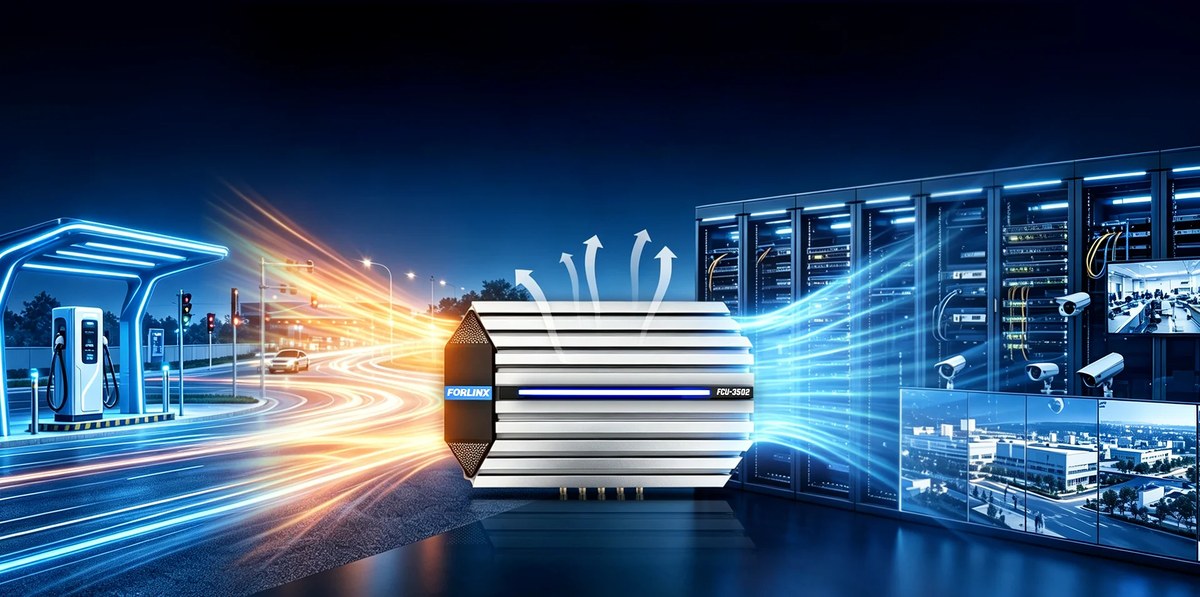
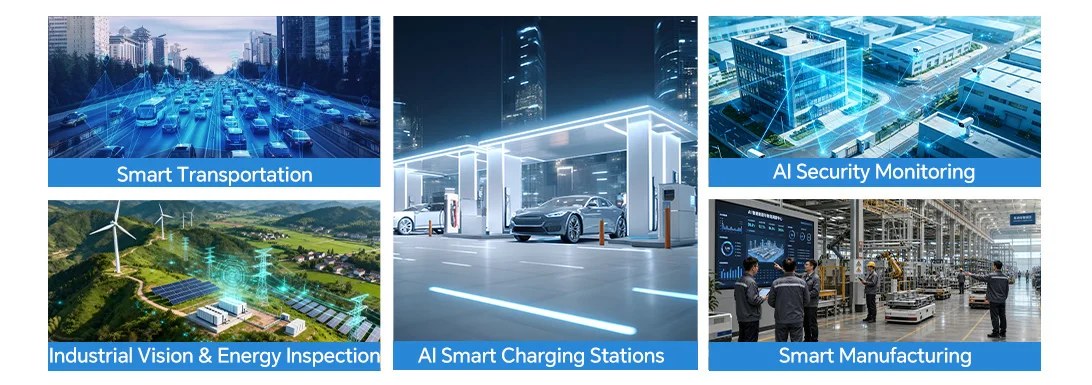
Forlinx lists smart transport hubs, industrial vision and energy inspection, AI charging stations and edge computing terminals as the target deployments. The box is rated for 0 to 70 degrees C and uses active cooling with a fan, which is a deliberate trade: fanless would widen the temperature range but limit sustained NPU load.
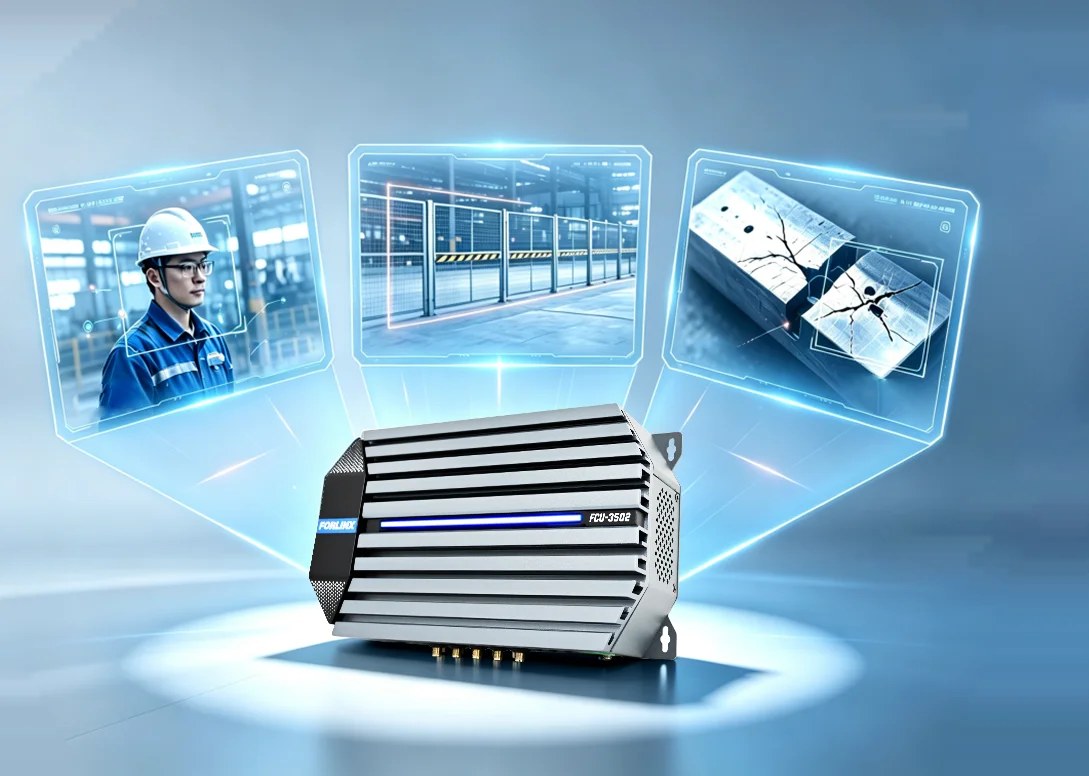
The chassis measures 233 x 141 x 66 mm and weighs just over 2 kg, and can be mounted on a desk or on brackets. A programmable RGB light bar on top is used to show operating and alarm states from a distance, which is a small detail that matters for anyone who has to walk a row of cabinets to find the unit with the fault light.
Practical notes
- Read the TOPS range as a configuration, not a specification. The 26 to 46 TOPS range spans two RK1828 variants. Confirm which card is fitted before sizing a workload.
- The RK3588 grade changes the clock, not just the thermometer. The industrial RK3588J runs at 1.6 GHz and 1.3 GHz rather than 2.4 GHz and 1.8 GHz. For a workload that is CPU-bound rather than NPU-bound, that is a real difference, and the commercial grade is the standard configuration.
- The language model and the video analytics share the accelerator. A 7B model running at 40 tokens per second is measured on the card; a deployment that also decodes and analyses 36 streams at once is asking the same silicon to do both.
- Thirty-six streams is a 720p figure. Higher camera resolution reduces the channel count, because the decode and inference cost scales with pixel rate rather than with stream count.
- Two of the three M.2 slots are spoken for by design. One is the RK1828 card and one is optionally a 4G or 5G module, which leaves the third for storage.
- Certification is stated as obtained for CE, FCC and RoHS, with environmental testing completed.
- The unit needs 24 V, not the 12 V that is common on smaller edge devices. The 9 V to 36 V range covers most industrial supplies, but check the rail before ordering.
IOTTourChina covers China-made IoT and edge hardware as part of its developer resource. This is editorial coverage, not an endorsement or an advertisement; specifications, availability and pricing should be confirmed with the vendor or a distributor before you buy.