ESP32-Plane-Radar turns a round ESP32-C3 display into a desktop ADS-B map
A desktop radar that shows aircraft overhead sounds like a radio project. The open-source ESP32-Plane-Radar is not one. It is a small display that asks the internet where the planes are, then draws them.
The project is published by MatixYo under the MIT licence. The hardware is deliberately minimal: one ESP32-C3 Super Mini board and one 1.28-inch round display built around the GC9A01 driver, a 240x240 IPS panel on a four-wire SPI bus. The author quotes a total of about 25 yuan for the two parts, reading the price of each specific variant rather than the lowest listing on the page.
What the screen actually shows
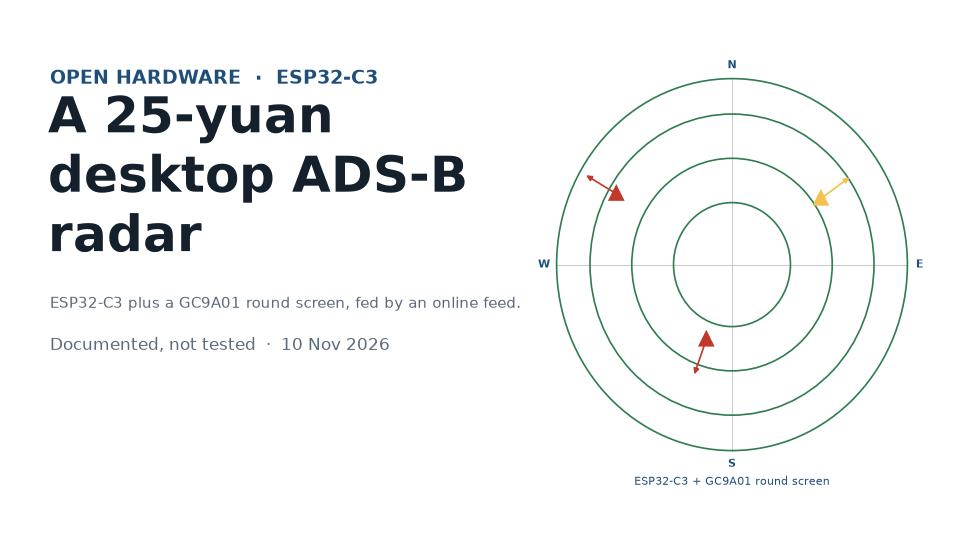
The display uses a deep blue background with dark green concentric circles, a white cross and white N, S, E, W markers at the centre. Each aircraft is a red triangle pointing along its heading, with a magenta velocity vector drawn out to the range ring. A label next to each triangle carries the callsign, the aircraft type and the altitude. Aircraft outside the current range are shown as a smaller red dot on the outer ring to indicate direction only.
The runway lines come from OurAirports' large_airport dataset, compiled into the firmware. They are drawn in cyan with an ICAO label each. The colour scheme, fonts and marker shapes live in a single header file, include/ui/radar_theme.h, so a community member can reskin the whole display without touching the logic.
Where the data comes from
This is the part the author is careful to state up front. A real ADS-B receiver uses a 1090 MHz antenna and an SDR, or a dedicated receiver chip, to capture the broadcasts that aircraft send about twice per second and decodes them locally. ESP32-Plane-Radar does none of that. It requests decoded state vectors from a public ADS-B aggregator such as opendata.adsb.fi, sending a bounding box defined by latitude and longitude and receiving every aircraft inside it.
So the position of every plane on the screen is measured by someone else's receivers. What the device computes itself is the distance and bearing to each aircraft, using the standard haversine formula for the great-circle distance and an initial-bearing formula for the direction. Both are a couple of lines of code. The data is polled every five seconds, a rate chosen because the public endpoints will not sustain denser polling and because aircraft broadcast their position only twice a second.
Hardware and wiring
The display connects to the ESP32-C3 with seven wires. The reset line goes to GPIO0, chip select to GPIO1, data and command to GPIO10, MOSI to GPIO3 and clock to GPIO4. The backlight is pulled up on the module, so it does not need a separate connection, and the author warns against driving the backlight pin directly from a GPIO.
| Part | Specification | Price | Role |
|---|---|---|---|
| Main board | ESP32-C3 Super Mini, 4 MB Flash | 12.5 yuan | Firmware, Wi-Fi, data, rendering |
| Display | 1.28-inch GC9A01 round screen, 240x240 IPS, SPI | 12 yuan | The radar face |
| Headers, jumper wires | User-supplied | - | Seven connections |
The BOOT button, GPIO9, is reused by the firmware: a short press cycles the range through 5, 10, 15 and 25 km, and a three-second hold clears the Wi-Fi credentials, the coordinates and the units and returns the board to configuration mode. That saves a button and costs nothing.
An all-in-one alternative
For anyone who does not want to wire seven connections, Waveshare sells an integrated board, the ESP32-S3-Touch-LCD-1.28-B. It carries the same 1.28-inch 240x240 round display but adds capacitive touch, a CNC aluminium case, a QMI8658 six-axis sensor, 2 MB PSRAM and 16 MB Flash on a single circular board. A community fork remaps the pins and flashes a prebuilt binary through the ESPHome web installer, so no wiring is needed. The integrated versions range from about 95 to 149 yuan depending on whether they include the touch panel and the case.
The author's two-part write-up covers the hardware and the screen here, and promises the next part on flashing the firmware with PlatformIO, merging the binary and writing it from 0x0, plus six mistakes encountered along the way.
How this was checked
The source article, the project's stated licence and the hardware and wiring details were read directly. The GitHub repository MatixYo/ESP32-Plane-Radar was confirmed to exist as a public repository. The ADS-B aggregator, the GC9A01 driver, the OurAirports dataset and the Waveshare board model were taken from the source text. No board was built, powered or flown for this article, and no radio reception claim was independently verified.
Source: Hardcore Electronics DIY, WeChat, 10 November 2026.