Bliiot's EA series maps four Jetson edge boxes from 67 to 157 TOPS for industrial vision
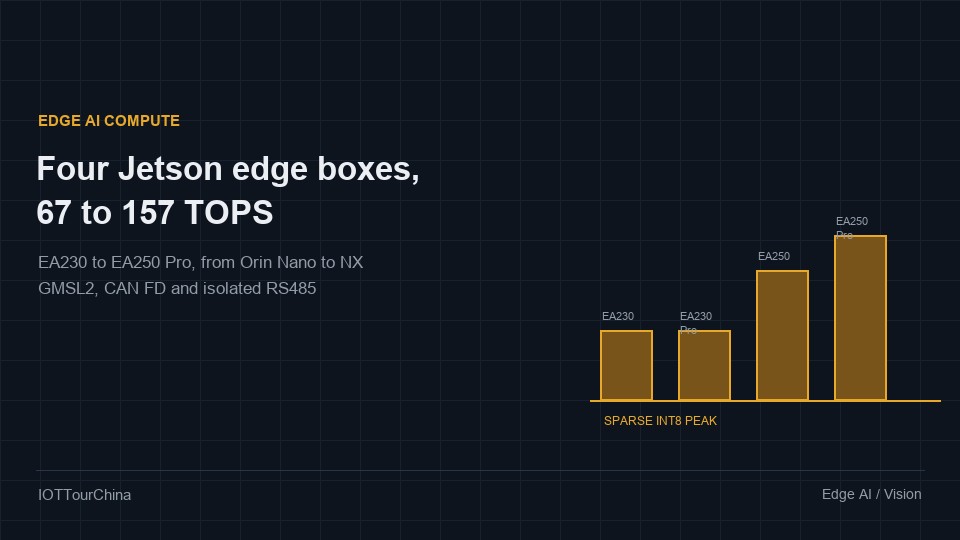
Edge AI boxes are easy to compare on a headline number and hard to compare on anything else. Bliiot's EA series is a useful case because its four published models expose the differences that usually stay buried in a specification sheet: which Jetson module sits inside, how cameras attach, and what the expansion slots can carry. Model names and figures below come from Bliiot's own EA series page and the vendor article; they have not been measured in our own testing.
Four models on two Jetson platforms
The line splits into two platform tiers and two expansion variants. EA230 uses a Jetson Orin Nano 8 GB module and is rated up to 67 TOPS, with USB as the main camera path and isolated RS485, CAN FD and digital I/O on board. EA230 Pro keeps the same module and rating but adds GbE, GMSL2 and MIPI camera options, supports four GMSL2 lanes in the matching configuration, and can take a Y board for CAN FD, RS485, DI, DO and analogue signals.
EA250 moves to Orin NX in 8 GB or 16 GB, rated at 117 or 157 TOPS, again with USB or network camera input and the same on-board industrial interfaces. EA250 Pro is the 16 GB, 157 TOPS configuration with four GMSL2 lanes as standard and a Y80 board providing 16 digital inputs, 8 digital outputs, CAN FD and three RS485 ports. Bliiot also states 18 channels of H.265 decoding for the Pro model. Across the series the stated operating range is -20 to 75 C with a 24 V industrial supply and DIN rail mounting.
The TOPS figure is the first place comparisons go wrong. It is a sparse INT8 peak. Dense models, image pre and post processing and operator differences all reduce delivered performance, and there is no fixed conversion factor. The vendor article suggests reserving 25 to 35 percent headroom for light detection work and more for complex models, with an eight hour full-load frame rate as the acceptance test. That advice applies to the category, not to one supplier.
Camera expansion is a power budget question
The camera expansion board is a four-way choice, not a stack: ordinary GbE, PoE with up to 30 W per port, isolated PoE with 1500 V port isolation, or GMSL2 over coax. The four types cannot be mixed in one board. Bliiot's article states a 60 W board-level budget, so four PoE ports cannot all run at full output, and the 1500 V isolation is a ground-loop measure rather than a lightning protector.
Four lanes is a property of the board, not the camera ceiling of the machine. More cameras can be aggregated through an external switch, but connecting a stream is not the same as exposing it at the same instant. Time alignment and synchronised exposure are different problems.
Three limits worth writing into the tender
Out-of-band management is often misunderstood. Where fitted, it can power on, power off or restart the device through an independent channel, and nothing more. It does not provide system login, program repair or model debugging, and it needs the module installed, the device powered and the channel reachable.
Precision time protocol in the machine supplies a common timestamp to images. It does not make cameras expose at the same moment. Synchronised exposure needs camera hardware triggering plus an external sync controller, and the two requirements should not be conflated in a specification.
The on-board and expansion I/O are ordinary non-safety switching signals. Emergency stops, safety doors and safety light curtains must be implemented with a separate safety PLC or safety relay. This class of box can monitor status and report alarms but cannot be the safety function. The operating system is Linux-based, so any Windows-only machine vision software needs a compatibility check before selection.
Where the series fits
The intended jobs are local visual inspection, multi-stream video analysis, sensor collection with local interlocks, and robotic perception. The stated boundaries are equally specific: no model training, no long-term video storage, no Windows application host, no safety loop, and no promise of synchronised multi-camera exposure from PTP alone.
For an integrator the useful exercise is not to rank the four models by TOPS. It is to list the camera count and interface type, the required field I/O, the environmental envelope and the expected model load, then map them onto the four configurations. Bliiot's own page makes the same point and states that a TOPS number cannot be converted directly into a number of supported cameras.