LocateAnything: one box, six tokens, and a tenfold claim that is not against YOLO
A write-up circulating in Chinese trade channels puts NVIDIA's LocateAnything at ten times the speed of YOLO. The paper does not contain a YOLO comparison. It contains one comparison against a YOLO-family model, on document layout, and LocateAnything loses it.
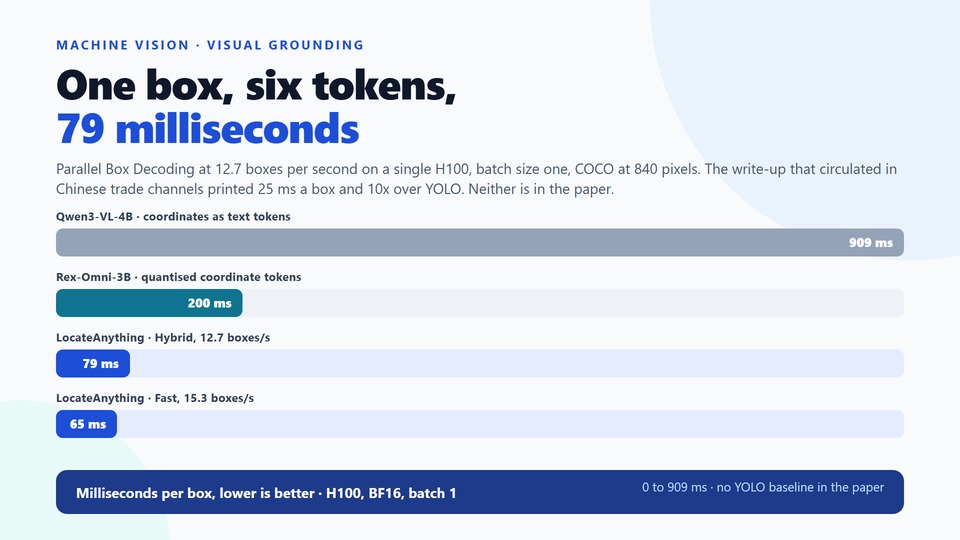
What the paper does contain is a single throughput number that holds up under inspection: 12.7 boxes per second on one H100, batch size one, BF16, measured on COCO with the short side resized to 840 pixels. That is 79 milliseconds per box, not the 25 milliseconds the write-up puts in its headline table.
The gap matters because it changes who can use the model. At 79 milliseconds a box and roughly seven annotated objects in a typical COCO image, a single frame costs about 0.55 seconds on the fastest datacentre GPU NVIDIA sells. A production line running a 200 millisecond takt does not fit that, and the paper never claims it does.
A box stops being four numbers and becomes one block
Vision-language models have been writing coordinates the way they write words. A box is serialised into some number of one-dimensional tokens and decoded left to right, one token at a time. LocateAnything's contribution is to treat the box as an atomic unit of constant length. Each block carries the four coordinates plus a box-open and a box-close token, six tokens in total, and the whole block is predicted in one parallel step with a multi-token prediction head that projects six positions at once.
Three things follow from that, and the paper is careful about which it claims.
First, the geometry stops being able to contradict itself. A left-to-right decoder can emit a right edge smaller than a left edge, because nothing in the token stream enforces order. A block predicted jointly is trained against a joint target, so the failure mode shrinks. The paper's wording is that PBD preserves intra-box geometric coherence and prevents generating irregular structural tokens. It does not quantify the reduction, and the 90 percent figure in the write-up appears nowhere in the forty-two pages.
Second, throughput goes up without a second model. The comparison that matters is against the quantised alternative, which already collapses a box to four tokens: that approach reaches 5.0 boxes per second, and PBD reaches 12.7. Against plain text-token decoding the ratio is steeper, 1.1 to 12.7, but the steeper ratio is measured against the older of the two baselines.
Third, and this is the part the abstract buries, the gain is not tied to NVIDIA's backbone. The appendix runs the same decoder head on Qwen3-VL-4B and moves COCO F1 from 50.8 to 52.0 while raising throughput from 2.8 to 9.4 boxes per second. A decoding scheme that transfers to a competitor's model is a different kind of result from a model that happens to be fast.
What 12.7 boxes per second means in milliseconds
Throughput in boxes per second is a unit that flatters a parallel decoder, because the fixed cost of encoding the image is amortised across every box in the frame. Converting to per-box latency makes the three models comparable and makes the write-up's table impossible.
| Model | Boxes per second | Milliseconds per box |
|---|---|---|
| Qwen3-VL-4B, text tokens | 1.1 | 909 |
| Rex-Omni-3B, quantised tokens | 5.0 | 200 |
| LocateAnything, Hybrid | 12.7 | 79 |
| LocateAnything, Fast | 15.3 | 65 |
The spread between first and last is a factor of eleven and a half. The model that reads coordinates as text takes most of a second per box, which is fine for an offline labelling run and unusable for anything interactive. The quantised baseline at 200 milliseconds sits right at the edge of a two hundred millisecond takt and, more importantly, has no margin left for the camera, the pre-processing or the decision logic downstream.
At 79 milliseconds LocateAnything has margin, and the margin is the honest version of the claim. It is not ten times faster than a classical detector. It is about eleven times faster than the language model it was benchmarked against and, at frame level, still costs about half a second for a seven-object image on an H100. Whether that fits a line depends on what else is running on the GPU and how many cameras share it, and neither number appears in the paper.
Three decoding modes, and an accuracy gap that only exists when data is scarce
The paper ships three modes and the write-up describes a trade-off between them that the tables do not show. Fast mode predicts blocks in parallel. Slow mode falls back to conventional next-token decoding. Hybrid mode runs Fast and re-decodes any block that trips a validity check.
| Mode | Throughput, boxes/s | COCO F1 mean | Training set |
|---|---|---|---|
| Slow, next-token | 3.9 | 52.1 | COCO only |
| Fast, multi-token | 16.9 | 49.6 | COCO only |
| Hybrid | 13.2 | 51.6 | COCO only |
| Slow, next-token | Not listed | 55.1 | 138M queries |
| Fast, multi-token | 15.3 | Not listed | 138M queries |
| Hybrid | 12.7 | 54.7 | 138M queries |
Read the top half and parallel decoding looks expensive: Fast mode is 2.5 points worse than Slow. Read the bottom half and the penalty has almost vanished, 55.1 against 54.7, four tenths of a point. The difference between the two halves is not the decoder. It is whether the model was trained on COCO alone or on the full 138 million queries. Parallel decoding costs accuracy when the supervision is thin, and costs nearly nothing when it is thick.
The paper does not say this. It reports the ablation and the main results in separate tables under separate headings, and the sentence that would connect them is absent. But the two tables sit eleven pages apart and the inference is the interesting one for anyone deciding whether to trust Fast mode on their own data: the answer depends on how much labelled data the fine-tune sees, not on the decoding scheme.
The Fast row in the lower half is also the one gap in the paper's reporting. 15.3 boxes per second is stated, the corresponding COCO figure is not, and every accuracy claim in the main tables is made under Hybrid. A reader who wants Fast mode's accuracy has to run it.
The training set is two thirds ordinary object detection
The six-task framing is accurate and the proportions are worth reading before the framing.
| Task | Share of queries | Share of boxes |
|---|---|---|
| General object detection | 66.9 percent | 83.1 percent |
| Interface element grounding | 16.5 percent | Not listed |
| Referring comprehension | 7.3 percent | Not listed |
| Text localisation | 3.6 percent | Not listed |
| Document and scene layout | 3.5 percent | Not listed |
| Point-based localisation | 2.2 percent | Not listed |
Two thirds of the supervision is a plain detection objective over 12 million unique images and 785 million boxes. Referring comprehension, the task most people mean when they say grounding, is 7.3 percent. Text localisation is 3.6. Point output, which is what a robot arm actually needs, is 2.2.
The dataset is public under NVIDIA's Eagle repository, and the data engine is described in enough detail to rebuild a domain-specific version. That is the more useful artefact for an integrator than the model card: a pipeline that turns product photographs into millions of localisation queries is a way to build a labelled defect set without labelling it.
Where it leads, and where a YOLO beats it
The write-up claims six benchmarks refreshed at once. The paper's own tables support a narrower claim, and two of the losses are against entries the write-up does not mention.
| Benchmark, mean F1 | LocateAnything-3B | Best other entry | Winner |
|---|---|---|---|
| LVIS, open vocabulary | 50.7 | 46.9, Rex-Omni-3B | LocateAnything |
| COCO, open vocabulary | 54.7 | 62.1, DINO-Swin-L | DINO |
| ScreenSpot-Pro, interface | 60.3 | 58.0, GUI-Owl-32B | LocateAnything |
| DocLayNet, layout | 76.8 | 81.1, DocLayout-YOLO | DocLayout-YOLO |
| M6Doc, layout | 70.1 | 55.6, Rex-Omni-3B | LocateAnything |
| TotalText, OCR | 43.3 | 40.6, Rex-Omni-3B | LocateAnything |
| HumanRef, referring | 78.7 | 81.6, SEED1.5-VL | SEED1.5-VL |
| RefCOCOg val, referring | 76.7 | 74.9, Qwen3-VL-8B | LocateAnything |
Five wins, three losses, and the pattern inside the losses is the useful part. COCO is a closed-set benchmark with eighty categories, and a closed-set detector that has seen those eighty categories will beat an open-vocabulary model on them; DINO-Swin-L is 7.4 points ahead and costs nothing in vocabulary because it is not being asked to generalise. DocLayNet is the layout benchmark, and the entry that wins it is DocLayout-YOLO, which is a YOLO.
So the honest version of the speed claim is narrower than the circulating one and more interesting. LocateAnything is faster than a language model that does the same job, and on the single benchmark where a YOLO-family model was also entered it trails by 4.3 points, and it is not faster than a YOLO on anything, because nobody ran that comparison.
NVIDIA's own research page makes the 2.5 times claim and attaches it to Rex-Omni, not to YOLO. The 10 times appears in the paper too, in one sentence, against Qwen3-VL. Both are throughput ratios measured on the same GPU against models of the same job description. Neither is a claim about classical detectors.
The same day, a four-billion-parameter diffusion model measured itself against it
LocateAnything was submitted on 26 May 2026 and revised the next day. On 30 September 2026, the day the Chinese write-up was published, a paper called GroundAnything arrived from XPeng, Peking University, Hong Kong University, Berkeley, Princeton, NUS and HKUST Guangzhou.
It takes the opposite architectural bet. Instead of predicting a box in one parallel step of an autoregressive decoder, it uses bidirectional diffusion over the coordinate tokens and refines the whole set through iterative denoising. Its abstract names LocateAnything explicitly as the fast baseline to beat, and reports 61.75 percent averaged over thirty grounding benchmarks against 53.32 percent for the fast multi-token variant of LocateAnything.
Two caveats keep that from being a knockout. GroundAnything compares against Fast mode, not Hybrid, and the Hybrid figures in its own tables are higher. And the 61.75 is the diffusion variant with entropy-guided decoding, a mode the paper describes as more than twice as fast as its own autoregressive sibling, which scores 72.42 on the same average. The comparison is between two different things wearing one name.
One detail worth noting for anyone tracking the field rather than the leaderboard: Shilong Liu is the second author of LocateAnything, listed at Princeton, and appears in GroundAnything's author list at the same affiliation. The two papers are not competitors in the sense a press release would imply. They are the same research conversation moving from parallel autoregression to diffusion in four months.
Six numbers in the industrial section that are not in the paper
The write-up's second half is a factory story, and every number in it is untraceable. The paper contains no occurrence of the word industrial and no occurrence of the word defect.
| Claim in the write-up | What the paper contains | Status |
|---|---|---|
| 25 ms per box on an H100 | 12.7 boxes per second, which is 79 ms | Contradicted |
| 20 to 35 ms across six scenes | No per-scene latency table | Absent |
| 92 to 98 percent recall by scene | No recall column, F1 only | Absent |
| YOLOv8m at 80 ms and 88 percent recall | No YOLO in the results | Absent |
| Invalid boxes down 90 percent | Coherence claimed, never quantified | Absent |
| Jetson Orin 300 ms, 100 ms after INT8 | No edge deployment, no Jetson | Absent |
The precision figure in the write-up's first table has a subtler problem. It gives COCO F1 as 52.1 at 3.9 boxes per second, and both numbers are real. They come from the ablation table, where 52.1 is Slow mode trained on COCO alone and 3.9 is its throughput. The row above them reports 12.7, which is Hybrid throughput on the full model. The table therefore quotes the speed of one configuration and the accuracy of another, which is the one error a comparison table is least able to survive.
What to take away
The model is real, the weights are public, and the decoder idea is worth understanding. The repository is under NVIDIA's Eagle project, the checkpoint is published under the NVIDIA organisation on Hugging Face, and the dataset is released alongside it. The interesting engineering claim is not speed. It is that a box is a structured object and that serialising it into tokens was always a modelling compromise.
Three things to check before planning around it. Throughput in this paper is boxes per second at batch size one on an H100, measured on COCO at 840 pixels, and it excludes pre-processing and post-processing. A dense scene raises the number rather than lowering it, because the parallel decoder amortises a fixed prompt cost across more boxes, which is the opposite of how a conventional decoder behaves. And the accuracy you get depends on the data you fine-tune on far more than on the mode you pick, which is the conclusion the paper's two separated tables support and never states.
The ten times figure belongs to Qwen3-VL. The YOLO comparison that would make the headline true has not been run by anyone.