Autane retrofits 60-tonne yard cranes for autonomous operation and matches human drivers over 60,140 real moves
Most robot autonomy research optimises for dexterity in a small, stiff, well-lit workspace. A container yard is the opposite: a machine 22 to 26 metres tall, carrying a 41.4-tonne container on steel ropes, expected to place it within four centimetres while wind moves the load and the machine itself has been in service for two decades.
The Autane system, published as the November 2026 cover of Science Robotics by teams from HKUST (Guangzhou), Southeast University and Shanghai Yuju Technology, is interesting less for a new algorithm than for the decision it made about scope. It does not build new cranes. It retrofits the rubber-tyred gantries already in service — the ones that automated container terminals leave behind, because rail-mounted cranes need track and magnetic-marker infrastructure that only exists on greenfield sites.
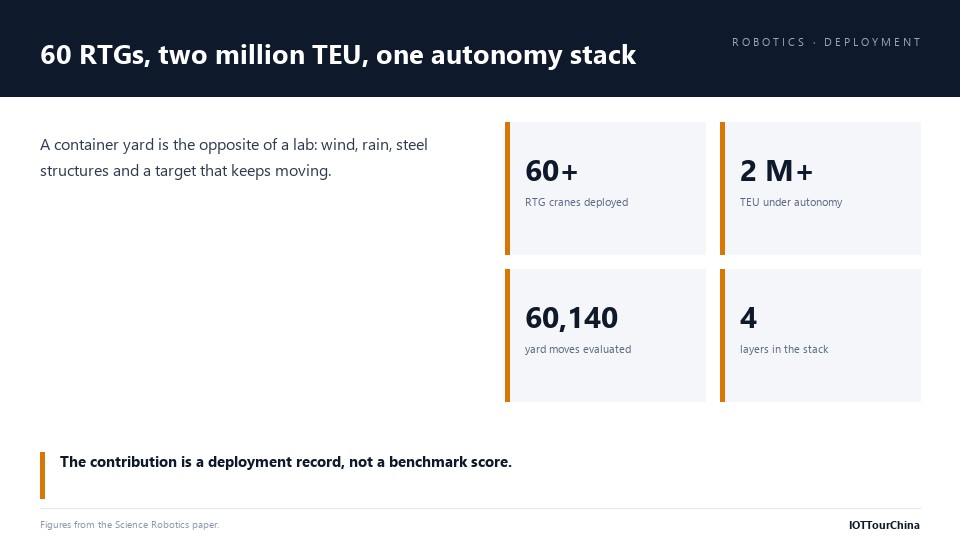
The reported deployment is 60-plus RTGs across multiple Chinese ports and more than two million TEU of autonomous operation, with the paper's controlled evaluation drawn from 60,140 real yard moves.
Why this is not a scaled-up robot arm
An RTG is underactuated. The number of actuators is smaller than the number of degrees of freedom, and the spreader swings like a pendulum pushed from the top. Once motion starts, inertia, rope compliance, wind and uneven ground all amplify small disturbances. Lose control of the swing and the container becomes a wrecking ball aimed at the neighbouring stack.
The precision requirement sits at the other end of the scale. Grab tolerance is ±3 cm, first-tier stacking ±4 cm, gantry positioning usually within 5 cm. Long-range travel plus centimetre alignment is the core conflict: drive faster and the swing grows; suppress the swing harder and the cycle time falls.
Add the operating environment — port lighting that changes by the minute, rain, fog, containers blocking line of sight — and the perception chain is continuously disturbed rather than occasionally.
Four layers, and what each one does
Perception. More than 15 heterogeneous sensor types fused into a coarse-to-fine localisation strategy: lock the work area at low precision, then switch to fine alignment. The stack combines LiDAR-vision-inertial SLAM, multi-object detection and tracking, lane detection tuned for overhead views at night, in rain and under occlusion, and online LiDAR-camera calibration. Pedestrian detection reaches 99.1 mAP50, and the end-to-end perception latency is held under 190 ms, which is the number that decides whether real-time yard work is possible.
Planning. A guiding vector field generates smooth collision-free trajectories, with safety-predictive correction layered on top for people, external trucks, internal trucks and neighbouring containers. The system does not replay surveyed routes; it re-reads the yard each cycle.
Control. Model predictive control tracks the gantry path, while a control barrier function defines a dynamic swing safety envelope. The envelope is tightened at high travel speed and relaxed during low-speed alignment, so safety and cycle time are traded explicitly rather than by tuning a single gain. Braking is characterised in the paper: maximum gantry braking distance under 3.75 m, trolley and spreader around 2 m. Across two million container cycles the system reports no collisions.
Operations and maintenance. This is the layer most autonomy papers omit and most operators care about. Retrofitted machines drift: mechanical wear moves, sensors age, a calibration performed at commissioning stops being true months later. The O&M module runs scheduled and error-triggered joint recalibration of GNSS, cameras and LiDAR, and a three-tier protection scheme that restarts minor faults and stops with an alarm on serious ones. Without this, precision decays and the deployment becomes a maintenance liability.
The field result
The evaluation ran on two RTGs at Suzhou Modern Terminal, using 60,140 real yard operations from January to March 2025 as the reference set, benchmarked against the combined average of experienced and novice human drivers. The system received ordinary yard dispatch instructions and executed gantry travel, anti-sway and placement without modifying the terminal's existing business systems.
Reported outcomes: 91.23 per cent average task success, 25.93 moves per hour, overall performance comparable to human operators, and better than human on two of the harder task classes — stacking and placement onto external trucks. Weather envelope is documented at 15 m/s wind, 25 mm daily rainfall and visibility down to 50 m.
The honest framing matters here. Roughly nine per cent of tasks are not completed autonomously in one attempt, and a seamless human takeover channel is provided. This is a low-intervention autonomous system, not a lights-out one.
The economics that decide whether it ships
Retrofit scope is the commercial argument. The system is adapted to ZPMC RTGs built between 2000 and 2021, some already over 20 years old. Instead of replacing the machine, sensors and an edge computer are added and the software stack installed.
The team's estimate is a payback of about 4.76 years per crane against a 15 to 20 year service life. That is the kind of number a terminal will actually evaluate, and it is why the retrofit framing rather than the autonomy framing is the story.
What the authors say does not work yet
The paper is unusually direct about limits, and they are the ones that predict where the next round of engineering goes.
Safety protection triggers frequently in close-interaction scenarios — insufficient clearance, momentary perception occlusion, residual spreader yaw — and the fix is adaptive safety thresholds that balance protection against cycle time. Older machines perform 3 to 9 per cent worse on success rate and efficiency than newer ones, which is a hardware floor the software cannot lift. Large-scale validation is concentrated on ZPMC RTGs, so other makes and crane types need further iteration. And the system addresses standardised container handling; bulk and irregular-material lifting would need new perception and control work.
Why this sits apart from the humanoid conversation
Most of the attention in robotics goes to humanoids and dexterous hands — machines designed to fit human environments. This is the opposite thesis: enormous bodies, huge inertia, strongly coupled dynamics, in environments already built for machines. The objective is not dexterity but safe, stable, economically justifiable continuous operation.
For anyone watching China's industrial robot supply chain, the pattern is worth noting. The hardware already exists in large quantities, decades of it. The value being added is a sensing and control layer plus the maintenance discipline to keep it calibrated in the field — a software-and-services business attached to an installed base rather than a new-machine business. That is a different commercial shape from the one most embodied-AI investment is currently priced against.