AgiBot G2 Max pairs a 20 kg arm with 0.5 mm repeatability on a mobile base
A robot that lifts twenty kilograms with each arm and still places a carton within half a millimetre is not a new category of machine. It is a dual-arm manipulator on a moving base, and the interesting question is not whether it can be built but what it is actually faster than.
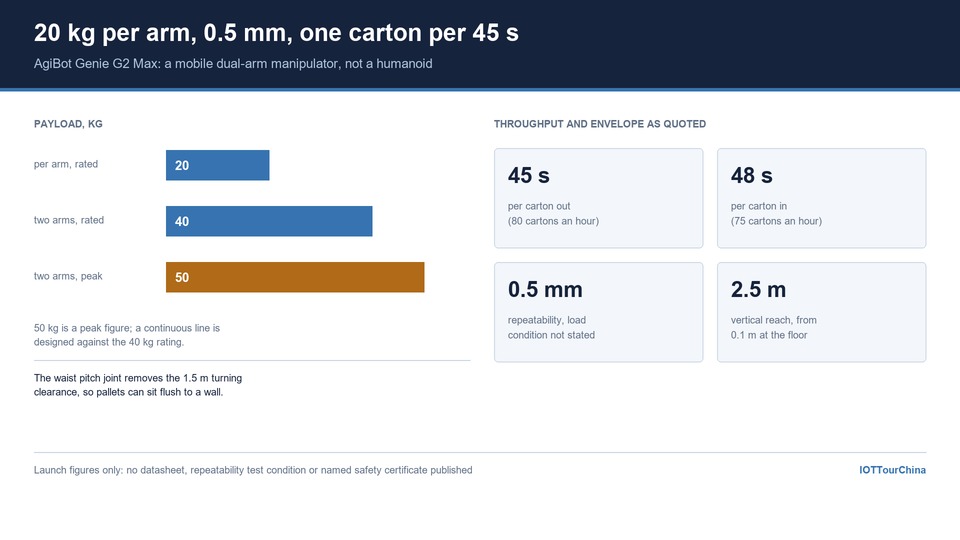
AgiBot launched the Genie G2 Max on 26 October, the third product in its AI WAVE series, and the company's framing is a trade-off it says the industry has never resolved: heavy equipment cannot do fine work, and precise equipment cannot carry weight. The published numbers are specific enough to check. Each arm is rated for 20 kg, the pair for 40 kg, and the pair peaks at 50 kg. Repeat positioning accuracy is quoted at plus or minus 0.5 mm. Vertical working range is 0.1 to 2.5 metres, horizontal coverage is 1.2 metres, and a waist pitch joint lets the body lean forward so pallets can sit flush against a wall.
That last detail is the one an integrator should read twice, because it is the difference between a robot that fits an existing line and one that requires the line to be rebuilt around it. Conventional mobile manipulators need roughly 1.5 metres of clearance behind the pallet to turn and reach, which in a warehouse laid out for people means a layout change. Bending at the waist instead means single-sided depalletising with the pallet against a wall, and AgiBot sells that as recovered floor area rather than as a technical feature.
What the load figures do and do not say
Three payload numbers appear in every version of the announcement, and they are not interchangeable. Forty kilograms is what the pair is rated for continuously. Fifty is a peak. Headlines have mostly carried the peak, which is the normal way launch specifications travel, but a line that runs eight hours a day is designed against the rated figure, and the gap between the two is where the engineering margin lives.
The claim that 40 kg covers more than 95 percent of industrial totes and components on the market is the company's own estimate of the market's weight distribution, not a measured survey. It is plausible for cartons of consumer goods and for automotive parts in returnable bins, and it is beside the point for the coil, ingot and palletised-bulk work that dedicated handling equipment does.
Repeatability is quoted without a stated load condition. That matters, because plus or minus 0.5 mm at rated payload, at the end of a fully extended arm, on a moving base, is a different specification from the same figure measured at half load near the body. The launch material says the robot holds accuracy at full load, which is a claim a buyer should ask to see demonstrated at the arm's maximum reach rather than at its most convenient pose.
The throughput numbers are the ones that reframe the product
The deployments AgiBot described are more useful than the specification sheet, because they come with cycle times.
At the Huguang Components plant in Kunshan, where AgiBot's own Qiyuan T1 robot rolls off the line every 2.5 minutes, the G2 Max moves shoulder housings and hip assemblies from a stacking area to the joint assembly station. The plant director's description is about rhythm rather than speed: at that takt, late material stops the downstream station, and he says the robot's all-day takt curve is close to a straight line. Stability at a fixed cadence is the actual requirement, and it is a different requirement from being fast.
At a JD Logistics goods-to-person warehouse, the robot handles inbound depalletising and stacking. AgiBot quotes 80 cartons depalletised per hour and 75 palletised per hour, with an overall success rate above 99 percent. Divide and the cycle times come out at 45 and 48 seconds per carton.
Those are the numbers that define the product's place. A dedicated layer palletiser handles several hundred cartons an hour and never varies, but it handles one carton format at a time and needs a fenced cell. A cobot on a seventh axis is more flexible than a palletiser and slower still. The G2 Max sits at roughly one carton every 45 seconds with the ability to change what it picks up, which makes it a fit for mixed-SKU lines, low-to-medium volume, and sites where the alternative is a person bending over a pallet.
The 12-metre Smart Wolf warehouse, which AgiBot says stores at six times the density of a flat warehouse, is a reminder of the constraint the robot is working inside. Inbound handling has to feed a system that runs hundreds of robots, and being the first step in that chain means a stall at the robot propagates through everything downstream. That is why the 99 percent figure matters more than the payload here.
One cycle-time claim does not fit the others
The Chinese version of the launch coverage adds two figures for a food factory that appear nowhere in AgiBot's own release: a single-carton cycle of 35 seconds or less, and an overall success rate of at least 99.9 percent.
Both are worth flagging. Thirty-five seconds per carton works out to about 103 cartons an hour, well above the 80 and 75 quoted for the warehouse, which is possible if the food line is a simpler pick-and-place with shorter travel, but it is not stated as a different duty cycle. And 99.9 percent is an upgrade on the 99 percent the company gives elsewhere, with no definition of what counts as a failure, no sample size and no measurement window. Neither figure appears in the English or Hong Kong coverage of the same launch, which quoted the warehouse numbers verbatim.
The conservative reading is that the warehouse figures are the documented ones and the food-line figures are a local addition. A buyer evaluating the robot should treat 80 and 75 cartons an hour with above 99 percent success as the number the company is willing to stand behind in writing.
Safety rating without a named standard
AgiBot calls the G2 Max a safety-standard-compliant robot, and the hardware listed is what that claim rests on: 2D and 3D lidar, ultrasonic sensors, bumper strips on the chassis, and physical emergency stops, arranged as 360-degree coverage of the body. Some Chinese coverage also lists stereo and fisheye cameras, which the company's own material does not mention.
What is missing is the part a plant's safety engineer will ask for first: which standard, at what performance level, and certified by whom. Industrial mobile manipulators are usually assessed against the ISO 10218 series, whose 2025 revision absorbed the collaborative-operation requirements that used to sit in a separate technical specification, with a required performance level assigned to each safety function. A robot marketed as ready to run in mixed human traffic without a fence needs that assessment documented, not asserted. Nothing in the launch material names a standard, a notified body or a certificate number.
The same gap applies to the batteries. Dual hot-swap packs plus autonomous docking is what supports the 7×24 claim, and the claim is about uptime rather than about duty cycle. How long a pack lasts under a carrying load, how long a swap takes, and whether the robot completes a swap mid-task or only between tasks are all unanswered in public material.
What the launch actually establishes
Three things are on the record and corroborated across independent outlets. The specifications are as stated, the robot was shown with JD Logistics at the World Artificial Intelligence Conference in July before its October launch, and it is running on real lines rather than in a demo cell. AgiBot also says its Qiyuan T1 robot passed 5,000 units off the line within about a month of going on sale, which is context for why a robot whose job is feeding that line has a credible customer.
What is not on the record is a datasheet. There is no published PDF with payload-versus-reach curves, no repeatability test condition, no MTBF, no field failure log, no price, and no named safety certification. Every throughput figure in circulation originates with the company, on lines the company chose, over windows the company did not specify.
That is normal for a product three days old, and it is also exactly the information a factory needs before committing a line. The G2 Max is a real machine with an unusually concrete set of deployment numbers attached; the numbers are just not yet the kind that survive an integration review on their own.
For an integrator weighing options, the comparison is not against a humanoid. It is against a cobot on a rail, which offers better repeatability and worse mobility, and against a palletiser, which offers five to ten times the throughput and no flexibility at all. The G2 Max wins when the carton changes, the pallet position moves, and the site cannot be rebuilt. It loses on throughput the moment the product mix stabilises.