Inovance and Amiro show a flexible assembly cell that plans its own grasp
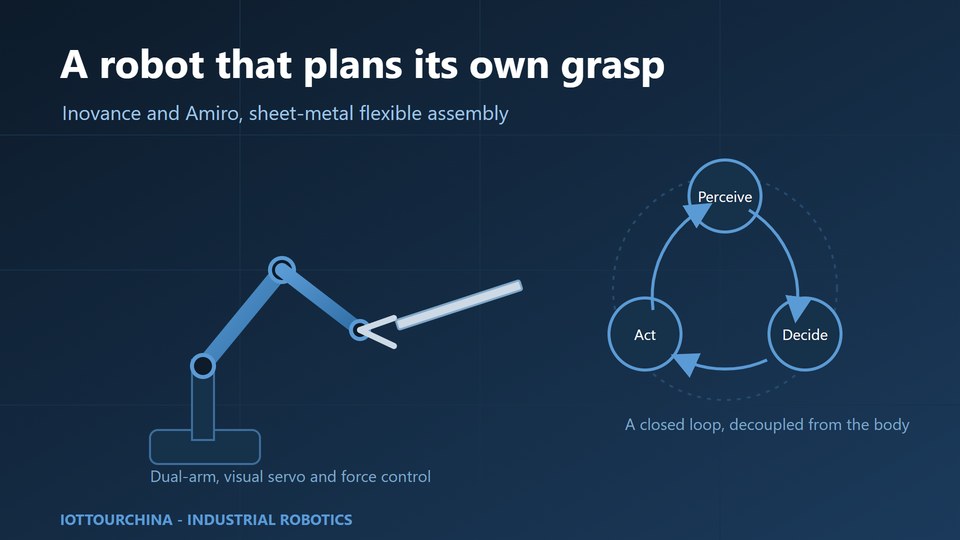
At the 2026 China International Industry Fair, Inovance Technology and Amiro Robotics demonstrated a sheet-metal flexible assembly cell. Instead of a fixed fixture and a pre-taught trajectory, the robot identifies an irregularly placed part, plans its own grasp and insertion path, and assembles it with sub-millimeter accuracy using visual servo and force control. The demo drew attention because it shows a Chinese industrial-automation incumbent and a two-year-old embodied-AI startup dividing the work: Inovance supplies the body, drive, force-control base and line integration, while Amiro supplies the perception, decision and planning brain.
Why sheet metal is hard to automate
Sheet-metal parts are thin, reflective and unforgiving. A thin wall deforms if the gripper closes too hard. A reflective surface breaks visual recognition. A sub-millimeter assembly tolerance demands final execution precision tighter than the rated repeatability of most industrial robots. Traditional automation answers this with dedicated fixtures, fixed stations and repeated teaching, which works for single-variety, high-volume runs but breaks down when part positions are not known in advance and must be solved from live vision.
Why flexible manufacturing has stalled
For half a century industrial automation rested on a set of assumptions: incoming material is standard, position is fixed, the environment is controlled. Inside that closed system, dedicated fixtures, fixed trajectories and repeated teaching deliver the last increment of efficiency. The model held for single-variety, high-volume production and underpinned the scale-up of the automotive and electronics industries.
Those assumptions are now failing. Automotive part variants keep multiplying, 3C product cycles keep compressing, and food and warehouse logistics already handle fully non-standard material forms. Once multi-variety, small-batch and frequent changeover become the normal case rather than the exception, the cost of redesigning a fixture and re-teaching a program for every new product turns from acceptable into unaffordable. The problem is not that one machine is short of performance; it is that the whole approach fails structurally against how demand has changed.
Much of what has been sold as flexible manufacturing is rigid automation in a soft shell. Changeover still needs deep manual involvement, debugging still runs in weeks or months, and behaviour under incoming-material variation is still fragile. The real barrier was never the mechanism. It is whether the perceive-decide-act loop holds under real conditions: the robot has to recognise, plan and control from an uncertain input without a human stepping in at every stage.
The closed loop behind the demo
The system runs a perceive-decide-act loop. On the perception side it performs real-time recognition and pose estimation of the workpiece under uncertain orientation. On the decision side it chooses a grasp strategy and an assembly path from the perception result rather than calling a preset program. On the execution side, visual servo is combined with force control so the robot makes fine adjustments from live feedback in the final approach. Dual-arm coordination lets the two arms hold and fit the part together, with hybrid force-position control during insertion. Amiro states that the full stack has been made into a transferable capability that adapts to multiple body configurations and can deploy a new operation on a customer site within three days.
| Stage | What the system does |
|---|---|
| Perceive | Real-time recognition and pose estimation of an irregularly placed part |
| Decide | Grasp strategy and assembly path chosen from the perception result |
| Act | Visual servo plus force control, dual-arm hybrid force-position insertion |
Decoupling the brain from the body
The notable architectural claim is that Amiro separates the soft capabilities, perception, decision and control, from the robot body. The same core algorithm stack can be deployed on different body types: wheeled dual-arm, fixed base, and potentially others. Amiro frames this as a platform play. Inovance complements it with its industrial base: the body, drive and force-control layer, line integration, and the architecture that coordinates the industrial intelligent brain. Inovance has said it plans to open SDK interfaces, a data-collection platform and scenario resources across more than seventy sub-industries, pairing its industrial experience with embodied-AI algorithm capabilities.
AMI-02, the wheeled dual-arm robot
The robot shown carrying this stack is Amiro's AMI-02, a wheeled dual-arm embodied robot. It is built on the NVIDIA Thor compute platform and supports on-device VLA, vision-language-action, model inference, so the robot can complete the perception and decision loop without a cloud connection. That choice is driven by shop-floor network conditions, data security and response latency. Public specifications for the AMI-02 list a maximum waist lift travel of 800 millimeters, head pitch from 0 to 70 degrees, an omnidirectional mobile base with LiDAR SLAM navigation and hot-swappable batteries. Earlier Amiro products include the AmigosBot, a dual-arm 14-degree-of-freedom machine with plus-or-minus 1 millimeter operation accuracy and a 5 kilogram single-arm load, and the AMI-01, an industrial flexible embodied robot with repeat positioning accuracy of plus-or-minus 0.03 millimeter and a 5 kilogram single-arm, 10 kilogram dual-arm load.
| Model | Form | Notable spec |
|---|---|---|
| AmigosBot | Wheeled dual-arm | 14 DOF, plus-or-minus 1 mm accuracy, 5 kg arm |
| AMI-01 | Fixed or AGV base | at most plus-or-minus 0.03 mm repeat, 5 or 10 kg load |
| AMI-02 | Wheeled dual-arm | NVIDIA Thor, VLA edge inference |
Why it matters
The shift being demonstrated is from a robot that executes a fixed program to a robot that understands a task and completes the operation autonomously. For manufacturers moving to multi-variety, small-batch, frequent changeover production, the cost of re-fixturing and re-teaching for every new product has become the binding constraint. A system that changes over by learning a new process, rather than by rewriting a program, is the core promise of flexible manufacturing. Amiro reports real customer deployments in 3C electronics, automotive and parts, food and warehouse logistics, and argues that surviving on a real production line, where yield, takt and stability are hard metrics, matters more than any benchmark claim.
The bet behind the demo
Amiro is young as a company, but its core team is not new to robotics. That combination, deep technical background without a legacy way of working, is what lets it take directions that look less attractive from the outside. The fashionable narrative is a general-purpose humanoid reaching every household; Amiro instead concentrates on industrial embodied AI, on the argument that industrial scenarios offer clear demand, measurable metrics, paying customers and an endless supply of real data.
On that path the hard problems are perception robustness on a live line, fine manipulation tuned to a specific process, and the engineering transfer from lab to production, and each of them stands on its own. Public information puts Amiro deployments in 3C electronics, automotive and parts, food, and warehouse logistics, which is only possible because the brain layer is portable across body types. In embodied AI the distance between a production-line installation and a lab demo is wider than in most other areas of the field, because a line gives no second chance: yield, takt and stability are hard metrics.
What to watch
Most of the accuracy and deployment figures come from demo stations and pilot lines rather than long-run production data, and the public record has not yet detailed which line is involved, who delivers it, or how the brain layer plugs into Inovance's architecture. The claim worth testing is whether changeover without reprogramming actually holds at scale. If Amiro's platform delivers a see-think-do loop, with multimodal perception at millisecond scale, VLA planning and edge inference, and compresses new-workstation deployment from months to under a week with zero-code changeover, that is the result that would separate a product from a demo.