The expo story counts four products; the vendor catalogue counts seventeen stations
The China Marine Economy Expo ran from 22 to 24 October 2026 at the Shenzhen World Exhibition and Convention Center, 350-odd exhibitors over roughly 50,000 square metres, and the reason to look at a shipbuilding hall rather than a robot hall is that the shipyard is the last place where nothing is standard. Hull sections vary, plate varies, the fit-up varies, and the batch size is often one.
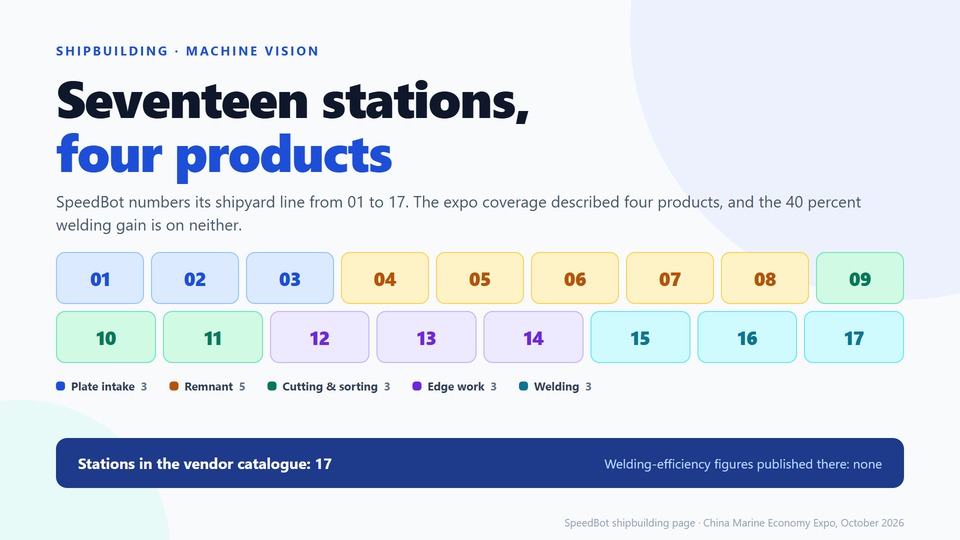
SpeedBot Robotics showed welding, grinding, remnant-material handling and a simulation platform there. The trade account of the stand describes four products. The vendor's own shipbuilding page describes seventeen numbered stations plus a remnant-material line. Four is the story. Seventeen is the catalogue, and the catalogue is the more useful document, because it shows what a shipyard actually buys: not a robot, but a station that takes over one manual measurement or one manual inspection and hands a number to the next station.
There is a third thing in the catalogue that the story does not carry. The one platform that ties the stations together, KUNWU, currently publishes exactly two performance numbers, and both of them are commissioning times rather than welding or quality outcomes. That is not a criticism of the platform. It is a statement about what stage the product is at.
Seventeen stations, grouped by what they replace
The vendor numbers the shipbuilding set from 01 to 17, and the order is a material-flow order rather than a product-line order, which is why it reads as an argument.
| Stage | Stations | The manual job being absorbed |
|---|---|---|
| Plate intake | 01 storage, 02 pitting, 03 coating thickness | Deciding whether a plate is fit to cut |
| Cutting and sorting | 09 part dimension, 10 gantry sorting, 11 robot sorting | Reading a nest, then lifting and kitting by section |
| Remnant | 04 inspection, 05 marking, 06 positioning, 07 beveling, 08 load and unload | Deciding what an offcut can still become |
| Edge work | 12 grinding and edge scraping, 13 sub-assembly kitting, 14 kitting | Dressing free edges by hand, then matching parts |
| Welding and measurement | 15 assembly welding, 16 segment dimension, 17 lifting lug welding | Fit-up, weld, measure, repeat |
Read down the middle column and the logic is a data handoff. The pitting inspection station outputs a plate grade. The part dimension station outputs a pose for every cut part. The gantry and robot sorting stations consume that pose. The remnant stations consume the leftover geometry, and the kitting stations consume everything above them. Each station is a vision cell with a robot attached, which is why the shipbuilding page is a list of stations rather than a list of machines.
One gap is worth noting because it is easy to miss. The numbered set has no weld-seam inspection station, even though the company's own March 2026 order announcement lists visual weld defect inspection as a delivered shipbuilding product, and no separate stand-alone metrology cell beyond the segment dimension station. Either the grid is a subset, or weld inspection is sold as an option that does not belong to the numbered line. The page does not say which.
What no-teach actually removes
The welding cell is the one with the most technical content, and it does two things rather than one. The robot either imports a CAD model of the part or scans it and rebuilds the geometry by inverse modelling, which the vendor sells as the drawing-free path. It then extracts the seam, plans the path and generates process parameters. The shipbuilding line adds SpeedWeld control software and laser vision sensors, and the stated target is thick-plate multi-layer multi-pass welding on curved seams in a hull section.
The distinction that matters to an integrator is what leaves the loop. Teaching is a human walking a torch along a seam, point by point, and storing those points. That step is gone. The fixture is not. A vision system can find a seam that has been fitted in the wrong place, and it can adapt the path to that, but nothing in the published material states a seam-gap tolerance, a fit-up tolerance, or what the cell does when the gap exceeds one. Welding engineers will read those three absences as the whole question, because a gap that is too wide at the root is a defect the path planner cannot fix by moving faster.
The dual-robot claim sits in the same category. The trade account describes two robots under a shared scheduler that either split a long seam into parallel segments or work independently, and quotes a welding efficiency gain of more than 40 percent against manual teaching robots on small and medium non-standard batches. Neither the shared scheduler nor the 40 percent figure appears on the vendor's English or Chinese site. The no-teach welding product page lists one advantage, working with or without drawings, and stops there.
| Claim | Where it appears | Status |
|---|---|---|
| Two robots under one scheduler | Trade account only | Not published by the vendor |
| More than 40 percent welding efficiency | Trade account only | No baseline, part family or shift pattern given |
| Lifting lug welding to ±0.5 mm | Vendor site, shipbuilding page | Documented |
| Multi-layer multi-pass on thick plate | Vendor site, order announcement | Documented |
| Welding at 30 to 40 percent of build hours | Trade account, uncited | Trade figure, not traceable |
| Nearly RMB 200 million shipbuilding orders | Vendor site, 2 March 2026 | Documented |
| Seventeen numbered stations | Vendor site, shipbuilding page | Documented |
The ±0.5 mm figure is the only dimensional tolerance anywhere in the shipbuilding material, and it is attached to lifting lugs rather than to hull seams. Lugs are the easy case: a small, repeated, well-defined part with a known weld path. If the tolerance that gets published is the lug tolerance, the hull-seam tolerance is the one that did not get published.
The remnant line is the transferable idea
The stations that are hardest to copy are the five dealing with remnant material, the irregular pieces left behind when a nest is cut from a plate. The default fate of those pieces is the scrap bin, at scrap price. The alternative is to measure them, keep them in a searchable store, and nest future small parts into them. That second path only works if the pieces are known quantities, and making an offcut into a known quantity is a vision and data problem, not a cutting problem.
SpeedBot's version runs the full loop: scan and warehouse irregular plates, mark and locate them, nest and cut, then sort, grind and bevel, then kit the parts into an automated store. The vendor calls the whole thing a remnant material utilisation line, and the shipbuilding page lists it as the line-level application that the seventeen stations feed.
The economics are real but the published numbers are not usable. The trade account puts the potential loss for a yard consuming hundreds of thousands of tonnes of plate at tens of millions of RMB, which is arithmetically plausible and completely unfalsifiable, because it does not state the tonnage, the utilisation rate, the price spread or the period. What an integrator can take from the piece is the architecture: scan-in, digital inventory, nest, cut, dress, kit. What cannot be taken is the payback.
KUNWU became a world model and stopped publishing counts
The company timeline dates the platform: 2025, industrial simulation platform launch, described as KUNWU for process planning, robotic simulation and solution validation. By the September 2026 funding announcement it is the KUNWU production-line world model development platform. The product page now opens with general intelligent manufacturing platform, then KWorld, described as the manufacturing world model behind it. The trajectory from simulation tool to world model took about a year.
| Model | What the page says it does | The one number published |
|---|---|---|
| LoCoGen | Natural language to self-correcting low-code workflow | Cutting and sorting line commissioning, six months to two weeks |
| LineGen | CAD drawings to executable 3D production line | Door and hood assembly, new model changeover, two weeks to two days |
| ProcWAM | Real-time process control using world action models | None |
| VILM | Quality inspection via few-shot or zero-shot transfer | None |
| JSSM | Reinforcement learning for dynamic production scheduling | None |
Two of five models carry a number, and both numbers are commissioning time on one named application each. For a platform whose job is offline commissioning, that is the right metric, and the two data points are unusually concrete: six months to under two weeks on a cutting and sorting line, two weeks to two days on a door and hood assembly changeover. The asymmetry is that the same company quotes a runtime efficiency figure for the welding cell in the trade press and quotes nothing for runtime efficiency here.
The counts that circulated with the expo coverage do not appear on the current site. Thirty-odd industry scenario templates, a dozen standard process packages, more than 400 digital models of common industrial equipment: those read like the specification of the 2025 simulation platform, before it was repositioned as a world model. They may still be true. They are not currently published, and a buyer who repeats them is quoting a version of the product that the vendor has stopped describing.
The model the coverage left out
The company also lists a humanoid welding robot, launched in 2026, and it did not make the four-product version of the expo story.
| Specification | Value |
|---|---|
| Mass | 60 kg |
| Height | 170 cm |
| Full-body degrees of freedom | 27 |
| Body payload | 30 kg |
| Arm payload | 10 kg |
| Peak joint torque | 120 N·m |
| Perception | Stereo camera and LiDAR in the head, handheld 3D structured light |
It is sold as a manufacturing agent with an onboard brain rather than as a welding arm, which is the same word the industry is using for every robot that has a foundation model attached. There is no price, no availability date, no cycle time and no certification on the page. For a shipyard the honest reading is narrow: a 170 cm machine with a 10 kg arm at the end is for the cells a gantry cannot reach, which in a hull block is a genuine category and a small one.
Three records that disagree, and one absence
The shipbuilding entry date is stated twice and differs. The company timeline puts shipbuilding business expansion in 2023. The March 2026 order announcement says the company officially entered shipbuilding in 2024. The earlier date refers to introducing production lines for profiles, remnants and fabricated components; the later one refers to entering as a business. Both sentences are defensible and neither is dated precisely enough to reconcile.
The customer count is stated as more than 300 worldwide, with exports to North America, Europe, Japan and South Korea, and 400-plus professionals. The shipbuilding customers are not named, including the buyer of a single line worth close to RMB 100 million. A project that size tends to be visible in procurement records, so the anonymity is a choice rather than a limit.
Then there is the arithmetic curiosity of two 400s on one strip: 400-plus intellectual properties and 400-plus staff. Both can be true simultaneously. It is still the kind of coincidence that makes a reader check the source twice.
The absence is the one that matters most for anyone integrating this into an existing plant. Nothing on the English site names an SDK, an API, OPC UA, Modbus or EtherCAT. The only plant system named anywhere on the site is MES, and it appears in the description of the electric vehicle battery tray inspection product, not in the shipbuilding set. The shipbuilding pages describe vision, robots, paths and reports, and they do not describe an interface.
What to ask before quoting a station
- The seam-gap and fit-up tolerance the cell accepts, and the behaviour when the gap is outside it.
- Whether SpeedWeld drives only the vendor's own robots or exports a path to a third-party controller, and in what format if it does.
- Where the welding procedure library lives: in the cell, in KUNWU, or in the customer's own process system.
- The scan accuracy and maximum plate size of the remnant scanner, because the payback depends on how small a piece is still worth scanning.
- Which plant interface exists today, by name, and whether it has documentation.
- Whether the 40 percent figure has a part family, a baseline and a shift pattern behind it, or is a comparison against an unspecified teaching workflow.
The reason this particular vendor is worth the trouble is that the shipyard is the correct stress test. Automotive gave the industry twenty years of teaching that a line can be engineered once and run for a decade. A hull block gives that assumption nothing to hold on to: the part is different every time, the tolerance is loose, the gap is whatever the fitter left, and the volume is low enough that a six-month commissioning cycle is a business failure rather than a schedule slip. Seventeen stations and a commissioning-time claim are a coherent answer to that. The 40 percent is not, yet.