Four chassis, one dispatcher: what Wanke's AMR range actually documents
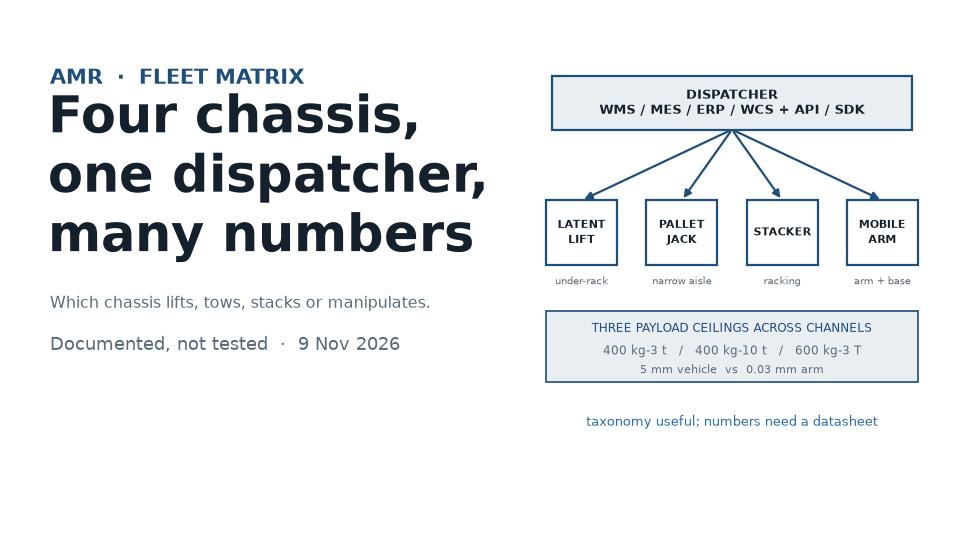
A workshop does not have one material-handling job. It has pallets to lift, loads to tow, racks to stack and parts to place on a machine. A product matrix published in November 2026 by a Chinese AMR vendor in Tengzhou, Shandong, argues that one supplier should cover all four with four different chassis rather than stretching one design across every load band. That taxonomy is the durable part of the article. The numbers attached to it are not.
The vendor is Wanke Industrial Technology, part of the Qingluan Fuxing group. Its account publishes a family of near-identical matrix articles, each opening with the same company description and closing with a different question a buyer should ask. This one covers four chassis forms and a fleet dispatcher. Read as a specification it is thin. Read as a map of which questions to put to a vendor, it is useful, and the conflicts between the vendor's own channels are instructive in their own right.
Four chassis forms, four different jobs
| Chassis form | What it does | Payload band as published |
|---|---|---|
| Latent lift, under-rack | Slides beneath a rack, jacks it up and drives away | Light duty, roughly 400 kg to 2 t depending on the channel |
| Pallet-jack style | Works like a powered hand pallet truck, with a short turning radius for narrow aisles | Roughly 1.5 t to 3 t |
| Stacker | Lifts to racking height, with a specified lift height and aisle width | Roughly 1.4 t to 3 t |
| Mobile manipulator | A chassis with an arm for blank picking, machine loading and finished-part transfer | Arm payload of roughly 6 kg to 12 kg |
The point of the split is mechanical. A latent lift robot needs a low profile and a jacking mechanism, not a mast. A stacker needs a mast and a counterweight, not a low profile. A pallet-jack chassis needs a tight turning circle. A manipulator needs a stable base and a repeatable arm, and its payload number describes the arm rather than the chassis. Treating all four as one product with one load rating is the mistake the article is arguing against.
That is also why an integrator should not quote a single payload for a mixed fleet. The article describes a dispatcher assigning heavy vehicles to outer routes and light ones to shortcuts, which only works if the dispatcher knows the rated load of each chassis as a separate field.
Where the numbers disagree
The same vendor's channels do not agree on the range, the model names or the accuracy figures.
| Claim | In this article | In other vendor material | Reading |
|---|---|---|---|
| Whole-range payload | 400 kg to 3 t in the headline | 400 kg to 10 t on the official homepage snapshot; 600 kg to 3 T in launch coverage | Three different ceilings for the same range |
| Light-duty model | A 600C rated at 600 kg with a 60 mm lift | A launch specification sheet naming 400A, 1000A and 1500A, with no 600C | Two naming schemes that do not reconcile |
| Positioning accuracy | A blanket plus or minus 5 mm | Plus or minus 10 mm on the 1500A sheet; plus or minus 5 mm on the 1000A and 400A sheets; plus or minus 0.03 mm for the manipulator arm | Three different metrics under one number |
| Automatic map update | Accuracy improved from 95 percent to 99 percent | Described as a 99 percent figure without the comparison | No denominator, no test set, no definition of a correct map |
| Return on investment | One vehicle serving 8 to 12 machines and replacing 5 to 6 handlers | A single vehicle replacing 2 to 3 workers in other coverage | Incompatible ratios with no shift length or throughput basis |
| Company scale | Twenty-plus years, five plants, 180,000 square metres, more than 1,500 customers | Repeated verbatim across the same account | Vendor self-description, not a specification |
The accuracy row is the one that causes real integration errors. A vehicle navigation tolerance and an arm repeatability tolerance are different measurements on different subsystems, and a heavy pallet-jack model can legitimately carry a looser navigation tolerance than a light precision model. Writing plus or minus 5 mm across a four-chassis range hides that. The 95-to-99-percent claim has no sample size, no definition of a correct map match and no failure taxonomy, so it cannot be turned into an acceptance test. The payback ratios have no shift pattern, no travel distance and no statement of which tasks were counted, so they cannot be turned into a budget.
A separate launch sheet, reproduced by a search aggregator, does give concrete per-model figures: the 1500A at 1.5 t with a 1246 mm minimum turning radius, plus or minus 10 mm navigation accuracy and 120 mm standard lift; the 1000A at 1000 kg with plus or minus 5 mm accuracy, a 960 by 650 by 250 mm footprint and a 60 mm lift; the 400A at 400 kg with an 810 by 545 by 280 mm footprint and the same 60 mm lift. All three quote eight hours of runtime and a maximum travel speed of 1.5 m per second. Those are the kind of figures a procurement spec needs. They also contradict the model naming in the matrix article, which is precisely why a written, revisioned datasheet should be the source of record rather than a marketing post.
What is actually useful: the interface layer
For an integration project the interesting claims are the ones about how the fleet joins an existing factory system. The vendor describes a dispatcher that connects to WMS, MES, ERP and WCS layers and exposes an API and an SDK. It describes cellular connectivity over 4G and 5G so a site does not have to rebuild its wireless network, a digital-twin view built from a handful of phone photographs of the equipment, automatic recognition of pallets with different dimensions and fork pockets, and map updates when the layout changes. The dispatcher assigns tasks by load and distance across mixed chassis types.
Those are integration hooks, not performance guarantees. The engineering content behind the three-zero marketing phrase is narrow and worth restating: the vehicles can join over a cellular link instead of requiring a plant-wide WLAN retrofit, which matters in older buildings and in multi-building routes. The four-to-six-photograph digital twin is a commissioning convenience, not a substitute for a surveyed map. Automatic pallet recognition describes a four-step sequence of driving to a pre-position, scanning width and fork pockets, selecting a stored parameter set and then lifting; the vendor also documents a fallback where the vehicle stops and asks for human input if no parameter set matches. That fallback is the more useful detail, because it defines the boundary of the automation.
What is missing from all of it is a versioned interface contract. An integrator needs the API and SDK revision, authentication model, task and status schemas, webhook or polling behaviour, error codes, and whether a sandbox or simulator exists. None of the matrix articles provides those. Until they do, the dispatcher should be treated as a claim to verify in a technical review rather than a documented capability.
Reading a vendor matrix as a specification
The practical rule is to separate a taxonomy from a datasheet. A matrix article is good for learning that four chassis forms exist and that a dispatcher sits above them. It is not good for learning what any one of them can carry. Before a number enters a specification, ask for the exact model suffix, whether the load is rated continuous duty or a static extreme, the test conditions behind any accuracy figure, which subsystem that accuracy describes, and the revision date of the sheet. Ask the same of the dispatcher: which of WMS, MES, ERP and WCS are actually integrated today, over what protocol, and with what documentation.
This is the same discipline that applies to any component announcement. A number without a subject, a test condition and a named document is a marketing number. It can still be used to decide what to ask next, but it should not be used to size a fleet.
How this was checked
The four chassis forms, the dispatcher description and the conflicting claims come from the source article and from sibling articles on the same account. Per-model figures come from a reproduced launch specification sheet, not from a live vendor datasheet. The vendor's own site could not be retrieved directly from this environment, so its product overview was consulted as a search-engine snapshot; that limitation is recorded here rather than presenting the snapshot as a fully retrieved page. No vehicle was operated, no fleet was observed and no interface was tested.
Source: AI Embodied Handling Robots, WeChat, 9 November 2026.