An RK3562 board runs a 0.5B language model for offline voice control
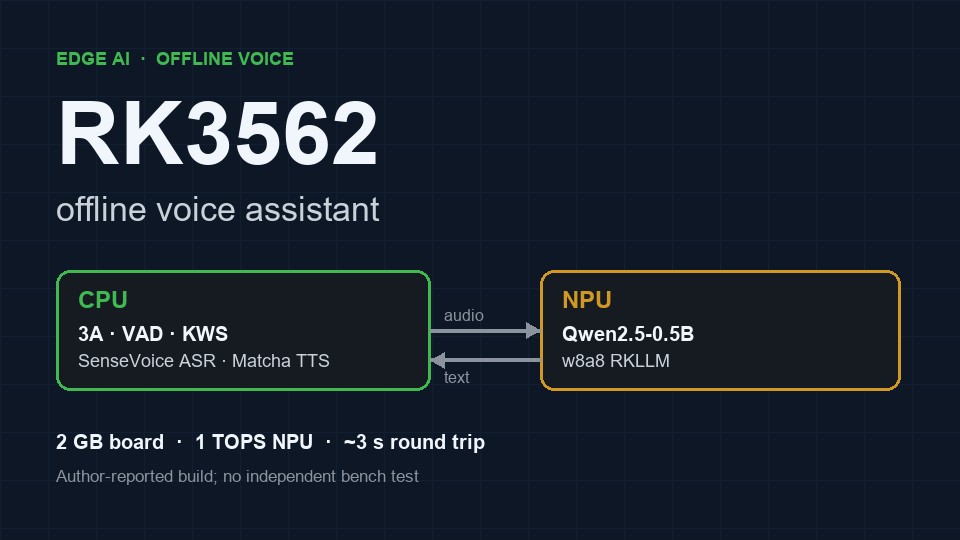
A 2 GB single-board computer can now hold a complete Chinese voice loop: wake word, speech recognition, a small language model and speech synthesis. The xiaorui project has ported its assistant to a Rockchip RK3562 EVB2, and the port documentation is specific about where each stage runs, which model fits and what has to be prepared outside the repository.
One board, two compute budgets
The RK3562 is a quad-core Cortex-A53 processor up to 2.0 GHz with a 1 TOPS NPU, according to Rockchip's product page. The port uses the CPU for the audio pipeline and reserves the NPU for the language model only. That split is the central design decision.
The CPU handles 3A processing, voice activity detection, the wake-word model, SenseVoice speech recognition and Matcha speech synthesis. The NPU runs Qwen2.5-0.5B-Instruct in an RK3562-specific w8a8 conversion. The project says the 1.5B model used on its RK3576 build does not fit the 2 GB board, and it explicitly warns against reusing the RK3576 w4a16 model on this platform.
The 2 GB limit decides the model
The tested hardware is an RK3562 EVB2 DDR4 V10 with 2 GB of memory, an external six-microphone PDM array and an RK809 codec. The repository documents a baseline of Linux 6.1.141, RKNPU 0.9.8, Python 3.14.7, Miniforge 26.7.2-0, RKLLM Toolkit 1.3.1 and sherpa-onnx 1.13.8.
That baseline matters because the model, runtime and quantization are tied together. The documentation says the Qwen2.5-0.5B model must be converted with RKLLM Toolkit 1.3.1 for RK3562, and that a model converted with a different toolchain or model revision is not guaranteed to be byte-identical. A clone of the repository does not include the SDK, the models or the VQE libraries.
The audio path is where the bugs were
The build uses six PDM microphones on channels 0 to 5 and takes the speaker playback signal back through the RK809 ADC on channels 6 and 7 as an echo-reference path. The project documents a kernel patch that sets the loopback digital volume to 0 dB, because the default path did not produce usable reference data.
Two details in the deployment notes are worth copying into any similar design. Reading the mixer with amixer can show a cached value after power-down, so the project checks the codec register directly while capture is running. The capture path also has to be set to microphone off and then main microphone, because the driver can skip a write when the value appears unchanged even after the hardware has powered down.
What the author measured
The article reports a three-second round trip from end of speech to start of reply, a 50-second boot to a ready chain, and about 1.7 GB resident memory across four processes on a board with 1963 MB. It also reports a 768 MB zram swap with zstd, a swappiness of 80, and OOM priorities that sacrifice Home Assistant before the voice gateway.
Those are author-reported figures, not independent measurements. The repository supports the direction of the work: it documents the RK3562-specific model, the memory constraints and the service layout, but it does not publish a benchmark table that an outside party can reproduce without the same board and SDK.
What the repository does not include
The project is small on GitHub, with five stars at the time of writing, and its license is listed as "Other" rather than a standard open-source license. The RK3562 deployment guide says the repository does not distribute the Rockchip SDK, the RKLLM runtime, the sherpa-onnx libraries, the VQE plugin or the model files. The VQE beamforming weights require a license from Rockchip.
That makes this a detailed engineering log rather than a turnkey image. The useful part is the placement decision: put the language model on the NPU, keep the audio front end on the CPU, and budget memory for the whole chain rather than for the model alone.
What to verify before copying it
Confirm the exact RK3562 board revision and memory size, because the port targets EVB2 DDR4 V10 with 2 GB. Check that the RKLLM runtime and the w8a8 model match the toolkit version. Confirm the VQE license and the six-microphone wiring. Then measure the round trip and the resident set on the target board; the published numbers are a starting point, not a specification.
No hardware was tested for this article. The hardware figures come from Rockchip's product page, and the build details and measurements are the project's own documentation.