A Tmall Genie alarm clock teardown reveals a T-Head RISC-V voice chip
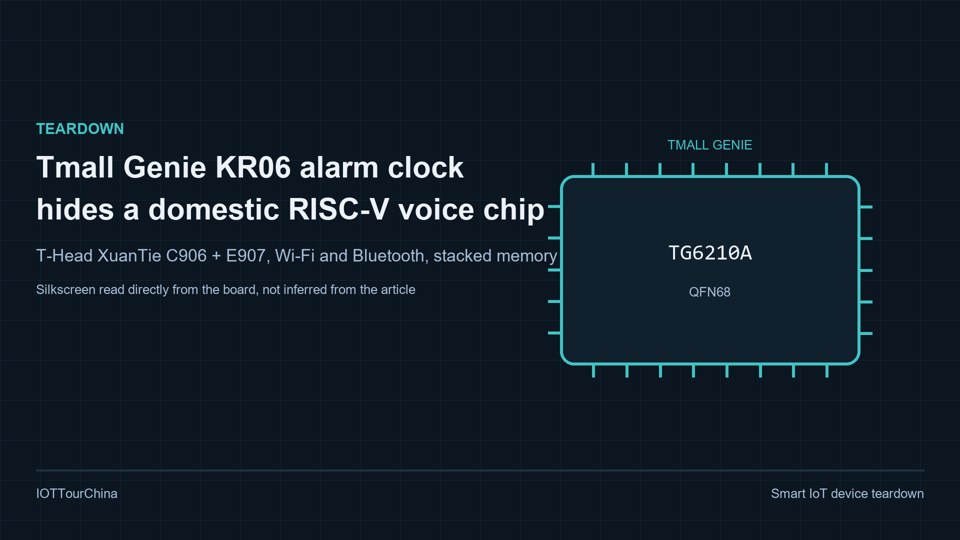
A teardown of the Tmall Genie AirPower smart alarm clock, model KR06, shows how a low-cost consumer speaker packages a domestic RISC-V voice system on a single small chip. The person who opened the unit photographed the main controller and read its silkscreen directly, rather than relying on the marketing text. The marking on the package reads TMALL GENIE, and the part number underneath is TG6210A.
This article reports what the teardown found and checks those findings against the chip vendor's own published specifications. We did not have the device on the bench, so nothing here is the result of our own electrical testing.
What was opened
The product is the Tmall Genie AirPower intelligent alarm clock speaker. The regulatory label on the back identifies it as model KR06, with a 5 V, 1 A input and a single 3 W speaker. The label names Zhejiang Maojing Artificial Intelligence as the issuer and Guangdong Aiboer as the manufacturer, and it carries a CMIIT equipment identifier dated 2023.
From the outside the unit looks simple: a bedside alarm with a front panel that shows the time, a Type-C port on the back, a reset hole, and a top button marked night lamp. Inside, the teardown shows a white-ink printed circuit board with black silkscreen, a small acoustic chamber, a flexible light guide, and a separate sub-board that carries the Type-C connector and reset switch and connects to the main board with a five-pin ribbon cable.
The interesting part is the main controller. The teardown author noted that the package silkscreen itself carries the TMALL GENIE mark, which is unusual, and then looked up the part number TG6210A.
The main chip: TG6210A
TG6210A is the second-generation custom voice AIoT chip that Tmall Genie calls MaoXin. According to Tmall Genie's own open platform documentation, the part is built around a T-Head RISC-V dual-core processor: an XuanTie C906 running at 480 MHz paired with an XuanTie E907 running at 320 MHz. It integrates Wi-Fi 2.4 GHz and Bluetooth 5.2 in dual mode and supports BLE Mesh networking. On-chip storage is listed as 700 KB of SRAM with 4 MB of PSRAM and 8 MB of Flash stacked in the package, in a QFN68 outline measuring 8 by 8 by 0.85 millimeters.
These numbers match what the teardown author reported from the board and what was announced when the chip launched in 2021. At that time the part was described as a high-integration, low-power AIoT chip that combines voice, Wi-Fi and Bluetooth, using the C906 plus E907 combination to balance performance and power.
A few details are worth separating. The SRAM figure appears slightly differently across sources: the vendor platform lists 700 KB, while some secondary documentation lists 736 KB. The teardown repeated the 700 KB figure, which is the one published by the chip's own platform, so that is the number used here. The radio is Wi-Fi 4 class, 2.4 GHz only, rather than a newer dual-band part, which fits the device's role as a near-field voice product.
Why the RISC-V cores matter
The two cores are real, publicly documented RISC-V designs from T-Head, which is Alibaba's processor IP group. The C906 is a 64-bit application-class core, and the E907 is a 32-bit high-end microcontroller-class core aimed at voice and real-time work. Both are part of the XuanTie family that T-Head licenses widely, and they appear in many other chips besides this one.
For a voice product the split is sensible. The E907 handles the real-time, low-latency signal and control work, while the C906 carries heavier application and networking tasks. Having Wi-Fi and Bluetooth plus the memory stacked in the same package means a finished product can be built on a very small board with few external parts, which is exactly what the KR06 shows.
This is also a useful data point for anyone tracking how domestic RISC-V silicon has moved from announcement to high-volume consumer products. A smart speaker that ships to millions of homes is about as mainstream as a custom system on a chip gets.
The rest of the bill of materials
The teardown identifies several other components by their silkscreen, and most of them check out as real, catalogued parts from Chinese suppliers.
The audio amplifier is an HT6872 from Jiaxing Herun, a Class-D part in an SOP-8 package rated to drive 3.85 W into a 4 ohm load. That matches the 3 W, 4 ohm speaker called out on the product label. Two 4.7 microhenry inductors sit next to the amplifier as part of its output stage.
The LED digit driver is a TM1620 from Titan Micro, a dedicated driver for seven-segment displays. The front panel is not a screen but a light-piping arrangement: a flexible light guide carries light from a small board with two LEDs to illuminate the four eight-shaped segments that show the time, and a separate LED driver board handles the digit segments.
The board carries two microphones, each tucked under a black silicone pad, with a ring of sponge around the microphone holes for acoustic isolation. The back of the board is almost empty except for the button and all the test points, which are placed there deliberately so the product can be tested on a fixture during manufacturing. The speaker is a 4 ohm, 3 W unit dated late 2022.
The teardown author also noted a practical detail about how large manufacturers design: the bill of materials lists second and third sources for many parts so production can survive a shortage. That is ordinary good practice, but it is visible here because the LED driver package has two extra pins, apparently to fit alternative parts.
How the device is put together
The construction is consistent with a low-cost bedside product. The front panel lifts off to reveal a translucent digit mask backed by an LED array that forms the four eights of the clock display. Removing two screws lets the acoustic chamber slide out of the shell. The control board sits to one side, covered with black foam, and the power and reset sub-board is brought out on a ribbon cable.
A dab of silicone seals the flexible cable entry point on the acoustic chamber. The light guide is bent and passed through a hole so the LEDs can sit away from the display while still lighting it. The whole thing closes up with a minimum of hardware, which keeps assembly time and cost down.
None of this is exotic, and that is the point. The value in this teardown is not the mechanical design but the confirmation that a domestic RISC-V voice system on a chip with wireless connectivity ships inside a mass-market speaker at a price most people would not think twice about.
What this means for builders
For overseas developers and integrators, the takeaway is that parts like TG6210A exist as documented, purchasable modules through the Tmall Genie open platform, not only as a secret component buried in one product. The platform lists the chip alongside related modules and gives the interface and packaging details a builder would need to evaluate it.
At the same time, this is a voice-first part. Its strengths are near-field and far-field voice interaction, wireless networking, and a small footprint. It is not presented here as a general-purpose microcontroller board, and the teardown does not show a developer-friendly breakout or a public software development kit for the chip itself. Anyone considering it should read the vendor documentation directly and confirm availability and licensing for their market.
The teardown also illustrates a method worth copying. Instead of trusting a product story, the author opened the device, photographed the board, and read the part numbers from the silkscreen. That habit separates what a device actually contains from what an article merely repeats, and it is the cheapest way to avoid designing around a chip that does not exist the way it was described.
Verification and limits
The physical facts in this article come from the teardown photographs and the silkscreen the author read. The chip specifications come from Tmall Genie's own open platform and from secondary documentation that we cross-checked. The RISC-V core names refer to T-Head's publicly documented XuanTie family.
We did not purchase or bench-test the device, so we cannot confirm radio performance, audio quality, power draw, or thermal behavior. Where sources disagree, such as the exact SRAM size, we used the figure published by the chip's own platform. Readers who need guaranteed numbers for a design should treat the vendor documentation as authoritative and verify a sample before committing.
The broader lesson is that teardowns are a primary source in their own right. A photograph of a silkscreen is harder to retract than a press release, and when the two disagree, the board usually wins.