ESP32 compliance: the mandatory rules and the still-voluntary label
A Chinese-language essay on selling connected products abroad argues that a cheap ESP32 module removed the technical barrier to building a device but left the compliance barrier exactly where it was. That framing is useful, and most of its radio-approval points hold up against primary documents. Its cybersecurity section does not: it puts binding law and voluntary labels into one list, and it describes a United States programme as already in force while the regulator still calls it a work in progress. This article checks the parts that can be verified and leaves the rest out.
Two kinds of requirement, not one
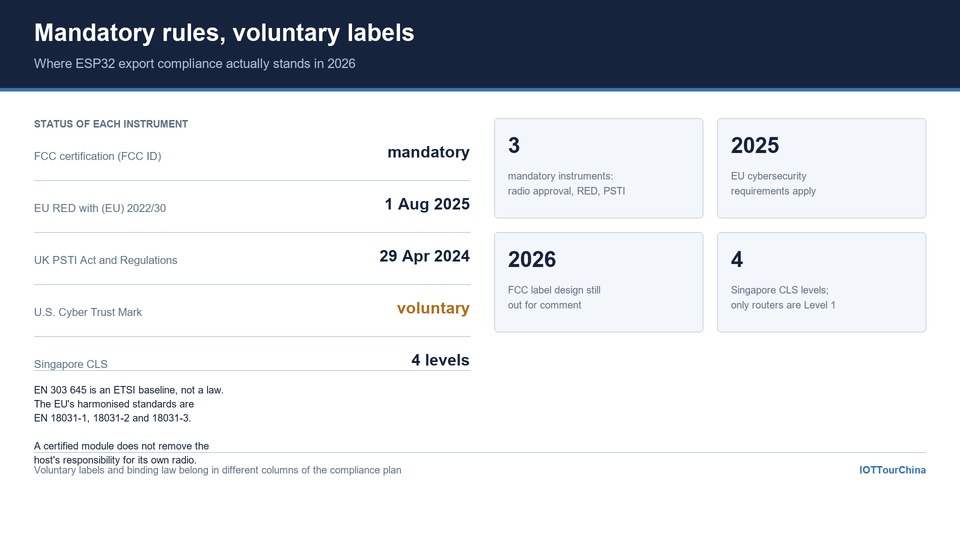
| Instrument | Market | Status | What it demands |
|---|---|---|---|
| FCC certification, the FCC ID path | United States | Mandatory for intentional radiators | 47 CFR 2.907, TCB review, a public database entry and an ID on the label |
| RED with Delegated Regulation (EU) 2022/30 | EU and Northern Ireland | Mandatory since 1 August 2025 | Article 3(3)(d), (e) and (f), with EN 18031-1/2/3 as harmonised standards |
| PSTI Act and Regulations 2023 | Great Britain | Mandatory since 29 April 2024 | Three baseline requirements and a Statement of Compliance |
| Cyber Trust Mark | United States | Voluntary, still being stood up | A label and QR code, with criteria based on NIST work |
| CLS, the Cybersecurity Labelling Scheme | Singapore | Voluntary at most levels, mandatory Level 1 for routers | Four levels, the first two by declaration and the last two with third-party testing |
The first three are legal conditions for placing a product on the market. The last two are labels a manufacturer chooses to apply for, with one narrow exception for Wi-Fi routers in Singapore. Treating them as a single checklist inverts the order of work, because the mandatory items have deadlines and penalties while the voluntary ones have application fees.
The radio approval side
FCC rules separate the two approval paths by whether the device transmits on purpose. The agency states that, except where a rule says otherwise, an intentional radiator is required to be approved using the certification procedure, while unintentional radiators are approved using the Supplier's Declaration of Conformity. A Wi-Fi or Bluetooth product is an intentional radiator, so an SDoC cannot replace an FCC ID. A product holding both a radio transmitter and digital circuitry, which is nearly every connected device, needs certification for the transmitter and SDoC for the rest.
Choosing a dual-band part changes the test plan. ESP32-C5 is the only chip in the family that reaches the 5 GHz band, and 47 CFR 15.407(h)(2) requires a DFS radar detection mechanism for U-NII devices operating in the 5.25 to 5.35 GHz and 5.47 to 5.725 GHz bands. The same rule requires that DFS cannot be disabled by the operator. A design that stays on 2.4 GHz does not take on that test, which is worth knowing before the PCB is laid out rather than after the first test booking.
A certified module does not make the host disappear. FCC modular approval is conditional on using the module within the terms of its grant and keeping the approved antenna arrangement, and the host has to carry a Contains FCC ID label when the module label is not visible after installation. The certificate was issued for a specific radio configuration, so the enclosure, the antenna and the firmware that controls the radio all stay inside the scope of the finished product.
Where the source essay's security list goes wrong
The essay names ETSI EN 303 645 as a thirteen-clause standard that the EU, Singapore and Australia refer to, then says the EU adds RED cybersecurity clauses on top of it. That reverses the legal position. EN 303 645 is an ETSI standard published in 2020 with thirteen high-level provisions. It is a baseline, not a regulation, and it is not harmonised under RED, so meeting it gives no presumption of conformity. The binding EU instrument is Commission Delegated Regulation (EU) 2022/30, applicable from 1 August 2025, which activates Article 3(3)(d), (e) and (f) of the Radio Equipment Directive for internet-connected radio equipment and for certain devices processing personal data. The harmonised standards are EN 18031-1, EN 18031-2 and EN 18031-3, cited in the Official Journal in January 2025. Their use is voluntary, and the official UK factsheet notes that restrictions on password enforcement, parental control and update mechanisms can remove the presumption of conformity and send the product to a notified body.
The essay also describes the U.S. Cyber Trust Mark as already in place and treated by platforms and large buyers as an entry condition. The FCC describes its programme as voluntary and says it is in the process of standing it up. The public timeline is short and recent: rules adopted in March 2024, ioXt Alliance selected as Lead Administrator on 13 April 2026, Cybersecurity Label Administrators conditionally approved on 11 August 2026, and a Public Notice on label design and post-market surveillance issued the day before a Commission keynote on 28 October 2026. A label whose design is still out for comment is not a market-access requirement. We found no primary source for the claim about platform gating, so it is not repeated here.
The regime that is genuinely mandatory in the United Kingdom is the Product Security and Telecommunications Infrastructure regime, in force since 29 April 2024. It sets three requirements: no universal default passwords, a public point of contact for reporting security issues, and a stated minimum period for security updates. It is a self-declaration regime with a Statement of Compliance rather than third-party certification. The published maximum penalty is 10 million pounds or 4 per cent of qualifying worldwide revenue, whichever is higher, and the obligation reaches importers and retailers as well as manufacturers.
Singapore's CLS is more useful than a single label because its levels mean different things. The Cyber Security Agency's presentation at the ETSI Security Conference 2025 describes four levels drawn from EN 303 645: Level 1 and Level 2 are developer declarations, Level 3 adds security-by-design and software binary analysis, and Level 4 adds penetration testing. The same presentation notes that Singapore amended its Telecommunications Act to mandate CLS Level 1 for all Wi-Fi routers sold locally from 2 May 2022, and counted more than 840 labelled products as of August 2025. A one-star label and a four-star label are not points on one scale so much as different amounts of independent scrutiny.
What this means for a module-based design
The security requirements are about product behaviour, not silicon. No ESP32 part number supplies a vulnerability disclosure contact, a defined support period or a signed update path. Those are firmware, documentation and process decisions that have to exist before the first engineering sample, because the evidence is what a conformity assessment reads. Under RED, a design that lets the user skip password creation loses the harmonised route and needs a notified body. Under PSTI, the support period has to be published with an end date, in English, free of charge, and in language a non-technical reader can understand. Both constraints reach back into the first firmware architecture decision.
The chip choice still matters, but on the radio side. ESP32-P4 has no wireless at all and needs a companion C-series or S-series radio. ESP32-C6 carries Wi-Fi 6 on 2.4 GHz plus an 802.15.4 radio for Thread and Zigbee. ESP32-C5 adds the 5 GHz band and, with it, the DFS test. Our ESP32 chip comparison guide lists seven parts and the naming traps around them; this article does not repeat that table.
A practical reading order follows from the status column. Satisfy FCC certification and the RED and PSTI obligations first, then decide whether a voluntary label adds anything for the target sales channel, and only then cost the labelling work. The essay's own advice to do compliance work at project kick-off rather than just before shipment is sound. It is the classification of that work that needs correcting.
Further reading on this site:
- ESP32 hardware selection: from development board to module to antenna
- ESP32 chip comparison: C3, C6, H2, S2, S3, P4 and C5
What we did not carry over
The essay's eight consumer product categories, five prompt templates, eight-question checklist and its cost estimates for modules, prototypes, retail pricing and return rates are business commentary without a purchasable subject or a primary source, so none of them appear here. We also did not verify the per-country radio approval lists for Japan, Canada, Australia and New Zealand, South Korea or Brazil, and therefore do not list them. Nothing in this article is a compliance determination for a specific product. The documents cited here are the ones to take to a certification body before committing to a design.