A low-cost wearable teardown shows how little a silkscreen alone confirms
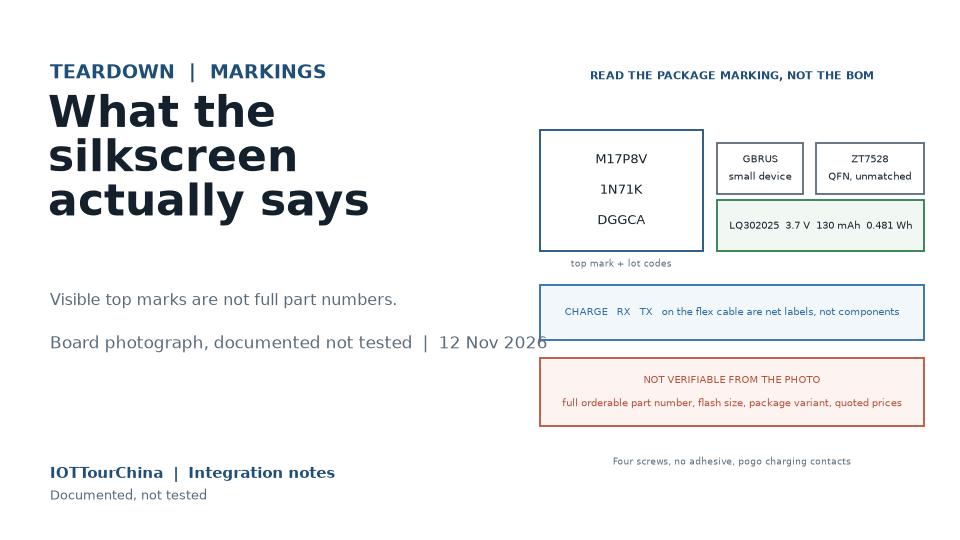
A teardown of a very cheap wearable usually arrives with a confident bill of materials: a named microcontroller, a named radio, a named charger, and a claim about what each part is worth. The photographs in such an article are a different kind of evidence. Reading them directly, without the accompanying prose, shows how much can actually be confirmed and how much is inference. For anyone reusing a board or learning to identify components, that distinction is the useful output.
What is legible on the board
| Location | Marking as printed |
|---|---|
| Main device, NXP logo | M17P8V on the first line, then 1N71K and DGGCA |
| Small device near the top | GBRUS, split across two lines with a dot before the final two letters |
| QFN device | ZT7528, with further batch and date style codes below |
| Lithium cell | LQ302025, 3.7 V, 130 mAh, 0.481 Wh, plus a 170327 style date code |
| Charging | Four pogo contacts on the rear, with two magnets |
| Rear sensor | Round optical window in the centre of the back shell |
| Enclosure | Four cross-head screws, no adhesive bead and no water-resistance seal |
| Flex cable | CHARGE, RX and TX printed next to test pads |
Three of those rows deserve careful reading. M17P8V is a short top mark followed by two lines that look like lot and date codes, not a full orderable part number. GBRUS and ZT7528 do not resolve to a public datasheet from the marking alone. And CHARGE, RX and TX are net labels printed on a flex cable: they name signals and test points, not devices. Counting them as components is an easy way to inflate a bill of materials by three parts.
Why a quoted BOM is not a measurement
The accompanying write-up names a Kinetis MKL17Z256FT4 controller, an NRF51822 Bluetooth device and an SGM4056 charger, and credits a third-party forum post for the bill-of-materials analysis. It also calls the controller an LPC part. None of those strings appears on the board photograph, and the LPC label does not match the family that an M17 top mark points to. A top mark plus a lot code can narrow a device to a family, but it does not by itself confirm flash size, package variant, temperature grade or pin count.
| Claim type | How to treat it |
|---|---|
| Characters visible on the package | Record verbatim, line by line |
| Full part number with suffixes | Only usable if a vendor document maps the top mark to it |
| Lot, date and assembly codes | Record but do not read as part of the model name |
| Net labels on flex cable or PCB | Signals, not components |
| Unmatched markings | Mark as unidentified rather than guessing a function |
| Spot prices and retail prices | Not verifiable from hardware; leave out of a technical record |
The final row matters because price comparisons tend to dominate this genre of article. A quoted component price is a snapshot of one listing at one moment, and a retail price for a finished device says nothing about the provenance of the parts inside it. Neither is a property of the board. A technical teardown is stronger without both.
A repeatable way to record a teardown
| Step | Reason |
|---|---|
| Photograph both sides, all markings and every cable route before opening anything | Reassembly and later checking depend on it |
| Disconnect the cell before probing the main board | Avoids accidental shorts while measuring |
| Record each package marking line by line, with the package shape and pin count | Separates model from lot code |
| Distinguish device markings, PCB silkscreen and net labels | Prevents signals being counted as chips |
| Match each full part number against a vendor document before writing it down | A family is not an orderable SKU |
| Label anything unresolved as unidentified | Leaves an honest gap instead of a plausible guess |
| Note mechanical facts separately from silicon facts | Screws, seals and connectors are directly observable |
This order also makes the teardown reproducible by someone else. If a second reader can look at the same photograph and arrive at the same table, the record is sound. If they have to trust a forum post to fill in half the rows, it is not a measurement.
What the hardware still tells you
The observable facts are still useful. The cell is a 302025 format 3.7 V lithium pouch rated 130 mAh and 0.481 Wh, charged through four pogo contacts held against a dock by magnets. The rear carries a round optical sensor window, and the heart-rate module is attached by a flexible cable; reusing that sensor would need a carrier board and a driver of your own, because the mechanical stack that positions it is part of the watch. Four screws with no adhesive mean the case can be opened repeatedly, which is what makes this class of device a low-risk soldering and desoldering exercise.
For a developer, the limiting question is not the list of parts but whether the debug interface is reachable at all. Without a confirmed orderable controller part number and a known debug pinout, there is no reliable way to choose a toolchain, a programmer or a firmware base. Everything else on the board is a reusable component; the controller is the part that would turn it into a development target. Until that is confirmed, the board is best treated as practice material rather than a platform.
Two columns instead of one
A useful teardown note has two columns: what the photograph shows, and what other sources say is on the board. Keeping them separate costs one extra table and prevents a very common failure, where a second-hand component list is reproduced so many times that it starts to look like an observation. The watch in these photographs gives a clear example: four visible markings, one clearly specified cell, and a handful of labels that are not devices at all. That is a complete and honest result, and it is more valuable for an integrator than a confident list of chips nobody verified.