splitflap: a documented DIY split-flap display driven by ESP32 and steppers
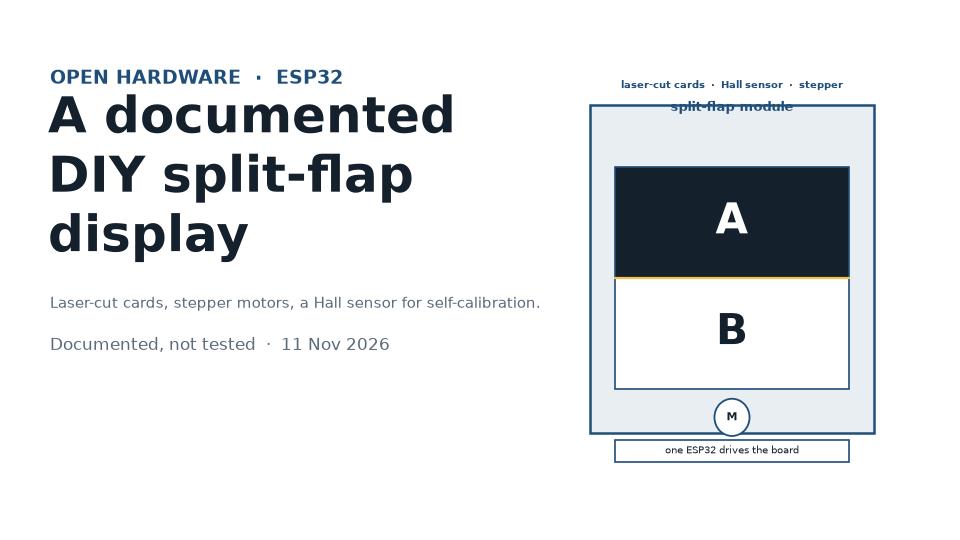
A split-flap display is the kind of mechanical readout you see on old station departure boards: cards flip over one at a time to change the character. The open-source splitflap project by scottbez1 packages that idea into a documented, modular DIY kit that a maker can assemble, expand and even scale into a wall-sized array.
The repository reports about 4.2K stars and is released under the Apache-2.0 licence. The author also sells ready-made driver boards and flap sets on Etsy, while the bill of materials and pick-and-place files are generated automatically so a maker can order a stencil-and-assembly run from a PCB house directly.
How a single module works
Each flap module carries a small sensor board with a Hall sensor on the back. On power-up the module spins one full turn to find its zero position; if it loses steps during operation, the Hall sensor detects the error and the firmware re-homes and re-counts. Six modules share one Chainlink Driver board, where a 74HC125 buffers the clock and latch lines.
The flap itself is a 54 by 42.8 mm card, cut from card stock with a 3D-printed jig, then folded and printed black-on-white. The mechanical frame is laser-cut 3 mm MDF or acrylic, held together with M4 bolts. A stepper motor turns the flap axle; an official video shows the motor spinning the axle while the Hall sensor watches for the zero mark.
A distributed three-layer architecture
The project is organised as a distributed stepper-motor array rather than a single board. The layers are:
- a sensor board per module, with the Hall sensor for zero calibration;
- a motor driver board that drives the stepper and buffers the bus;
- a master controller, where one ESP32 drives the entire display.
Modules are chained in a long serial cascade, and the 74HC125 buffer plus a loopback check let the bus run reliably across many modules. The same pattern is relevant to any serially cascaded build such as LED strings, sensor arrays or conveyor stations.
The toolchain is the real lesson
The firmware runs on PlatformIO with the Arduino framework. What makes the repository worth studying is the automation pipeline: KiCad 5 designs feed KiKit and KiBot so that Gerbers, the bill of materials and the pick-and-place file are regenerated with one command after every revision. A flap-font generator and even a script that exports the promo animation are included.
| Layer | Role | Notable part |
|---|---|---|
| Sensor board | Zero calibration per module | Hall sensor |
| Chainlink Driver | Bus buffering, 6 modules | 74HC125 |
| Master | Whole-display control | ESP32 |
| Mechanical | Frame and flaps | Laser-cut MDF, M4 bolts |
How this was checked
The source article, the repository's stated licence and star count, and the hardware and architecture details were read directly. The GitHub repository scottbez1/splitflap was confirmed to exist as a public repository. The KiCad, KiKit, KiBot, PlatformIO and Etsy references were taken from the source text. No module was assembled, powered or run for this article, and no motion or calibration claim was independently verified.
Source: Electronics Development Learning, WeChat, 11 November 2026.