An open ESP32 watch ships its schematic, firmware and printed case as separate repositories
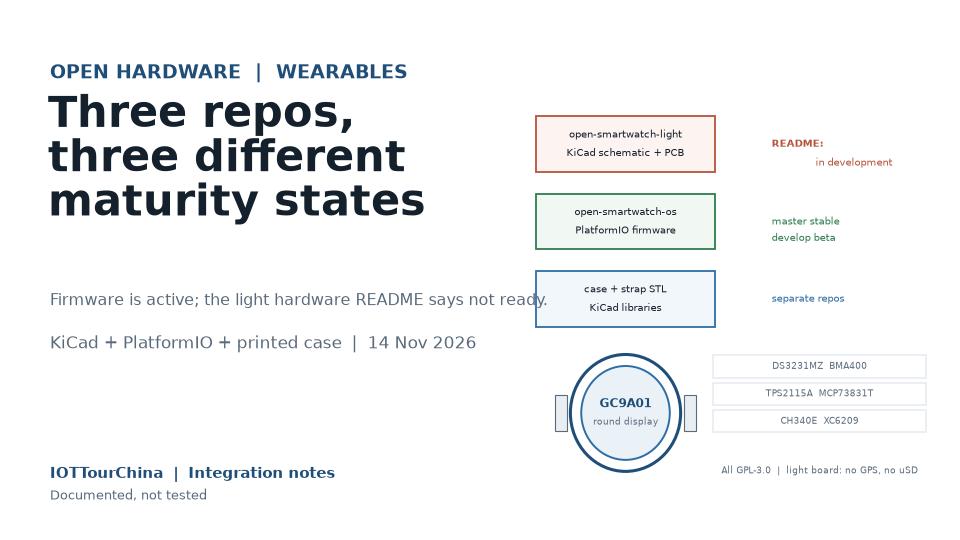
A shared link to an open smartwatch usually invites one question: can I build it. For this project the more useful question is which of its repositories is actually maintained, because the hardware, the firmware and the printed case do not live in one place and they are not at the same stage. Reading the repositories directly gives a clearer picture than the photos of finished watches.
Three repositories, three different states
| Repository | What it holds | First-party status |
|---|---|---|
| open-smartwatch-light | KiCad schematic, PCB and gerbers for the light version | README says the project is in development and is not ready for release; last pushed in April 2021 |
| open-smartwatch-os | Firmware built with PlatformIO | Still updated in September 2026; master is the stable branch and develop is the beta branch |
| Case, strap and KiCad libraries | 3D printed STL files and symbol or footprint libraries | Published as separate repositories |
Both the light hardware repository and the firmware repository are published under GPL-3.0. The light repository description explicitly says there is no GPS and no microSD slot, and a second hardware variant carries those parts. That split is why a star count on one repository says very little about the maturity of the whole design: the firmware repository is active while the light hardware files have not moved in years.
What the schematic actually contains
The KiCad schematic in the light repository lists its components by exact part name. That list is more useful than a bill of materials copied from a schematic image, because it distinguishes a real device from a net label or a pin name.
| Function | Part in the schematic |
|---|---|
| Processor and radio | TTGO Micro-32 module |
| Round display | GC9A01 IPS display over SPI |
| Motion and wake | BMA400 accelerometer |
| Real time clock | DS3231MZ |
| USB interface | CH340E USB bridge and USB-OTG |
| Power path | TPS2115A power multiplexer, MCP73831T charger, XC6209 regulator, 2N7002 transistor |
The commonly quoted parts are all present, but two devices often missing from short summaries are there too: the CH340E bridge and the 2N7002 transistor. Conversely, the datasheets for a BMP280 pressure sensor and a Quectel L96 GPS receiver sit in the documentation folder while neither part appears in the light schematic. A reader who needs those functions should check the other hardware variant rather than assume the light board carries them.
Two design ideas worth reusing
The first is the power path. TPS2115A handles the switch between USB and battery power so that plugging in a cable charges the cell without dropping the supply, and unplugging returns the board to battery power without a reset. That is a reusable pattern for any small battery product, and it is fully visible in the schematic.
The second is the round display. A circle with a modest pixel count needs a driver and a user interface that respects the shape, and the firmware repository contains working code for both. Someone designing a round panel does not have to start from a blank framebuffer. Neither of these requires the rest of the watch to be production ready, which is why they remain useful even when the hardware status line is cautious.
What the status line means for a build
The light hardware README states in plain terms that the project is in development and not ready for release. Treat the files as a reference design, not as a manufacturing package. Gerbers and an interactive bill of materials are provided, but that is a starting point for review, not a released layout with an agreed revision, assembly notes and a tested supply chain.
There is also a compliance boundary to keep in mind. The radio module is sold with its own declarations, and module certification can be reused only under the conditions of its grant, with the antenna arrangement unchanged. A finished watch is a different host product and needs its own assessment for the market where it is sold. Where a module label is not visible on the outside of the finished product, the host normally has to carry the relevant identification text as well. Choosing a certified module does not remove that work.
Practical checklist before ordering anything
| Check | Why it matters here |
|---|---|
| Confirm which hardware variant you need | The light version has no GPS and no microSD slot |
| Read the README of every repository separately | Firmware activity does not imply released hardware |
| Verify the display and sensor parts against your own BOM | Schematic part names are exact, summaries are not |
| Plan for the printed case and strap as separate files | They are not inside the hardware repository |
| Budget a host-product compliance review | Module certification is conditional, not a blanket transfer |
For a wearable prototype, the value here is the completeness of the reference material: schematic, firmware, case geometry and a library of parts are all public. The value is not a promise that the light board is finished. Keeping those two statements separate is the honest way to use the project.