A Rockchip core-board RFQ should pin the module revision, carrier and image together
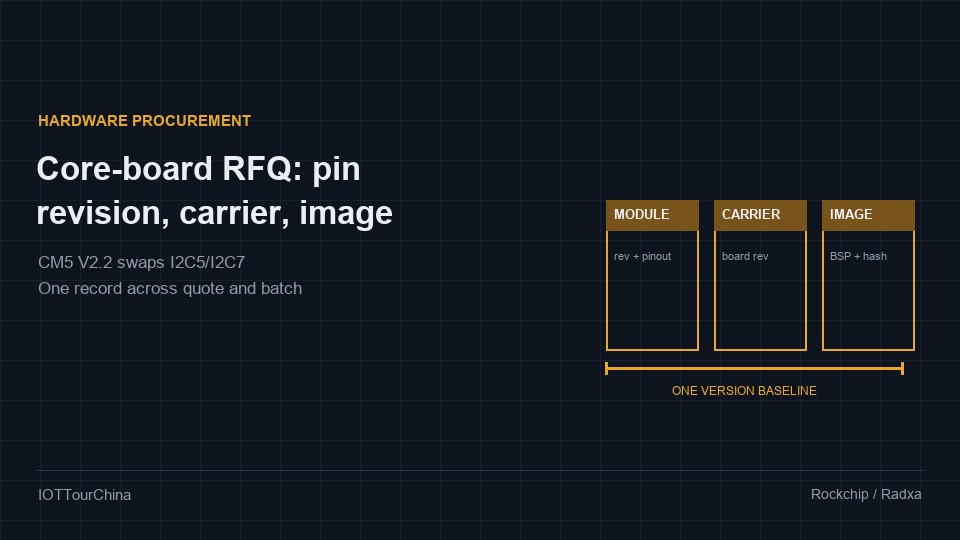
Two suppliers can quote the same series name and still be offering different hardware. A procurement note built on Radxa's public CM5 and NX5 records argues that a price comparison is only meaningful once the quote, the carrier board and the software image point to one version baseline. The Radxa facts are taken from official documentation; the note contains no supplier quote, customer AVL or acceptance record, and no supplier behaviour is asserted.
A series name is not an orderable identity
A Rockchip data sheet describes what a chip can do, not how a module exposes it. The module vendor combines memory, eMMC, connectors and power design, and the carrier board decides the actual sockets, rails, protection and peripherals. A line reading RK3588, 8 GB, Linux does not uniquely identify the hardware that will arrive.
Radxa's NX5 is a concrete example. Its documentation identifies an RK3588S system-on-module on a 260-pin SO-DIMM connector, and separates the module, the IO board and the development kit as distinct objects, with the IO board sold separately. The download pages list module pinout and schematics, IO-board schematics and images separately. Pointing at a development-kit photo or the series name cannot replace those versioned files.
What the supplier should actually fill in
The proposed RFQ line is a full order code plus RAM and eMMC configuration, module hardware revision, the matching documentation revision, the target carrier revision and a specific image or BSP identifier. If a field cannot be confirmed at quote time, it is marked to be verified, with an owner and an evidence date, rather than assumed to match the sample.
Compatibility also needs an object. Mechanical fit, pin and voltage compatibility, booting the vendor image, and full regression of the cameras, network, display and update path are different claims. For an existing carrier, a hardware owner checks power, connectors and lane assignment, and a software owner checks the device tree, drivers and boot medium. If either conclusion depends on a document that has not been delivered, the offer stays a candidate and is not an approved drop-in replacement.
A revision can change the circuit
Radxa's published CM5 revision history records real changes across versions. Early revisions changed eMMC to SDMMC routing, removed a Wi-Fi host-wake net and moved the status LED. A later revision added HDMI HPD divider resistors, changed Ethernet PHY configuration resistors and revised the fan circuit. Version 2.2 moved HDMI control parts onto the module, added level conversion, made the design compatible with RK3588S2, and swapped the positions of I2C5 and I2C7 to meet a 3.3 V I2C requirement. Version 2.21 added series capacitors on the HDMI lines.
This does not prove that every CM5 revision is incompatible, nor does it generalise to other vendors. It shows why a revision number can affect both the carrier and the software acceptance scope. The download pages provide a V2.21 pinout and V2.2 IO-board files, and the hardware-interface page warns against fitting a CM5 to a CM3 IO board. Public files being available is not evidence that two similar-looking boards are interchangeable.
Quote, sample and first batch answer different questions
The note separates three release points. A quote establishes whether offers are comparable; a target-carrier sample establishes whether the combination works in the product; a first incoming batch establishes whether delivery still matches the approved combination. Sample success under one set of conditions does not prove identical production batches, long-term supply or stability at the product's temperature.
A first-batch acceptance record should tie the arrival label to the approved sample, the batch, hardware revision and image version, and the review of any changed item. Where a delivered revision differs from the approved one, the hardware and software owners obtain both sets of interface documents before accepting equivalence. Actual PCN timing, permitted substitutions and return responsibility belong in contract terms, not in a public revision page.
Cost and the limits of the argument
A lower board price is not automatically a lower project cost. One quote may include carrier adaptation, BSP delivery and fault diagnosis; another may include only a bare module and a development-kit image. Splitting engineering and responsibility out of the price is the only way to compare them. Delivery lead time, MOQ, approved-vendor lists and end-of-life notice should be obtained in writing for the exact order code, not inferred from a channel page.
This is a procurement method, not a recommendation of any module or supplier, and it makes no delivery or reliability promise. Where a project has no real test record, the correct entry in an acceptance sheet is pending test, not passed. The value of the note is the discipline: one numbered record shared by purchasing, hardware and software, so three teams are not comparing three different products.