Picothermal turns a phone into a WebUSB thermal camera
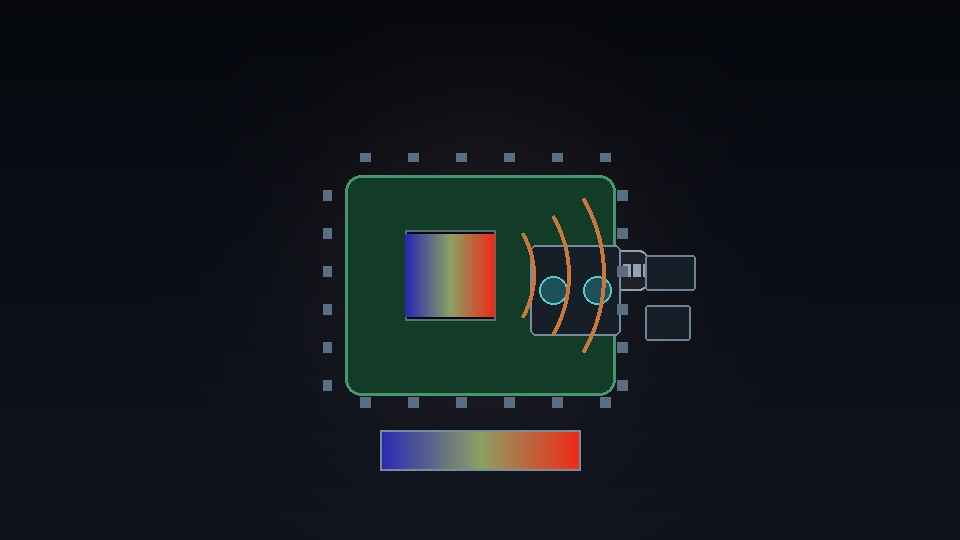
A WebUSB thermal camera called Picothermal pairs a FLIR Lepton 3.5 infrared sensor with a Raspberry Pi RP2040 and connects to a phone or laptop over USB-C. The device needs no dedicated app: a browser that supports WebUSB opens a web page and shows the live thermal image. The whole hardware design, firmware, and enclosure drawings are published under the MIT licence.
What the camera does
The camera is a small board that plugs straight into a USB-C port. Once a compatible browser loads the web page, it shows a live heat map with no software to install and no driver to configure on Windows. The author, Cezar Chirila, built it as a second version of an earlier idea: instead of a screen, a battery, or onboard storage, the board only moves sensor data to the USB link, and the phone supplies the display and power.
Hardware in one view
| Component | Used part | Notes |
|---|---|---|
| Thermal sensor | FLIR Lepton 3.5 | 160 by 120 pixels, radiometric, reads absolute temperature; low-gain range minus 10 to 400 degrees Celsius, 57 degree horizontal field of view, about 150 milliwatt typical |
| Microcontroller | RP2040 | Dual-core Arm Cortex-M0 plus; 16 Mbit W25Q16JV QSPI flash holds the firmware |
| USB connector | USB4155-03-C | ESD3C3.3ST5G protection and MPZ1608S101ATA0 ferrite bead on the entry |
| Sensor clock | ECS-2520MV-250-CL | 25 megahertz oscillator for the Lepton module |
| Debug | Tag-Connect TC2030-CTX | SWD footprint for firmware flashing and logging |
| Power | 5 volt input | Split four ways: two TLV62569A bucks to 3.0 volt at 1 amp and 1.2 volt at 1 amp, two AP7330 LDOs to 3.3 volt at 300 milliamp and 2.8 volt at 300 milliamp, each rail with a test point |
Why there is no app
WebUSB is the whole point. A Chromium-based browser can claim the device and stream video straight from a web page, so the project skips the native app that usually makes a thermal gadget useless once the vendor stops updating it. On Windows the firmware uses Microsoft OS 2.0 descriptors to bind WinUSB automatically, so the device is driverless on first plug. The design deliberately drops the screen, battery, and storage: the phone is the screen and the battery, and the board only shuttles the sensor stream to USB, which is why it stays so small.
From a 32 by 24 sensor to a 160 by 120 one
The first version used a Melexis MLX90640, a 32 by 24 array of 768 pixels. It was enough to see the general shape of a hot spot but too coarse for detail. This version moves to the FLIR Lepton 3.5 with 160 by 120 pixels, or 19200 in total, about twenty-five times the resolution, and it reads absolute temperature because the sensor is radiometric.
Firmware written mostly by an AI agent
The firmware was originally planned in C using TinyUSB for the USB stack. Short on time, the author rewrote it in Rust with the embassy framework using coding agents, and warns in the readme that the code is largely agent written and probably hard to maintain. The core is a chip-agnostic no_std library: a Lepton driver that talks to the sensor over I2C for register access and over SPI for the video stream, plus a protocol module shared with the web host. Both are covered by host-side tests that need no hardware. Flashing is straightforward: a compiled UF2 file is dragged into the RP2040 bootloader, or probe-rs writes it over SWD, and logs travel over RTT through defmt. There is intentionally no USB serial console, so all the USB bandwidth goes to the video.
Where it works today
WebUSB is implemented only by Chromium-based browsers. Windows Edge and Android Chrome are the two platforms the author tested; other Chromium browsers such as Chrome, Opera, Brave, Vivaldi, and Samsung Internet should work, as should the macOS, ChromeOS, and Linux variants once Linux has the udev rule added. Firefox and Safari do not support WebUSB, and every browser on iPhone and iPad is blocked by the WebKit engine, so those platforms are out for now.
The USB identifiers are borrowed
The firmware ships with VID 0x1209 and PID 0x0001, which is the shared test identifier allocated by pid.codes and meant for prototypes only. Anyone building boards from the project should apply for their own PID first, because sharing that identifier means clashing with every other project that uses it.
What is still on the roadmap
The author lists the USB Video Class as a possible later addition. If the device ever speaks UVC, it could be used like an ordinary USB camera by any application, instead of only through the WebUSB page. The current version is WebUSB only.
Files to build your own
The hardware repository holds the KiCad project, a PDF schematic, Gerber files, the bill of materials, and STL enclosure files issued in two variants for the 0.8 millimeter and 1.6 millimeter board thicknesses. The firmware repository is written in Rust and also carries the MIT licence. At the time of writing the hardware repository had about sixty-four stars and the firmware repository about nine.