An NFC e-paper card separates tag communication from card emulation
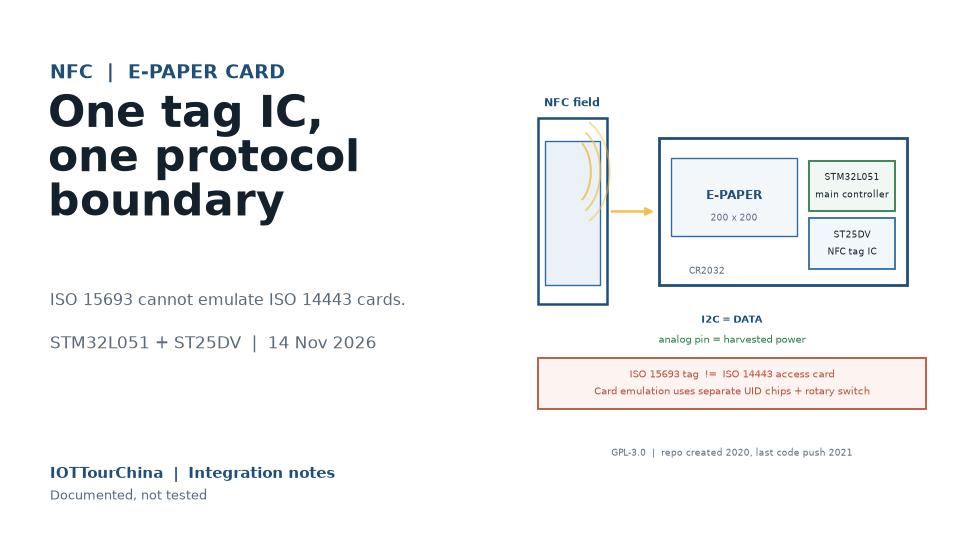
A business card with an e-paper panel and an NFC antenna looks like one small product, but the interesting part of this open design is how sharply it separates three jobs that are easy to conflate: talking to a phone, harvesting a little power from that phone, and pretending to be an access card. The project README is unusually explicit about which chip does which job, and about the one job the main NFC chip cannot do at all. That makes the repository more useful as a reference design than the photographs of finished cards.
Two chips, two different paths
| Element | What the repository and vendor page say |
|---|---|
| STM32L051 | Main controller, an ST L0 series part with a Cortex-M0+ core |
| ST25DV | NFC tag IC, an NFC Forum Type 5 device communicating with the controller over I2C |
| Energy harvesting | An analog output pin that can power external components when RF conditions allow |
| Display | 200 by 200 monochrome e-paper panel, Waveshare unit in the original build |
| Power | A CR2032 cell in the original design, because an e-paper refresh needs a steadier supply |
The vendor product page describes energy harvesting as an analog output pin to power external components. I2C on the same device is a data path: the page documents a fast transfer mode with a dedicated 256-byte buffer between the I2C and RF interfaces, and the project README calls the ST25DV an NFC PHY that talks to the STM32 over I2C. Supply and data are therefore separate routes. A short summary that says harvested energy is delivered to the controller through I2C merges them into one, which is worth correcting before anyone sizes a supply rail from it.
The protocol boundary decides what the card can emulate
The README states the limitation without hedging. The ST25DV supports ISO 15693, while the M1 cards used for building access and canteen payment are ISO 14443 devices. Those protocols do not interoperate, so the NFC tag IC cannot emulate them. Card emulation in this hardware revision is physical: several inexpensive UID chips share the NFC antenna with the ST25DV, and a rotary switch selects which one is connected.
| Design choice | Consequence for a builder |
|---|---|
| One UID chip per emulated card | Each extra card needs another chip and another switch position |
| Shared antenna | The tag IC and the UID chips coexist on the same RF front end |
| Rotary switch | Card selection is mechanical, not firmware driven |
| Software emulation on ST95 or ST25T | Listed in the README as a future direction, not an implemented feature |
| Colour e-paper panel | Also listed as a planned next version, not shipped |
A community fork replaces the rotary switch with a five-way button and adapts the design to a newer display driver. It is a useful pointer, but it is a separate repository with its own state. Treating either the fork or the roadmap notes as part of the released design is the fastest way to order the wrong parts.
What is actually in the repository
| Directory | Contents |
|---|---|
| Hardware | Schematics and PCB sources for Altium Designer in source, ready-to-fabricate gerbers and a bill of materials in release |
| Firmware | Two project layouts for the same STM32L051 source, one for CLion and one for Keil |
| 3D Model | STEP and STL files for the display bracket and the printed case |
| DAP-Link | Hardware and firmware for a self-designed debug probe, unnecessary if an ST-Link or J-Link is available |
| Android | Companion application for customising the displayed content |
Two practical notes in the README save real time. The STM32L051 belongs to the L0 family, so the L0 firmware support package has to be installed first, either through STM32CubeMX or the Keil Package Installer, or the build fails on missing headers. And the e-paper panel has a batch problem: older stock of the 200 by 200 Waveshare screen uses a different driver IC, so the firmware does not carry over. Confirm the panel batch before writing a refresh failure off as a software bug.
Reading the repository state correctly
The main repository was created in June 2020 and last received a code push in January 2021. It is published under GPL-3.0 and still attracts forks and issues, but a high star count on a repository whose hardware files have not moved in years says little about manufacturing readiness. Gerbers and a bill of materials are provided, which means a reviewer can start from a real layout, not that the layout carries a released revision, assembly notes or a validated supply chain.
The same distinction applies to compliance. An NFC tag IC is not a certified radio module with a transferable grant, and a finished card is a host product that needs its own assessment in the market where it is sold. Where a certified module is used in a design, reuse is conditional on the grant terms and on keeping the antenna arrangement unchanged, and the host may need identification text on the outside when a module label is not visible. Choosing a well-documented tag IC does not remove any of that work.
There is also a legal boundary that belongs in any build note about card emulation. Copying credentials you do not own, including employer-issued encrypted cards and public transport cards, is unlawful in most jurisdictions and outside the scope of this project. Being able to read a UID is not the same as being permitted to clone it. A tutorial that leaves that sentence out is incomplete.
Checklist before ordering anything
| Check | Why it matters here |
|---|---|
| Confirm the e-paper panel batch and driver | Old stock is not firmware compatible with the new panel |
| Install the L0 firmware support package first | Otherwise the firmware build fails on headers |
| Read the README of each repository separately | The fork changes the switch and the display driver |
| Treat ISO 14443 card emulation as separate hardware | The ST25DV cannot do it |
| Keep colour e-paper and software card emulation in the roadmap column | Both are stated as future work |
| Plan a host-product compliance review | A card you build is a product, not a component grant |
The lasting value of this project is that it names its own limits. Two ICs, one display, one cell, and a README that tells you exactly which protocol boundary the design cannot cross. That is a better starting point for an integration than a feature list, and it is the reason the repository is still worth reading years after its last push.