Is radar algorithm work dead? A five-year view of what AI actually cheapens
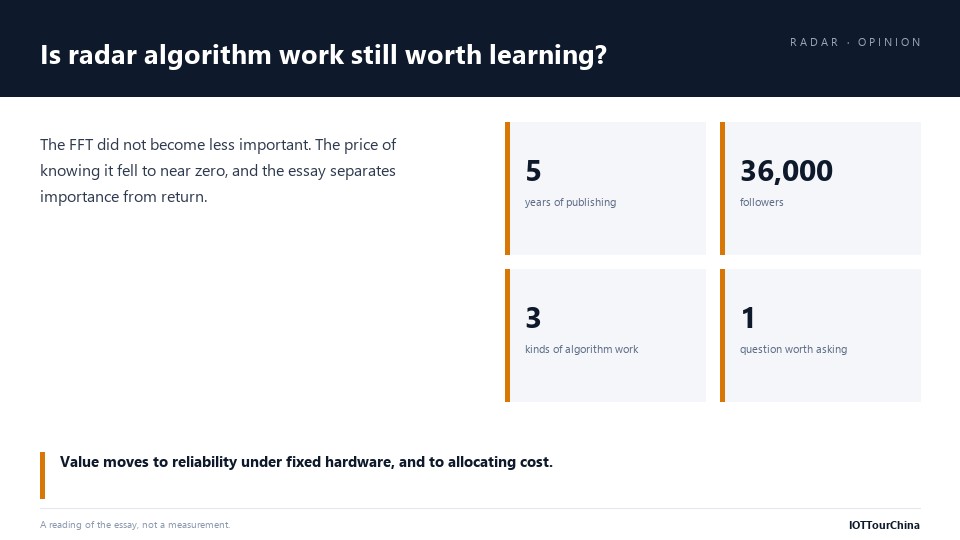
The question in the title was not rhetorical when it was asked. The author, who has published radar engineering material under the same account for five years and reached about 36,000 followers, wrote it on the anniversary after watching a language model diagnose a point-cloud glitch from a packet capture faster than the engineer holding the probe cable.
The scenario is specific enough to be uncomfortable. A radar's point cloud occasionally jumps. The engineer captures data, sends it with the protocol description, and before the cable is untangled the model has found the anomaly, proposed two fixes and run both against the data. Days of work compressed into an afternoon.
The follow-on thought is the one worth writing about, because it does not stop at the engineer. A manager watching the same screen is estimating next year's headcount. And a competitor with the same tools can build something comparable faster too — so the saving shows up in quotes rather than in margin.
Knowledge is not the same asset as return on knowledge
The essay's sharpest distinction is between how much a method matters and how much a person can charge for knowing it. The FFT underpins most radar processing. Its importance has not fallen. But no company can ask a customer to pay more because its product "uses FFT".
That gap — large systemic value, near-zero acquisition cost — is where AI is pushing a great deal of engineering work. Historically, the price of an algorithm included finding the references, understanding the code, solving the interfaces and iterating through failures. When that interval collapses, the job structures and quotes built around it move too.
The apparent paradox resolves once you see the incentive. The more an industry depends on a foundational capability, the more it pushes that capability into libraries, standard parts and silicon. Use rises, unit cost falls, productivity improves — and the people who supplied it by hand need a new position.
Universal access has limits, though. Getting an answer, understanding the answer and placing it inside your own problem are three separate steps, and models, compute, lab access and usable data are not distributed evenly. Two engineers can both generate a direction-finding routine; one asks whether the peak is visible, the other asks about array error, noise conditions, source-count assumptions and compute budget. The code looks similar, the delivered capability does not. The difference is whether someone can put a general method back into a specific set of conditions.
What the value moves to
The essay splits algorithm work into three kinds that are usually priced as one: connecting mature blocks so existing hardware runs; improving reliability in difficult conditions under fixed power and cost; and discovering new observation methods. Different accumulation, different risk, different return.
On this reading, foundations matter more, not less — but they need to be learned with intent. Linear algebra is how you see structure in array data; probability is how you reason about error; signal processing is how you know what an operation preserved and what it threw away. That knowledge is what lets you compare the several solutions a model offers instead of trying them at random.
For engineering specifically, the essay's point is that AI is starting to organise engineering actions, not just answer questions. It cites an OpenAI disclosure from 3 November 2026 in which a model participated in enclosure, board and firmware design, a manufacturer built a small prototype batch, and transferring to production still produced several rounds of review over tolerances, assembly and production conditions.
Once interfaces and feedback exist, a machine can continue to the next step. One person covers more ground; the team arrangement needed to finish the same task changes. Experience then splits three ways: some becomes rules inside tools and is inherited by the next person; some depends on conditions nobody has characterised yet and remains research; some is repetition that automation absorbs.
The awkward consequence for individuals: if your position rests on a few parameters others do not know, how long that lasts depends on when those parameters enter the system.
The trade-off that does not automate
What remains firmly human in the essay is the allocation of cost. Take a mobile robot's radar. The customer wants obstacles caught early, nuisance stops reduced, power and price down. Longer observation helps weak signals and hurts response time; keeping more information helps downstream processing and costs compute and bandwidth. Those constraints have to be arranged within one task.
A model can compute, search and compare. It cannot decide what this task is allowed to spend. Customer specifications are usually incomplete, a site constraint may never have entered the requirements, and a saving in one department can be a cost in another. Finding those relationships is what makes an optimisation worth doing or not.
The essay is careful about "full stack" too. Crossing several interfaces does reduce miscommunication and can find better solutions — but taking on more modules without test conditions, scheduling authority and room to make trade-offs mostly adds waiting and rework.
Firms, research, training
Applied to companies, the question becomes where the profit goes once building is easier. Cheaper R&D can turn previously uneconomic niches into business, and it can also multiply suppliers. Both happen in different markets at once. Using a stronger model buys tool capability first; whether it becomes advantage depends on what the team does with it and how long peers need to reach parity.
What is harder to copy is repeatable delivery: installation, training, use and maintenance that hold up across customers. A competitor can reproduce a demo; reproducing delivery requires equipment, process, experience and relationships. The essay also notes the organisational version of the same idea — a strong individual solves problems, a company needs the result to survive personnel changes, which requires records of why a decision was made and which conditions must be tested.
On research, the argument is that AI moves the bottleneck rather than removing it. It cites a 17 October 2026 aptamer design paper in which a model agent's candidates went through three rounds against real experimental feedback, and an OpenAI benchmark from 6 November with 100 wet-lab-derived tasks in which a model correctly refused to treat a mislabelled control plate as a control — while other runs misread controls and ignored contradictory evidence. Generating hundreds of explanations for a problem that lacks a measurement does not beat one good observation.
On training, the essay identifies the loop that worries it most. Junior work used to carry part of the training cost: writing a driver taught hardware, cleaning data revealed acquisition problems, fixing a defect taught a call chain. When AI does those tasks faster, the short-term saving is visible while the mentor's time is not. Raise the hiring bar and the training that used to happen inside a job has to happen before it. Every firm individually prefers to pay less for training; the industry as a whole still needs someone to provide it.
The answer, such as it is
The essay does not claim radar algorithms are dead, and it does not claim nothing changes. Its conclusion is narrower and more useful: producing tools better does not mean radar designs itself, and it does not mean relying on AI solves every problem. Someone still has to judge results, define requirements and design the product.
It ends with a testable commitment rather than a prediction — publish work that can be reproduced, ask where a method's boundary actually is, and revisit the industry judgments later to see if they held. Setting the ten-year mark as the checkpoint for today's confident-sounding claims is the most honest part of the piece.
For anyone building radar products in China's supply chain, the practical reading is this. The parts of the job that consist of retrieving, porting and adapting published methods are being repriced downward, quickly. The parts that consist of knowing which conditions your product will actually meet, what it is allowed to spend to meet them, and how to deliver the same result a hundred times are not. The first category is where most job descriptions still live.
This article is part of the mmWave Radar channel.