A 1 Hz camera plus ultrasound holds near-eye gaze tracking near 3.5 degrees
Put a pair of smart glasses on, take them off, put them back on, and the gaze cursor drifts. That single behaviour is one of the main reasons eye tracking has not become a background capability in wearables. Camera-based tracking can reach high accuracy in a lab because it images the pupil and the corneal reflection directly, but continuous image capture, infrared illumination and the vision pipeline consume a power budget that a pair of glasses does not have. Acoustic tracking is far cheaper to run, but its echo signature depends on where the device sits relative to the eye, so a re-seating invalidates the model.
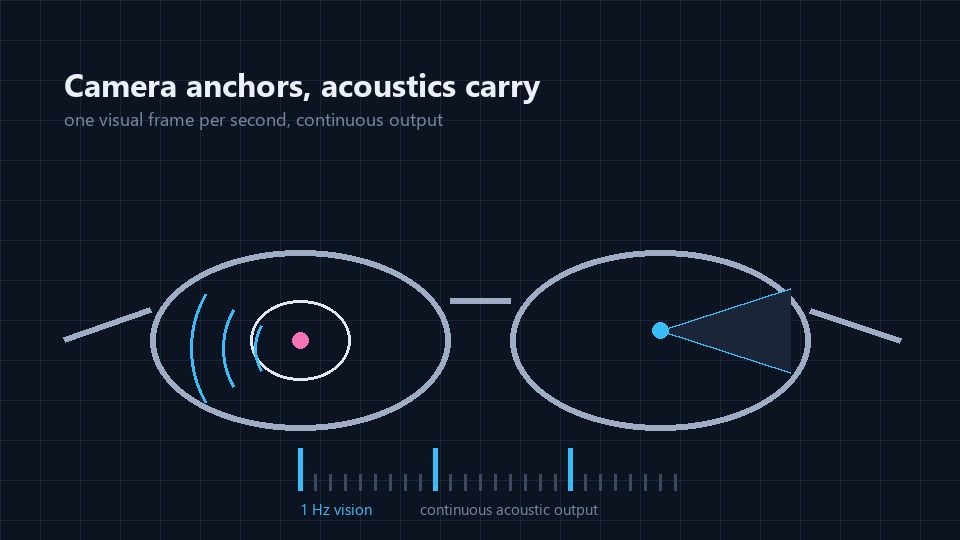
A paper at UIST 2026 from Yuhan Ma and Feng Lu at Beihang University declines to choose between the two. It puts an infrared camera and an ultrasonic module on the same frame and assigns them different jobs on different time scales: the camera provides occasional trustworthy anchors, and the acoustic path provides continuous output between them.
Why neither modality wins alone
Camera-based near-eye tracking dominates the field for good reasons. Pupil centre, corneal reflection and a three-dimensional eye model, combined with a mature calibration procedure, deliver both accuracy and stability. The cost is structural rather than incidental: the accuracy is bought with continuous high-resolution capture and a vision model running at frame rate.
Acoustic tracking takes the opposite approach. It emits ultrasound above the audible range and analyses the reflection, producing an energy distribution in time and frequency rather than an image of the eye. Earlier work on eyewear-mounted acoustic tracking reported roughly 3.6 degrees of within-session accuracy at under 5 percent of the sensor-level power of a camera system. The weakness is equally structural: because the signal is a distribution rather than a picture, small changes in device-to-eye geometry change the distribution, and existing acoustic systems lack a natural way to recalibrate after the glasses are taken off and put back on.
The paper's proposition follows from that asymmetry. Let vision supply the accuracy it is good at, but only in small numbers of high-value samples. Let acoustics supply the continuity and low power it is good at, and keep correcting it against visual anchors.
The prototype keeps both sensors intact
The hardware is built to be worn on an ordinary spectacle frame, and it deliberately does not attempt to miniaturise the sensors into invisibility. The visual side is a near-eye infrared camera with illumination and a small camera control board. The acoustic side is built around an ESP32-S3-Mini driving a MAX98357 amplifier and a micro-speaker that emits frequency-modulated continuous waves between 17 and 20 kHz. Reception uses a PCMD3180 capturing four PDM microphones, time-division multiplexed into the controller. Both directions sample at 48 kHz. The control and adapter boards measure about 28 by 17 mm and the sensor about 10 mm, arranged around a single eye, with data streamed to a computer for synchronised recording and real-time processing.
The report is explicit that this is a system-level validation platform rather than a consumer form factor. The value of the design is that both sensing modalities retain their full capability, which is what makes it possible to test the coordination strategy at all.
Three states, three jobs
The division of labour is managed as a state machine with three states.
On first wearing, the system enters calibration. The user looks at nine points on a screen in sequence and the system builds the camera branch's gaze mapping, with vision running at 30 Hz.
It then moves to a warm-up state. Vision still runs at 30 Hz, but only high-confidence gaze results are accepted, and each is paired with the acoustic features captured at the same instant to build acoustic-feature to visual-reference samples. The two modalities run at different rates, so the pairing has to be handled explicitly rather than by index.
In steady state, the camera drops to 1 Hz. Between anchors the acoustic path produces continuous output, and a filter updates the acoustic mapping against each new visual anchor. In the reported configuration that yields an 83 Hz output rate from a 1 Hz visual stream. In a higher-tier configuration, acoustic output rises to 750 Hz with vision at 30 Hz.
The state machine also defines graceful degradation. Under conference noise, subway noise or infrared brightness interference, the system drops the affected branch: if vision fails it falls back temporarily to acoustic-only output, and if acoustics become persistently abnormal it returns to warm-up and runs approximately on the visual branch. It does not promise that error stays flat under either interference, only that the system keeps working instead of failing outright.
What the numbers support
In the steady-state, 1 Hz configuration the fused average error was 3.53 degrees. Raising vision to 30 Hz brought fusion to 3.02 degrees against 2.98 degrees for the vision branch alone, which is the expected result and a useful sanity check on the fusion: a well-behaved combination should approach its strongest member without beating it by much.
The higher-tier results are more striking and more fragile. Static fixation held fusion error between 1.20 and 1.36 degrees, and high-speed tracking between 2.38 and 2.64 degrees. That supplementary experiment had a single participant, and the report says so directly, framing it as a trend rather than a generalisable result. The honesty is appropriate; a one-subject high-tier number is an existence proof, not a specification.
The power accounting is where the argument becomes concrete. The acoustic module draws about 20 mW. The vision module draws about 370 mW at 30 Hz and about 140 mW at 1 Hz. Dropping vision to 1 Hz and adding the acoustic path, measured on the prototype, cut sensor-side power by about 57 percent. On the same computer, steady-state CPU utilisation and compute time fell by 81.2 and 79.5 percent against the 30 Hz vision baseline.
Two caveats belong next to those figures. The full pipeline still runs on a computer, and the vision module does not yet use hardware-level power measures such as clock scaling or inter-frame sleep. The 21.4 to 31.4 mW of ideal sensing power quoted in the paper is an estimate built from datasheet operating points of existing components, not a measurement of this prototype. Reporting a sensor-side 57 percent reduction while explicitly not claiming a whole-device runtime is a distinction many wearable papers blur.
What has to happen before all-day use
Embedded deployment is not finished. Moving from a computer to a low-power platform is not a board swap: visual capture, acoustic processing, lookup-table updates and the Kalman filter all have to be re-budgeted before the end-to-end figure means anything.
The visual reference remains the soft spot. Short occlusions are covered by the degradation strategy, but if vision is unavailable for a long period the system loses its mechanism for online correction and recovery from model mismatch. The authors point at fusion methods that depend less on the visual reference as future work.
The experimental envelope is also narrow. Participants had to keep head motion limited, and AprilTags at the four screen corners assisted coordinate alignment. Sensors were placed around one eye only, so binocular deployment and more complex three-dimensional interaction are unverified.
The part worth carrying forward
The paper's actual claim is not that acoustics can replace vision, nor that stacking two sensors raises peak accuracy. It is a claim about time scales. Vision does not need to process thirty images a second; it needs to be trustworthy at the moments it is consulted. Acoustics does not need to solve calibration on its own; it needs to hold output steady between anchors and drift toward the next correction rather than away from it.
That reframing is what makes the hardware choices coherent. The interesting question for a wearable sensing architecture is not which sensor is better but which sensor should be awake, and when. The reported configuration runs an 83 Hz output from a 1 Hz camera, and the authors' closing argument is that all-day eyewear probably does not need a stronger imaging chip so much as a mechanism that knows when to look and when to listen.
Source: Embedded Home, WeChat, 5 November 2026. Paper: Yuhan Ma and Feng Lu, Integrating Visual and Acoustic Modalities for Near-Eye Gaze Tracking, UIST 2026, Article 212, DOI 10.1145/3830398.3830650.