The CosmoEdge build that passed 72 hours is not the build that has ONVIF
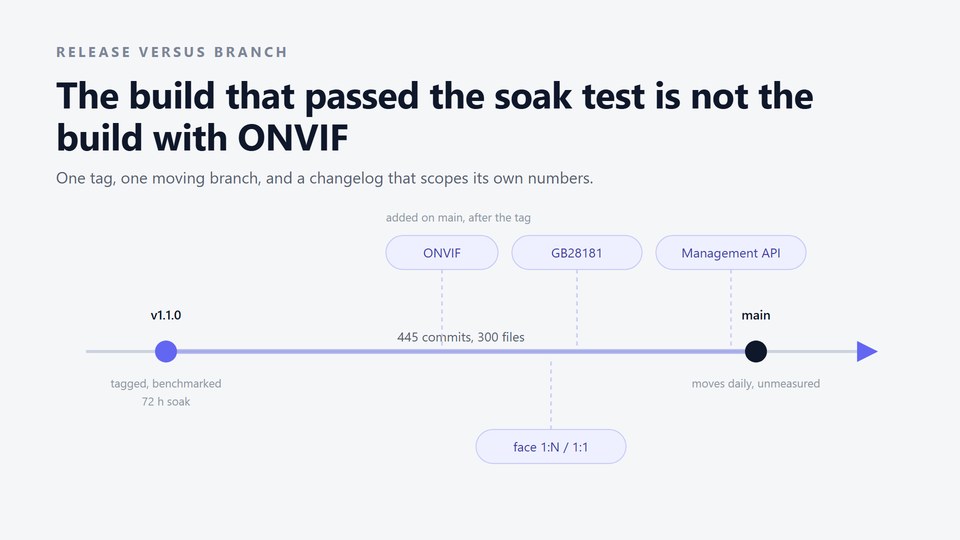
Two artefacts share the name CosmoEdge, and they are not the same software.
The v1.1.0 release was published on 24 August 2026. Its benchmark report is specific and reproducible: on a Rockchip RK3576, eight channels each running two business tasks at five frames per second, 4316 of 4320 sampling points inside the gate across 72 hours, and a VLM boundary at four channels before the fifth fell to 69.7 percent of the target rate.
The repository has moved on. On 24 October 2026 the main branch stood 445 commits and 300 changed files ahead of that tag, and the features an integrator reaches for first — ONVIF onboarding, GB28181 signalling, a versioned management API, face identification — landed after the release rather than in it.
That gap matters because the numbers travel with the project name while the code travels with a tag.
The project states the limit itself
The changelog opens with an Unreleased section whose first paragraph is a scope disclaimer rather than a feature list. In its own words: those changes are on main after v1.1.0 and are not included in the published binaries; validation remains specific to the recorded candidate, platform and workload; and the v1.1 benchmark results do not qualify later builds or newly added features.
Read that as an instruction rather than a disclaimer. If a proposal cites eight channels at five frames per second and the unit is then built from main, the cited measurement was taken on code that is not running on site.
What exists on the branch and not in the release
| Capability | What landed on main | In v1.1.0 |
|---|---|---|
| ONVIF camera access | Discovery, manual registration, authentication, stream selection | no |
| GB28181 access | Camera registration, catalogue discovery, channel playback, with TCP or UDP set separately for signalling and for video | no |
| Management v1 API | Seven endpoints for models, scenes, channels, schedules and tasks, with resumable uploads and immutable versions | no |
| Laya-V on BM1688 | Native VLM through the model repository, alarm review, region questions, persisted answers | no |
| YOLO26 and oriented boxes | Raw-output decoding, geometry propagation, model templates, toolchain admission | no |
| cosmo-accuracy | Video-sample event measurement, reproducible suites, cross-version comparison | no |
| Protected RK3576 presets | Model Guard multi-file RKNN packages, caller-chosen certificate storage | no |
| Face identification | 1:N matching against an enrolled library, 1:1 pair comparison | detection only |
The documentation corroborates the table independently. Against the v1.1.0 tag, the pages covering ONVIF access, GB28181 access, the management API, accuracy evaluation and companion projects do not exist at all.
Two rows need a correction that a summary would have missed. Face detection is not new: the v1.1.0 API reference already documents it, its boxes and its attributes. What is new is identification against an enrolled library and comparison of two images. And the YOLO26 work is routed through a root-level integration guide rather than a documentation page, so a reader who only browses the docs site will not find it.
The last row also shows why a changelog is not an inventory. Face identification was documented on 23 October 2026 in 178 new lines of the image-analysis reference, and it does not appear in the Unreleased section at all. The changelog lists what its authors chose to announce; the branch is larger than the list.
One endpoint, three operations
This is the part most likely to cost an integrator a day.
Face detection, face identification and two-image comparison are separate operations that share a single route. There is no face-recognition endpoint and no face-compare endpoint to discover, because the scenario selected when the task is created decides which workflow runs.
| Operation | Scenario | Input | Key result |
|---|---|---|---|
| Locate faces | face detection scenario | one image | boxes and confidence; confidence does not identify anyone |
| Identify an enrolled person | picture face comparison, scenario 92000002 | one image plus an enrolled library | matched flag, match degree, person ID and name inside the match info |
| Compare two faces | two-image face comparison, scenario 93000002 | image A and image B, no library | comparison score from 0 to 100 |
| Compare two bodies or workwear sets | two-image workwear comparison, scenario 93000058 | one eligible body target per image | comparison score as body appearance similarity |
Two of these boundaries are easy to get wrong. Detection confidence is not identity: a confident face box says a face is present, not whose it is. And a pair-comparison score measures similarity of detected target features, not whole-image pixel similarity and not image quality, so it is not a substitute for a health check on the camera feed.
The reference adds a caution that applies to every row above: updating the documentation does not add the capability to an older device. Query the target unit for the scenarios it actually offers before writing the integration, and confirm that the model is present on that unit.
A tool called accuracy that reports no accuracy
cosmo-accuracy exists to answer one narrow question. Send video samples through a real device, read back the persisted alarm events, and measure how the algorithm behaved on those samples.
It reports whether a positive clip produced at least the expected number of events, whether a negative clip stayed under its allowed maximum, and the positive-hit, negative-clean and false-positive rates per algorithm. It also reports timing changes across algorithms, configurations, software versions and concurrency.
Then the limit, in the project's own words: the measurement is event-level and sample-level, with no frame labels and no box matching, so it does not calculate precision, recall, F1, mAP or IoU, and it is not a product gate, an approved baseline or a release certification.
That is the right disclaimer, and it also closes a door. The tool can answer whether main is slower than v1.1.0 on the same clips at the same concurrency — samples are pinned by SHA-256, a positive case expects at least one event, a negative case allows none, and rates are computed from valid measurements while infrastructure errors are reported separately. The tool cannot answer whether main is less accurate, because frame-labelled accuracy is not something it measures.
So the benchmark gap is only half closable. Duration, event counts and cross-version drift are measurable on your own footage. A frame-level precision or recall comparison between the tag and the branch stays your own instrument's job.
The suite format is deliberately small: a suite file, a case list, exported task configurations and a video directory. A frozen local-video configuration has to set the repeat count to zero so the clip loops. A preflight command checks suite references, sample hashes, a decodable stream reported by ffprobe, device login, target chip, algorithms, schedules and upload headroom before the first write. A plaintext password on the command line is rejected; a short-lived token or a password from stdin is required.
Two traps in the management API
Management v1 publishes models, scenes, channels, schedules and tasks from a platform rather than from the console. It reuses the existing login endpoint and session header, keeps the existing response envelope, and sits alongside the web, MQTT, ONVIF and GB28181 interfaces instead of replacing them. The reference describes it plainly as a development-branch extension.
| Endpoint | Input | Returns |
|---|---|---|
| Capabilities | empty object | protocol, serial, identified chip, runtimes, incarnation, features |
| ResourceInventory | platform and resource IDs | every retained version with native ID, digest, configuration and task state |
| PrepareResource | SHA-256 hash, byte size, display name | a verified existing file, or an upload ID and offset |
| UploadChunk | bytes plus upload ID and offset headers | durable offset and the final measured hash |
| ApplyOperation | operation object | pending, succeeded or failed |
| OperationStatus | operation ID | durable result, with interrupted intents reconciled |
| TaskActivate | operation ID, version IDs, incarnation, enabled | switching one logical task, or disabling all versions |
The first trap is that a 200 response is not proof of completion. The envelope keeps a result code, a data field and a message, and the documentation says outright that HTTP status alone does not show an operation finished.
The second trap is chip identification. The detector reads both the compatible string and the model string from the device tree, and accepts case differences and NUL-separated properties. Some BM1688 kernels report the generic compatible string shared by the CV181x family. The rule is that the generic compatible alone is never mapped to BM1688 — an explicit BM1688 identity in the model string has to supply the missing evidence, and anything missing, unrecognised or conflicting stays unknown.
The practical consequence: model creation can fail with an unknown chip on a board that really is a BM1688. Refreshing the platform or changing the management address will not repair it, because the defect is in the backend detector shipped inside the image; the edge backend has to be upgraded and the device re-probed. The reference is explicit that a CPU check or a file-fixture check does not stand in for hardware acceptance.
Two companion projects with their own clocks
The engine now points at two satellite repositories, and the useful detail is that neither shares the engine's release cadence. The training skill, which hands a coding assistant the business goal, the full dataset and the available compute, is published as a preview at version 0.1.0, with later revisions living only on that repository's main branch. Connect, a local MCP server that lets an assistant query alarms, fetch images and request a confirmed start or stop of a detection task, is an alpha source preview.
Neither version implies anything about the engine. A preview training skill can produce a model that a v1.1.0 device rejects on packaging, and the alpha status of Connect says nothing about the stability of the engine it talks to.
What to pin
If the deployment needs ONVIF onboarding, GB28181 signalling, scripted provisioning or face identification, the release binary will not do it and the branch is the only option. In that case the capacity figure in the proposal has to come from your own measurement, because the published one describes different code.
If the deployment needs a defensible, quotable capacity number on a fixed configuration, v1.1.0 is the artefact that number belongs to, and an honest citation includes the tag.
Either way the unit of record should be a commit rather than a version name. The project publishes its validated candidates with reproduction notes, and that habit loses its value the moment the number and the build are allowed to drift apart.
IOTTourChina covers open-source IoT hardware and edge platforms built on widely available Chinese silicon as part of its device and developer resource. Details should be confirmed against the project's official documentation.