Rorqual-groove fiber expands 400 times its area at 0.8 kPa and turns pressure into grip force
A rorqual whale engulfs a volume larger than its own body without building high pressure inside its mouth. It gets there by unfolding the grooves on its throat first and stretching tissue second. A fiber drawn from a semi-crystalline polymer copies that order of operations, and the result is a pneumatic actuator that begins to move at roughly 0.8 kPa and reaches 400 times its original cross-sectional area.
The work comes from Tural Khudiyev's group at the National University of Singapore with collaborators at the Singapore University of Technology and Design, published in Science Advances on 23 October 2026 and available in full through open access. The headline number is not the interesting part for anyone specifying hardware. What matters is that the output force became a linear function of air pressure over a range small enough to pick up a cone of incense ash, and that this happened with no force sensor and no closed loop.
The biology is a sequence, not a shape
Rorqual whales feed by lunging: they open the mouth at speed and take in a volume of water that can exceed their own body mass. The ventral groove blubber along the throat is deeply folded, and on engulfment those folds open before the tissue itself is stretched. Two compliant mechanisms in series, geometry first and material second, which is how an animal reaches enormous volume change without an enormous pressure source.
The fiber version, which the authors call f-VGB for ventral-groove fiber, carries that ordering into hardware. A conventional elastomeric tube is a material problem from the first kPa onward. Pressurize it and the wall stretches, so pressure buys strain, and because the wall thins as it stretches the inflation becomes unstable. At some point one section bulges and that bulge propagates along the tube, which is why a long elastic tube never inflates uniformly. The f-VGB stores most of its stroke as folded surface instead, and the fold does not care how long the fiber is.
Fabrication follows the same logic. Multilayer film is hot pressed and folded into a preform, then drawn in two thermal steps until the cross-section is hundreds of micrometers, with the pleats intact. Chain orientation and crystallites formed during the draw lock the fold geometry into the material, and a sacrificial cladding that protects the core is removed afterward.
Two stages, three pressure bands
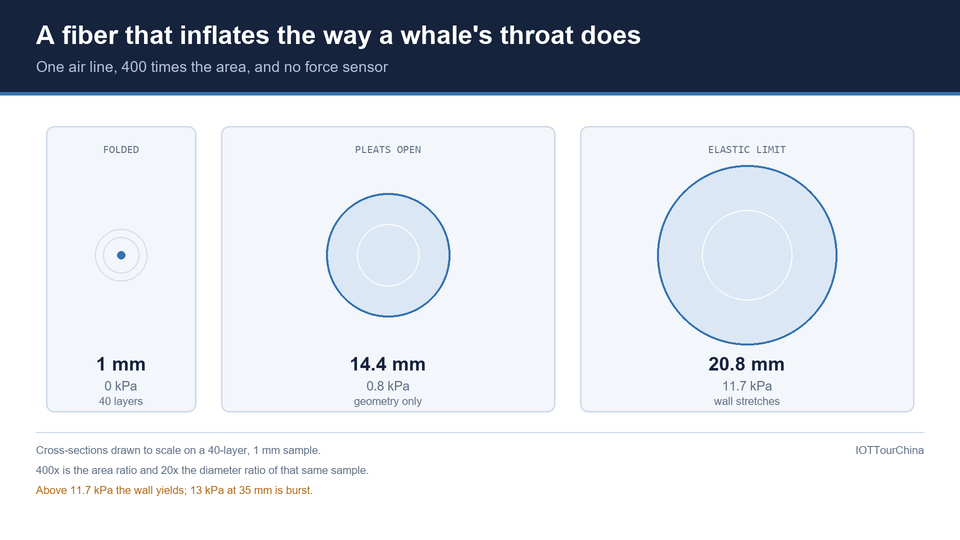
The numbers below come from a 40-layer fiber with a 1 mm initial cross-section and a 5 cm test length, which is the sample the paper uses for its characterization curves.
| Stage | Pressure | Diameter | Reversible |
|---|---|---|---|
| Micro-pleat unfolding | begins at 0.8 kPa | 1 mm to 14.4 mm | Yes |
| Elastic expansion | up to 11.7 kPa | 14.4 mm to 20.8 mm | Yes |
| Plastic expansion | above 11.7 kPa | 20.8 mm to 35 mm | No |
| Bulge propagation and burst | about 13 kPa at 35 mm | failure | No |
The two reversible rows are the working envelope, and 11.7 kPa is the elastic ceiling, not 13 kPa. Beyond it the wall yields, the deformation stops being reversible, and at roughly 35 mm a bulge starts to propagate and the fiber bursts. Read the datasheet language carefully here: 400 times is an area ratio and 20 times is a diameter ratio, and both describe the same sample, because 20 squared is 400. The paper quotes both and so will any supplier.
The control variable moves from pressure to volume
This is the part that changes a bill of materials. In a normal pneumatic actuator, pressure maps monotonically onto deformation, so holding a pose or a force means measuring something and correcting for it: a proportional regulator, a pressure sensor and a loop fast enough to track the wall thinning that makes elastic tubes nonlinear in the first place.
Here the geometry carries the sequence. One supply line, one flow path, and the pleats open in order as volume arrives, at a pressure that barely rises while they do. The practical consequence is that an on-off source plus a flow restrictor can walk the actuator through its whole stroke, and force control can stay open loop. The paper leans on this explicitly: the unfolding pressure is low enough that the fiber inflates by exhalation, which is how a garment with no battery and no pump enters the argument. The laboratory characterization itself used a pump at a fixed PWM setting rather than a regulated supply.
There is a second consequence that matters more for textiles than for robots. The fiber does not lengthen as it inflates. Elastic tubes stretch several-fold while they bulge, which drags them out of position inside a woven structure and demands higher pressure to get anywhere. A 20 m f-VGB stays 20 m. The authors use this to argue that the fiber can be woven as weft against cotton warp without the fabric distorting, and they tested a knitted variant where 1.5 mm fibers reach 20 mm inflated inside a hollow-layer shell.
What it is not
The fiber expands radially and uniformly. It does not bend, twist or extend as a programmed gait, and the paper demonstrates none of that. Bending in soft pneumatics still belongs to Pneu-Net style chambers with asymmetric wall stiffness, and contraction still belongs to braided McKibben muscles; both were invented to convert pressure into a directional motion, and both remain one structure, one motion.
That distinction matters because this paper has been described in Chinese-language coverage as a single fiber running through a straight, bend, helical twist and axial elongation sequence under steady inflation, with the claim that one air line can switch between preset deformation modes. That sequence is not in the paper. What the paper reports is a two-stage inflation sequence, unfolding then stretching, and the demonstrations are buoyancy and radial gripping. A reader who orders fiber expecting a bending muscle will get a balloon.
| Comparison | f-VGB, 40 layers | SEBS elastic tube | Plain ECOC tube |
|---|---|---|---|
| Diameter expansion at equal pressure | 20 times | 1.5 times | 1.1 times |
| Onset pressure for expansion | 0.8 kPa | over 30 times higher | over 30 times higher |
| Length change during inflation | none | several-fold elongation | several-fold elongation |
| Force versus pressure | linear | nonlinear, hysteretic | nonlinear, hysteretic |
Force you can dial
The gripper numbers are the ones worth carrying into a design review. Chamber pressure maps to contact force linearly across a range of 0 to 50 mN, and that linearity holds across different starting gaps between the gripper legs. The force is small enough that a three-finger gripper built from 40-layer, 300 micrometer fibers picked up a cone of incense ash, an object the paper notes fractures at 35 mN.
Two things make that possible, and only one of them is the low pressure. The first is that contact begins gently: as the fiber meets an object the internal pressure rises gradually instead of jumping to whatever the supply delivers. The second is tolerance. The gripper absorbed surface height variation of up to 2.4 mm without losing the force relationship, so it does not need precise positioning to land a known force. Elastic tubes struggle in exactly this regime, where regulating below 100 mN is defeated by bulging and hysteresis.
Down at the other end of the scale, a pair of forceps built from 40-layer fibers with a 100 micrometer cross-section handled synthetic filaments thin and fragile enough to stand in for nerves. The authors raise neurosurgery as a direction for that format, not as something they demonstrated.
Smaller does not mean higher pressure
Miniaturizing a pneumatic actuator normally costs pressure. The pressure at which an elastic tube becomes unstable climbs steeply as the tube gets thinner, so a tube small enough for microsurgery needs a supply that no wearable will carry. The f-VGB breaks that coupling because its onset pressure is set by the fold geometry rather than the wall. The paper measures unfolding pressure as roughly flat across sizes while the elastic tube reference climbs steeply, which is the actual argument for the sub-millimeter devices rather than any single demonstration.
Manufacturing keeps up with that claim: the group spooled 100 m of continuous fiber at a 300 micrometer cross-section, and cross-sections in the 200 micrometer range still carry 40 folded layers. The fiber is drawn, not molded, so the device and the structural element are the same object.
What a build actually looks like
| Demonstration | Fiber used | Output | Still needs |
|---|---|---|---|
| Flotation garment | 20 m, 40 layers, 2 mm | expands past 25 mm on pleat unfolding alone, supports a 70 kg person | knitted nylon-blend hollow shell, compressed CO2 cartridges |
| Three-finger gripper | three fibers, 40 layers, 300 micrometers | 0 to 50 mN, 2.4 mm surface tolerance | 3D printed fingers, single supply line |
| Micro forceps | 40 layers, 100 micrometers | handling of nerve-like filaments | off-the-shelf regulator and valve |
The garment is the demonstration that best survives scrutiny, because it exercises the properties that are hard to fake: a 20 m continuous length, low enough pressure for a cartridge rather than a compressor, and no length change to distort the knit. It also shows the ceiling. The garment is inflated from CO2 cylinders, which are rigid, single-use and nothing like a wearable air supply.
Where it breaks
The elastic ceiling is a design constraint, not a footnote. Cross 11.7 kPa on the 1 mm sample and the fiber is in plastic territory, and 13 kPa at 35 mm is where it bursts. Operating margin has to sit below the first number, not the second, which is a tighter window than the 400 times headline suggests.
Recovery depends on shape memory rather than robustness. The authors deliberately damaged fibers at 45 kPa for 20 inflation cycles and then restored them by machine washing at 50 degrees Celsius. That is a maintenance procedure available to a textile and a foreign concept to a sealed robot, and it should be read as a way to extend service life, not as a license to overpressure.
Daily wear can exceed the elastic limit on its own. Dressing strains are enough to plastically deform the fiber and shorten its life, which is why the garment uses buffer yarns with lower strain limits to take the load first. Any textile integration inherits that constraint.
The pneumatics stay rigid. Compressor, valves and regulators are off-the-shelf parts in the current build, which tethers the platform. The authors name the missing pieces themselves: fiber pumps for the pressure source, stiff tube fibers as distributed gas storage, and fiber computers to fold control and sensing into the textile. Until those exist, this is a soft actuator attached to hard plumbing.
Who should care
If the requirement is a few tens of millinewtons of repeatable, gentle force from a single air line, delivered inside fabric or at sub-millimeter scale, this is a credible route with a published pressure window and a manufacturing path that already produces 100 m spools. If the requirement is bending, multi-axis motion or hundreds of newtons, this fiber is the wrong component and the coverage suggesting otherwise is wrong about why.
The paper places itself against the pressure side of the pressure-volume landscape, and that framing is the useful takeaway. Programmable motion does not have to come from more valves and faster loops. Sometimes it comes from putting the sequence into the geometry and letting volume be the input.